Unknown's avatar

About ml

A comparative literature professor interested in how Arabic literature has worked, throughout its history, as a part of world literature

Does dividing and ruling Egypt need an outside conspiracy?

Descending into Cairo International Airport at 4am you enter the diaphanous layer of orange smog over the city: disgusting, weirdly exciting. Then coming out of the metro tunnel (still not having slept in like 3 days) you pass the sidewalk newsstand and are greeted by this somewhat offputting picture:

Welcome home.
The bleeding xenophobic nastiness is the cover of this month’s October magazine, announcing the cover story on “The Maspero Fitna [sectarian strife] and the Plot to Divide Egypt.” I bought for the issue to see what it was all about, then had trouble figuring out where in the house to place it so it wouldn’t catch me by surprise and gross me out to see the Nile flowing out of Uncle Sam’s shirt cuff; this isn’t something you want on your coffee table.  The whole issue seems to be about justifying and glorifying Egypt’s armed forces in the wake of the Maspero massacre: not only the cover story, on which more in a minute, but also some smaller pieces. One columnist lamented that 6 October was simply treated as a convenient day off, whereas it should be held sacred as the commemoration of “the greatest Arab military victory in modern times” (pretty sad).  Another columnist suggested that in the atmosphere of insecurity and uncertainty now gripping Egypt, it is necessary for the people and the army to “renew their faith in one another” (!) and become closer than ever.

Now to the cover story. I noticed ten years ago – and it is still largely true though maybe a bit less so – that in Cairo there is always one meme per day making the rounds, the same phrase repeated by everyone from the doorman to the college president; then the next day the whole country gets a secret memo with the new meme of the day. After Maspero it was “foreign hands” inciting sectarian violence because they “don’t want the country to be stable.”

So riding around in various taxis ten days ago, I had heard fragments of this “foreign hands” theory. One man believed it was chiefly Israel planting provocateurs among the Christian demonstrators in order to destroy the country and take it over, because “I know Copts – some of my best friends are Copts – and Copts are basically cowards – they wouldn’t want violence.”  Another man thought the Maspero massacre was done by Salafis paid by Gulf powers like Saudi Arabia, “to reduce the country to chaos to show their own people that a revolution doesn’t lead to anything good.” (That’s actually a pretty good one.)  Whatever the particular agent, I wondered where people got the idea of blaming someone else for what clearly seemed to be a state-perpetrated massacre of civilians and an episode of sectarian street violence incited by the state-run media (see Bassam Youssef’s scalpel-sharp Jon Stewart-style piece on the incitement).

Now, reading the magazine, I discovered where they got it: from the state-run media!  October is a state-run magazine that costs less than 40 cents.  Even if you don’t buy it, you see the headline on the sidewalk.

The cover story is by retired general Hossam Sowilam, whose complex theory proposes a variety of conspirators.  Of course Israel and the United States, but also Iran, Qatar (it hosts al-Jazeera), and perhaps some Palestinian groups, among others, who knows.  Why would these diverse enemies want to create a chaos-paralyzed or divided Egypt? Each has its reason, but the basic idea is to take it over, or destabilize/disempower it in order to “pursue the Broader Middle East Strategy outlined by George W. Bush.”  Colonial grand strategy is unproblematically applied to the contemporary United States, disregarding the very great price (in money and credibility) that the U.S. has paid precisely not to split up Egypt but to maintain stability and the appearance of unity in its government.  Egypt’s armed forces are the only positive character in the piece.  My favorite part is where he invokes the Crusades to ask who liberated Jerusalem and answers himself (anachronism, what anachronism?): the Egyptian Army!  Led of course by Saladin, or Salah al-Din al-Ayyubi. You can read the whole incoherent rambling theory (in Arabic), or look at Thanassis Cambanis’ recent Atlantic post on his interview with the same guy.

Sense-making is not the point here; the buckshot approach allows a reader or viewer to choose one strand of the theory; the whole need not cohere.  Sense-making was also not the point of SCAF’s fuck-you press conference one week ago, in which the generals deployed the abusive-spouse defense (“I didn’t hit her, and anyway she started it”) not so much to clear the cloud of fear Maspero created as to exploit it. As if to say, hey, we hold the monopoly on legitimate and illegitimate force, so we don’t actually need to make sense.  We are in power; we can kill demonstrators on Sunday and brazenly lie about it on Wednesday.  For a lot of people outside the Twittersphere, this strategy actually worked; many ordinary people sided with the army and against the demonstrators.  (“What were the Copts raising so much trouble about, anyway? We have never had a problem with them here. We’ve always treated them very nicely.”)

I almost thought that press conference was the end of it, the door slamming shut for good, but fortunately the reaction to Maspero continues. On TV right now,  journalists Mona Shazly and Ibrahim Eissa are grilling two SCAF generals, not only about Maspero but about basic questions of Egypt’s government, in a special three-hour (so far) talk show co-hosted by two independent TV stations.  The generals are patronizing and again make no sense, oscillating between hectoring and damage control (“They did not respect the proper rules and procedures of demonstrations. The soldiers were scared, they wanted to avoid becoming casualties like their comrades. Any country’s military in our position would have reacted the way we did”); the journalists are being polite (Mona, the same TV host who interviewed Wael Ghonim in the midst of the revolution last Feb, has this affect as though it made her really, really sad to tell SCAF to their faces they are doing a terrible job running the country). But at least the conversation (or missed opportunity for conversation, since they are pretty much talking past each other) is happening publicly.  They are even taking questions from the public via Facebook and Twitter etc.

There have been some good ones from the journalists: does SCAF really plan to hand over power? Does it want Egypt’s cabinet to be weak and dependent? Doesn’t SCAF realize that it is a political power now with a political role, so it needs to think like a politician and not just react like an army? Aren’t they wrong to pretend “all’s for the best in the best of all possible worlds” (ليس بالامكان ابدع مما كان) in Egypt’s security apparatus?  Who knows if this interview will really lead anyone to recommit to the revolution project.  But in a state where the military apparatus has appropriated the voice of God (in a few different ways) in the past 60 years and especially the past 9 months, at least people are still making the gestures of trying to see past the generals’ cynical theodicy.

Video of our conversation at BU

BU’s media services people used a new program called Echo 360 to capture the conversation in Boston last Wednesday between Sulayman Al-Bassam, Graham Holderness, and me.  Watch it here: : http://echo360.bu.edu:8081/ess/echo/presentation/7a568a3f-fce4-45ba-b2a1-9c119488e55e
Apologies for the weird focus on the video – I think everyone is still getting the hang of the new technology.

“Show me what democracy looks like”

Is Cairo boiling today? I’m not there. People there must feel that this is a last chance to drag the revolution out from under the wheels of the Egyptian Army’s tanks; today is probably the day that will decide whether or not the army’s massacre of civilians at Maspero last Sunday, with the associated state-media-incited sectarian violence, is or isn’t forever considered an inexorable turning point in Egypt’s post-Mubarak history, a turn into something slimier and darker than the nice “transition period” people had been talking about.  (Remember the Eastern-bloc “transitions to democracy”? Like pre-Putin Russia?)  A line in last Tuesday’s front-page Al-Masry al-Youm editorial put it succinctly:

الفطرة الانتقالية لم تبدأ بعد  The transitional period has not yet begun.

The paper also called on Prime Minister Essam Sharaf (the name means “honor”) to “have the sharaf to resign.”  He hasn’t. Instead, an unabashed cover-up press conference by SCAF, some dithering by the main political parties.  The intelligentsia immediately started doing its thing, sometimes with great wit.  This is a mock film poster for a feature called “The Ministry of Interior is Still in My Pocket,” starring Hosni Mubarak:


The artist known as Sad Panda proposes cutting off the tower of the State Radio and TV building rather than cutting the bells and domes off of churches in Upper Egypt (More from Sad Panda here):

And another artist, Abdallah, highlights the contrast between 1973 and 2011 in a cartoon titled The Maspero Slaughter. “I sacrificed my life on 6 October on top of a tank,” says the skeleton on the right. “And I sacrificed my life on 9 October, under a tank!!” responds his friend on the left.

Where am I as all this unfolds? In Boston, home of the original Tea Party and still showing traces of its founding by a band of salafist reformers called the Puritans.  Having a great time hanging out with a hyper-talented theatre director and his company, but also homesick for Cairo. Since I can’t be at Tahrir or Azhar Square, maybe I’ll go visit the sleep-in near South Station this morning – this is the Boston chapter of the Occupy Wall Street folks, showing us all what democracy sounds like.

And maybe I won’t. Here’s an excerpt from the FAQ posted on the official Occupy Boston web site – doesn’t really suggest a vibrant and unified opposition to capitalist hegemony, does it?:

“Where can I park my car?

There are plenty of parking lots in the area. Daily parking lot rates can be as high as $30/day on weekdays.  Rates of $9-$12 are more common for weekends. Street parking is available all around the financial district, Chinatown and the waterfront. Meters cost a quarter for 12 minutes and you can only get up to 2 hours at a time. Meters are shut off at 8:00 pm and are off all day on Sundays.

I went to Dewey Square but I didn’t see an occupation there.  Where are you?

We are tucked away behind some small trees. Look harder, we are definitely there.  We are directly across Atlantic Avenue from the Federal Reserve Bank of Boston, which is this large silvery building.  …

I don’t like the food at Occupy Boston, or I don’t need free food.  Where else can I buy food nearby?

South Station has a small food court.  Quincy Market / Faneuil Hall is an 8-10 minute walk north on Atlantic Ave, and there is a wide variety of restaurants there.  Chinatown is a 2-3 minute walk south on Surface Road, and there are a lot of inexpensive restaurants and delis there.  Really, it’s downtown Boston; you can walk in any direction and find a lot of places to eat.”

Okay, in fairness, these are the FAQs intended for visitors and clueless fellow-travelers.  The protests are gaining momentum, spreading to different cities, and will probably get more interesting. But you know what I mean. These Bostonians can sound a bit whiny.  The physical courage of the Egyptian protesters, standing their ground in the face of unimaginable state violence, is just somehow (and thank God no one runs us over with APCs here) of a different moral stature.

Mobility

So far, the defining experience of our time in Cairo has been the traffic jam.  No longer.

Over the past three days, while I have been in Boston for some events surrounding Sulayman Al-Bassam’s Arab Shakespeare Trilogy (on which the other blog should have more to say soon – it all went great), my husband has quickly and good-naturedly relocated our kids and all our stuff to a different apartment, in Dokki rather than the Za(ح)malek. Friends have taken over out old lease. Now we are walking distance to the kids’ school.

I do hope to write something soon on the commuting thing.  What I’ve been claiming to do over the past month is research for a new book on a century of Arab-Russian literary and cultural ties, but what I’ve been doing in fact, for at least an hour a day and more like two, is picking up the kids from school, i.e., conducting Socratic dialogues about Egyptian politics with taxi drivers.  No, not trying to be Khaled Al-Khamissi, let alone Tom Friedman; just curious what happens when you draw people out and see what they say, where and why they contradict themselves.  For obvious reasons I have never recorded these, though I believe they could be interesting.

Should be a pretty smooth trip back from the airport though; I get back on Sunday at 4:15 am.

Preview – Speaker’s Progress in Boston

“How do you make a play about an abstract idea like change?”  Sulayman Al-Bassam speaks to the Boston Globe.

Judging by the dress rehearsal I saw last night, there are still some technical things to be ironed out before tonight’s opening (never mind the idea of change – the real issue is that these guys are scrambling for provisional closure, editing to the last minute!), some meanings to be nailed down, but the play has an amazing energy.

Boston people: come see the show and any of the myriad post-show or para-show events at ArtsEmerson! Reminder: you can also see Sulayman and me in discussion with Graham Holderness at BU this afternoon, 12-2.

Coverage of Al-Bassam’s Speaker’s Progress in New York

Very favorable New York Times review of the New York performance of The Speaker’s Progress at BAM last week; Al-Bassam’s own “wonderfully dry performance” gets special praise.  In Richard III he played an implausibly slick and charming U.S. Ambassador (later edited out to make room for Mister Richmond in the US performances); now he has switched sides, playing an Arab director and performing in Arabic (at least in the draft of the script I saw). 

 A brief write-up an audio interview with Jeffrey Brown of PBS’ NewsHour, who also did a long segment on Al-Bassam when his Richard III: An Arab Tragedy played Washington and New York in 2009.  The first segment’s headline had Al-Bassam “take inspiration” from Shakespeare; the current one has him “taking inspiration” from the Arab Spring.  And there is something to this: it does seem that the source text Twelfth Night plays a relatively insignificant role in the logic of Al-Bassam’s new play — it could have been any other play, or even another type of iconic performance.  Whereas his Hamlet was really a Hamlet.  This is not a criticism.

These things are being posted on SABAB Theatre’s Facebook page: http://www.facebook.com/groups/sababtheatre/

On “sectarian” violence

This post is provisional.  Horrible images tonight, videos, tweets, firsthand reports from the street and the morgue, of deadly violence against peaceful protesters outside Maspero, the state TV building.  [Update: see Jazeera roundup video.]  State media are more or less claiming the protesters attacked the police (“19 people were killed, some by gunfire, after a demonstration of hundreds of Coptic Christians turned violent” – or watch Nile TV here), and the “turned violent” phrasing has now been picked up by NYT and others, but on YouTube people have posted video clearly showing army vehicles running down protesters, kind of hunting them.  More people have died tonight, as Foreign Policy’s Blake Hounshell has pointed out, than during the famous Battle of the Camels in early Feb. So far, it is a clear story of army brutality against peaceful protesters, i.e., of regime continuity.

But the dead are mainly Christians; the Coptic Hospital is being attacked. There are also scary reports, including from Yasmine Rashidi on the ground (she writes on Egypt for NYRB), of street-level violence targeting individual Copts, e.g., Muslim guys beating up a Christian girl.  A pogrom?  Christians all over Egypt tomorrow will be reaching for their passports, saying they told you so.

The rhetoric of “sectarian violence” is circulating, edging out the tired old “foreign hands” and “forces seeking to foment chaos.” The danger of the “sectarian violence” meme is that it can self-fulfill.  You don’t even need a lot of pre-existing suspicion or actual grievance, and here you have some measure of both.

What now?

At some point – but we may be very far from that point here – people can decide not to be provoked.  In February 2005 I was in Beirut, working on an NGO project to develop a “culture of respect for the rule of law” (on which perhaps more later) in Lebanon. Amid the protests that followed Rafik Hariri’s assassination (and which eventually led to the withdrawal of Syrian forces from their explicit occupation of Lebanon), various foreign journalists descended on the country.  Many of them asked various forms of the same stupid question: “So, like, are you going to have another civil war now?”  To which the standard Lebanese answer was, “No, you idiot.” With an undertone of “We tried that. Enough already.”

The logic behind the question seemed to be an acceptance of the Syrian claim that the occupation was needed to keep Lebanese from killing each other.  Of course this was always Mubarak’s line too – not only divide-and-rule but actually stoking sectarian violence in order to appear as the one force capable of containing it. For instance, Mubarak’s Interior Minister was implicated in the New Year’s Eve 2010 bombing of a church in Alexandria, in which 23 people were killed.

Looking for a hopeful concluding sentence, something that starts with a “But.”  Maybe tomorrow?

[Update 9am: Streets very calm on the way to school; taxi driver said a lot of people are staying home from work because of fears of violence. He described last night’s events as “fitna,” intracommunal strife. Which is both reassuring and really not.]

At Sadat’s tomb

October 6 is the only day of the year, and the only reason, for which many Egyptians make an exception and speak well of Sadat.

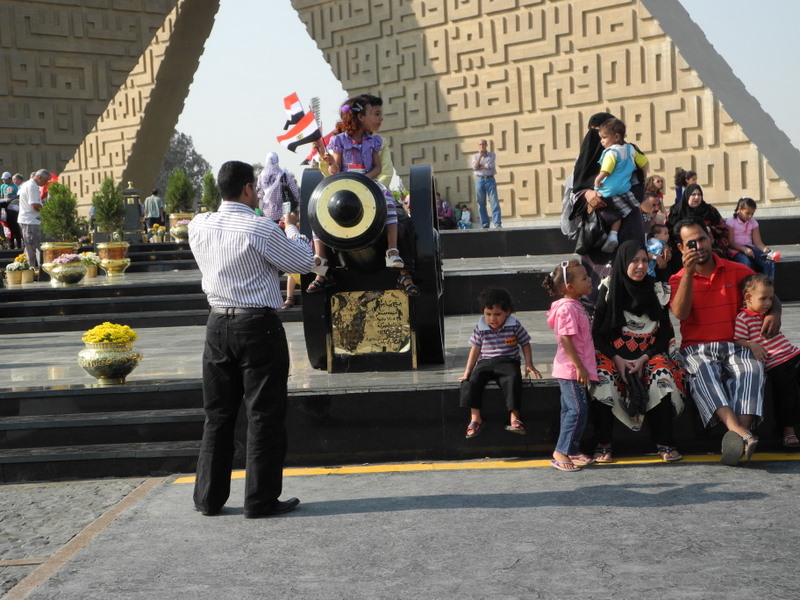
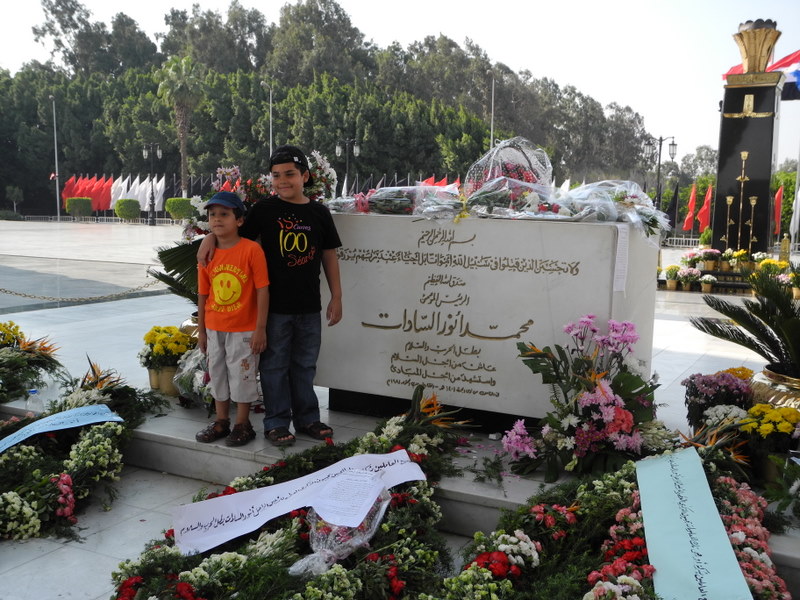
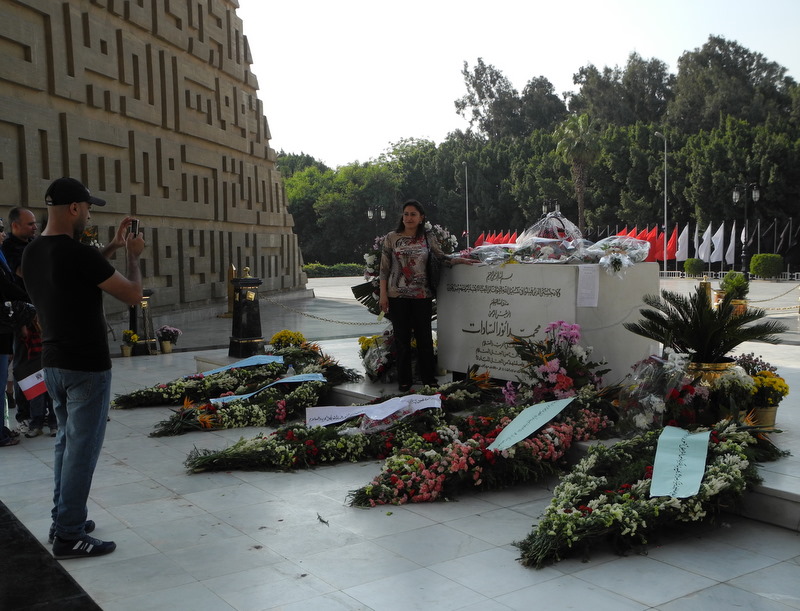
Watch them getting photographed at his grave, open to the public this year for the first time (under Mubarak, one photographee told me, it had been closed: “Only the leaders would come and put wreaths, and we would see it on television”). This afternoon, a marching band, Hizb al-Ghadd members standing around looking official (why?), and a fully democratic photo opportunity:

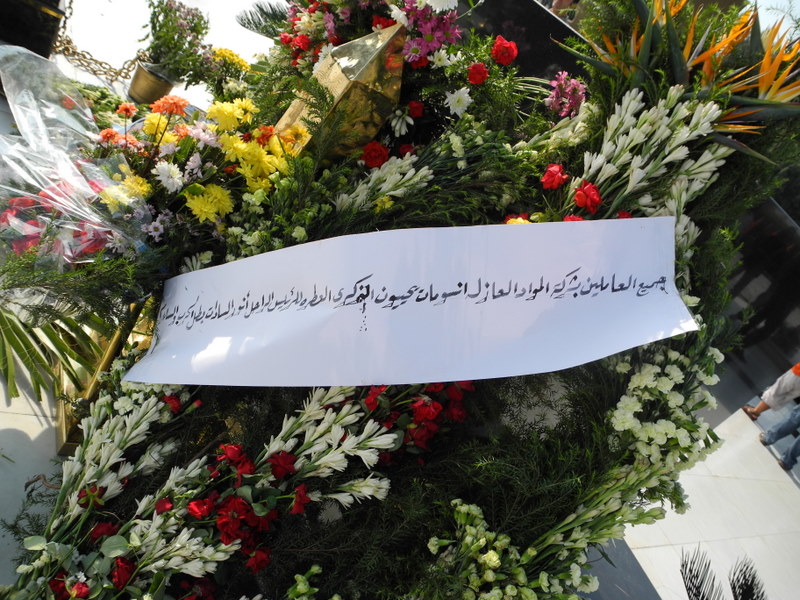
Lots of wreaths, this one from an insulation manufacturer called Insumat:

What to do with the overdetermined symbolism of Sadat? He helped Islamist groups and messages gain unprecedented dominance of the public sphere, yet it was an Islamist group that killed him. His tomb is pyramid-shaped (“I’ve killed Pharaoh!” his assassin reportedly shouted), but those ornamental spirals cut into each stone wall panel are actually letters spelling the first name of one of the casualties of the 1973 war.  (Can you see them? Scroll back up or find clearer images here.)  And that’s before we get into the economic liberalization business. Even without a revolution thrown into the mix, the Sadat legacy would be too complicated to digest. Still deep ambivalence here about 1973 and 1978. Over coffee this morning my friend (in her mid-60s now) recounted her vivid memories of hearing about the miraculous Egyptian advance, despite the Israeli napalm-delivering pipes that, she said, “were capable of turning the Suez Canal into a river of fire” — but then she quoted from a poem by Naguib Sorur:

ياخوفي في يوم النصر ..
نكسب سينا ونخسر مصر !

(“I am so afraid on Victory Day… We win Sinai, but lose Egypt!)

In his official speech today, a very put-together-looking Tantawy compares the Egyptian people’s fortitude in this “transitional period” to its fortitude in 1973.  Not altogether promising, given the eventual results.  On various TV channels, slender earnest young hostesses interview various gray-haired men (that’s who traditionally appears on TV, I think) about “Sadat’s role” in the 1973 war, and the effect of the Camp David Accords.  In the newspapers, everyone from onetime Sadat assassination plotter and current Gama3a Islamiyya leader Aboud ElZomor (fascinating long interview) to Sadat’s widow Gehan (still trying to rehabilitate her husband’s presidency – also in Arabic here) reflects on the phenomenon of Mubarak’s rule as an unintended consequence of Sadat’s. Meanwhile writer-activist Ala’ al-Aswany deploys a “salon” as a cultural protest on the sidelines of the official SCAF celebration to bring out some less-told stories of October 1973. All fascinating. Has there been a rash of scholarship on this period at some point, which I’ve somehow missed?

Marking 6 October

Today was the 6th of October, 38th anniversary of Egypt’s “victory” over Israel in the October War of 1973 (known from the Israeli point of view as the Yom Kippur War). I’ve always written the word “victory” in sarcastic quotation marks, without giving it a second thought (since actually Israel won the war, striking back and driving Egyptian forces back across the Suez Canal after their amazing advance), but today — and if you’ve ever served in a military this might sound really stupid — I had to recognize the intensity of emotion attached to that word for many Egyptians. Even my secular, skeptical, open-door-policy-hating theatre critic friend described the crossing of the Bar-Lev Line as miraculous.

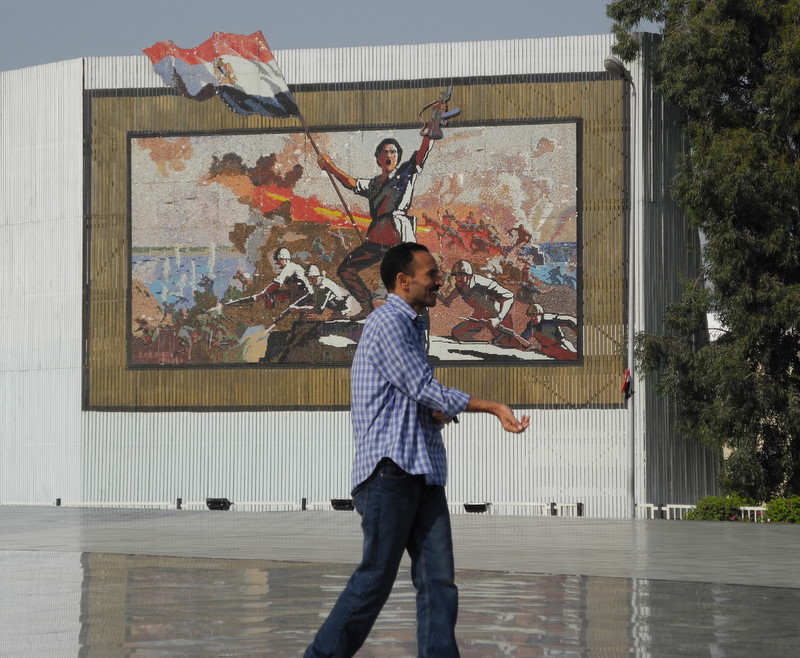
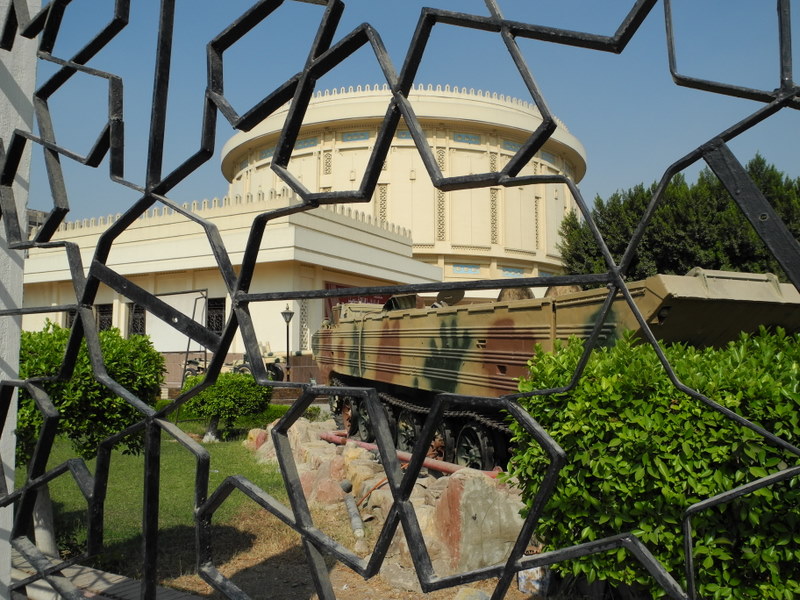
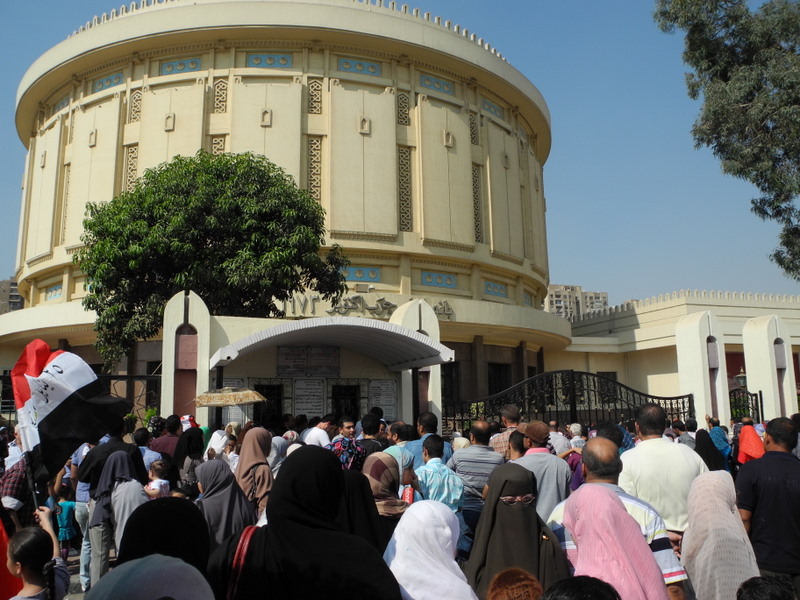
I made my best effort to get into the October 1973 War Panorama [official site – scroll down] on the Salah Salem Road.  For curiosity/kitsch value, I thought. I’ve always driven by and wondered what it was like. One of my favorite articles [full text requires subscription] on the revolution had been a New Yorker piece whose ironic lede took author Wendell Steavenson to the cavernously empty Panorama. Well, clearly August was not October. Today the place was mobbed, jammed, with Egyptians seeking entry tickets, which were free on the occasion of the anniversary.  Normally they are 2 pounds (30 cents) for Egyptians, 10 pounds for Arabs, 20 pounds for foreigners.

Most people were very orderly and patient as they waited in line. One woman with a napping baby in her arms had been waiting for two hours!  Everyone I asked was coming for the first time, or hadn’t been since a long-ago school trip.  Why were they here?  عشان نتفصح… عشان نحتفل … عشان النهارده اجازة.  To sightsee!  To celebrate!  Because we have a day off!
But there was an undertone of discontent. Some people started to complain, even one man started to orate, about the poor organization, how there was “no system.”  You had to line up to get a free ticket, then line up again to get in the gate; meanwhile the people coming out, sandwiched between two pushing lines of increasingly overheated people trying to get in, complained that the show hadn’t been worth it: “You watch five minutes of it and khalas, you’re done.”
(All this recalled an old Nasser-era joke about a new system to sell chicken through a cooperative: the customer stands in a series of queues to choose whether he wants a rooster or a hen, live or slaughtered, befeathered or plucked, whole or in parts, etc. — only to be told at the end: “Well actually, there’s no chicken. But اي رايك في النظام how do you like the system?”)
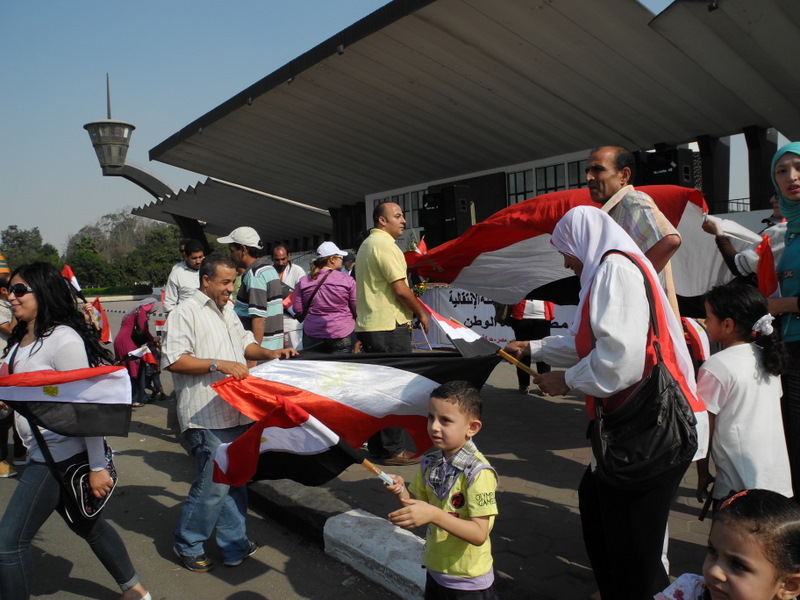
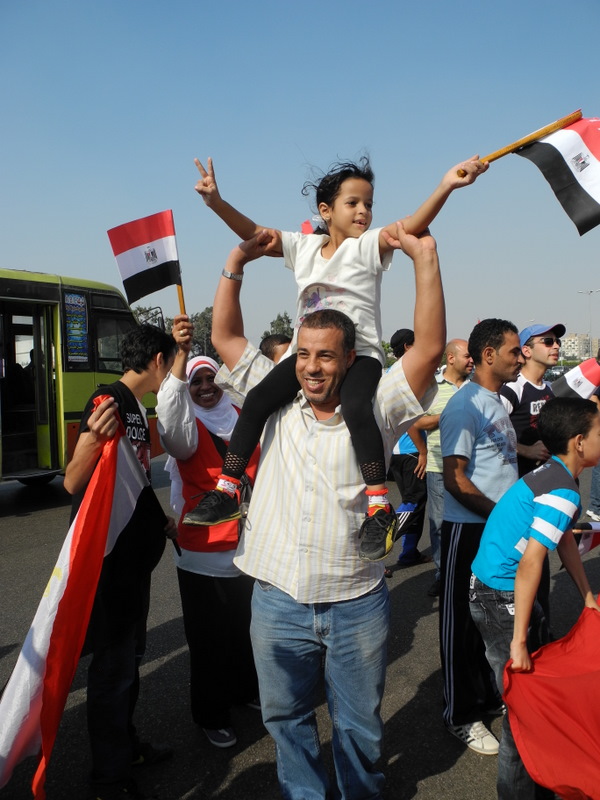
But on the whole people wanted to feel patriotic. Flags, lots of red-white-and-black clothing, and even these kids, 4 1/2 and 2 1/2, dressed up as Sadat, in full regalia, complete with toy guns. His nametag said Sadat; hers said Gihan.

(Baby Gihan looks a wee bit grumpy: “It’s just the sun,” her proud father explained.)

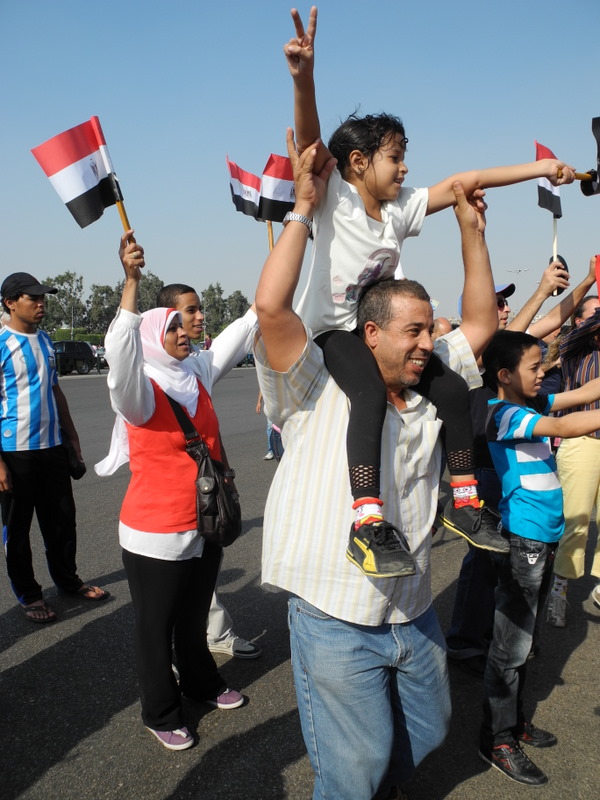
Off the hook for the Panorama’s multimedia propaganda show (“Tickets are free today, but foreigners have to pay for tickets, but we can’t sell you a ticket today because they’re free, so why don’t you come back tomorrow?”), I asked a family nearby how to get to the Manassa, the Tomb of the Unknown Soldier and Sadat’s grave. They kindly gave me a ride. They had driven all the way in from Faysal, by the Pyramids, “to celebrate our armed forces” – عشان نحتفل بفواتنا المسلحة. To my amazement (but why?) they said this entirely without irony. Mom, dad, three kids ranging from college age to 7. Had they known it would be a pro-SCAF demonstration? They were thrilled to join (that’s mom and dad waving the flag).

Today was not only a sort of PR show for SCAF (which organized a big official celebration in Tahrir, and whose warplanes have been buzzing the square for three days) but also a chance to meditate on the beginning of Mubarak’s rule.  precisely the 30th anniversary of Sadat’s assassination: he had been reviewing a parade on the occasion of the 8th anniversary of the war when an Islamist conspirator had run up and shot him; then-Vice President Mubarak reportedly dived under a chair and survived. Today the stand bore a banner: “Na3am lil-thawra, la lil-fawda” (“Yes to the revolution, no to chaos.”)

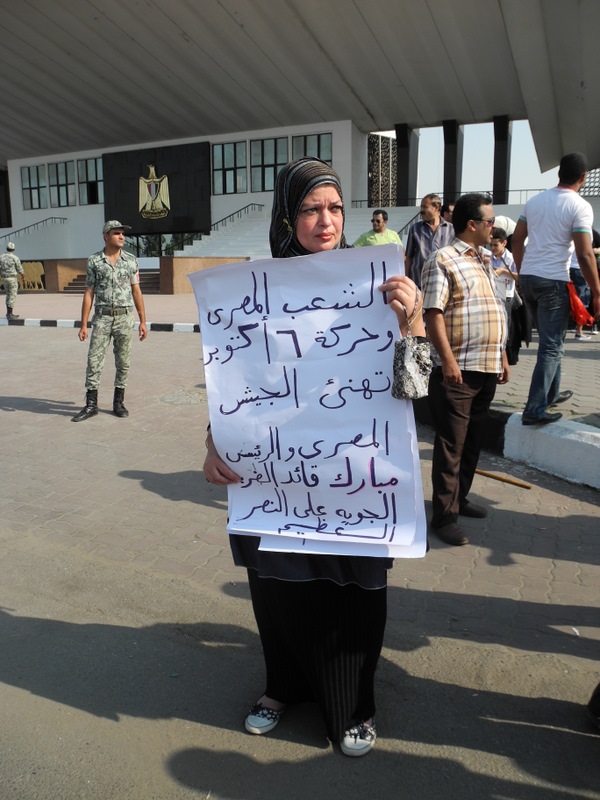
You could argue that there is a fine line between supporting SCAF now (deploying the “it’s them or chaos” trope) and supporting the old Mubarak system. And indeed, one lady had a pro-Mubarak sign:

I don’t even live here, but at the sight of those signs I felt my “takfir siyasi” (political excommunication) reflexes rising. Didn’t even say goodbye to the sweet family who gave me the ride, who had been so thrilled about my being American and speaking Arabic. Certainly didn’t exchange phone numbers or get photographed with them as they had intended. Yet somehow all these people have to live together, and devise some kind of public rituals to convince them that the revolution belongs to them all.

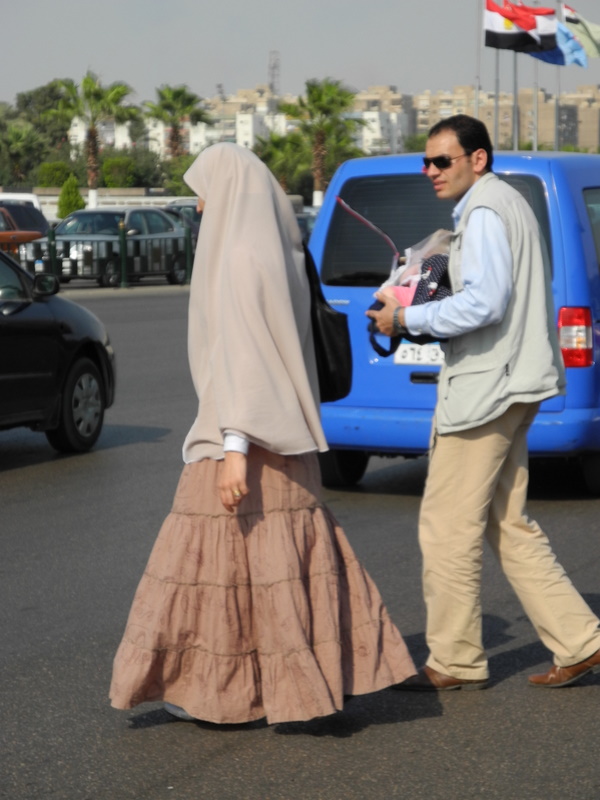
What is to celebrate? I thought as I ran across fast-moving Salah Salem Street to Sadat’s tomb. Hold on tight to your seats.

There is still a tough crossing ahead
(and yes, that is a newborn baby in his arms).