Drawing a funny moustache on the personality cult

Some wise guy reportedly stole the Field Marshal’s shoe at Eid prayers, providing fodder for a sarcastic news cycle of Facebooking and Twittering.

Fake front page of state newspaper Al-Ahram: "Field Marshal: Egypt Will Pass to a Stage of Stability as Soon as We Find the Shoe."

Latuff weighs in

There have been several of these moments: the fuss about Tantawi’s suit, the Twitter campaign to send him birthday greetings. Some of these comments are very funny, and it’s hard to resist pressing “share” or “like,” but I just want to say (with a shoutout to Lisa Wedeen) that making fun of the Dear Leader is still somehow replicating the ubiquitous image, playing into the nascent personality cult.

The dynamics of containment and subversion are complex, and I can accept that in a real totalitarian system some little moments of caricature and parody can be crucial in reminding people that they are human, that they are smart, that they are not alone. But in Egypt, nine months after toppling Mubarak? Do people really need to be reproducing images of Tantawi, even funny ones of his boxer shorts?  Resuming almost without interruption the 20th-century habit of poking gentle fun at the head of state? The message is, “Down with military rule,” but the subtext is: the military ruler is inevitable.(Maybe his face should instead be replaced by an image of a flower wherever it appears, like the female Salafi parliamentary candidate?)

By the way, what’s so incongruous about the well-tailored suit?  Arguably it’s exactly what Tantawi should be wearing, since SCAF represents what is basically a large corporation (“Military Inc”) with economic holdings in all kinds of “civilian” fields including manufacturing of medical supplies, electronics, and home appliances; infrastructure including the “spanking new” (actually about 10 years old but crazy well-maintained) highway to Ain Sokhna and all the gas stations on it, possibly even the resort where my kids and I are spending their Eid vacation. (This is unconfirmed. But according to the driver who brought us here: “Most of these resorts are run by the military. The waiters who serve you — conscripts. You’ll see. It’s not a problem: the mandatory military service in Egypt creates so many soldiers no one knows what to do with them.”  I reminded him that if this is true, it was his tax money subsidizing this use of underpaid conscript labor to enrich top military brass. But in fact, of course, it’s mine.)

These must be the real issues: SCAF’s internal dynamics (the council has 40 members!), top generals’ fear of losing the vast chunk of the Egyptian economy they control (something no one besides Springborg seems to discuss in detail – and with the prophetic power of pessimism he basically called it on Feb 2!), their fear of fracturing within the military ranks (Nasser and his fellow coup plotters were junior officers). This cogent analysis by Philippe Droz-Vincent lays out the reasons why it may be hard for SCAF to engage in a real handover to democracy – and helps explain, I think, why ridiculizing the SCAF dictatorship will do nothing to remove it.
My Mahfouz moment

For what it’s worth, you can read my half-baked reminiscence of meeting Naguib Mahfouz over on Marcia Lynx Qualiey’s Arabic Literature (in English) blog, which by the way you should all be following if you aren’t already.

My friend Robyn Creswell’s more eloquent account of one of these Mahfouz evenings, published as an obituary, came out in n+1.

http://nplusonemag.com/naguib-mahfouz

On “sectarian” violence

This post is provisional.  Horrible images tonight, videos, tweets, firsthand reports from the street and the morgue, of deadly violence against peaceful protesters outside Maspero, the state TV building.  [Update: see Jazeera roundup video.]  State media are more or less claiming the protesters attacked the police (“19 people were killed, some by gunfire, after a demonstration of hundreds of Coptic Christians turned violent” – or watch Nile TV here), and the “turned violent” phrasing has now been picked up by NYT and others, but on YouTube people have posted video clearly showing army vehicles running down protesters, kind of hunting them.  More people have died tonight, as Foreign Policy’s Blake Hounshell has pointed out, than during the famous Battle of the Camels in early Feb. So far, it is a clear story of army brutality against peaceful protesters, i.e., of regime continuity.

But the dead are mainly Christians; the Coptic Hospital is being attacked. There are also scary reports, including from Yasmine Rashidi on the ground (she writes on Egypt for NYRB), of street-level violence targeting individual Copts, e.g., Muslim guys beating up a Christian girl.  A pogrom?  Christians all over Egypt tomorrow will be reaching for their passports, saying they told you so.

The rhetoric of “sectarian violence” is circulating, edging out the tired old “foreign hands” and “forces seeking to foment chaos.” The danger of the “sectarian violence” meme is that it can self-fulfill.  You don’t even need a lot of pre-existing suspicion or actual grievance, and here you have some measure of both.

What now?

At some point – but we may be very far from that point here – people can decide not to be provoked.  In February 2005 I was in Beirut, working on an NGO project to develop a “culture of respect for the rule of law” (on which perhaps more later) in Lebanon. Amid the protests that followed Rafik Hariri’s assassination (and which eventually led to the withdrawal of Syrian forces from their explicit occupation of Lebanon), various foreign journalists descended on the country.  Many of them asked various forms of the same stupid question: “So, like, are you going to have another civil war now?”  To which the standard Lebanese answer was, “No, you idiot.” With an undertone of “We tried that. Enough already.”

The logic behind the question seemed to be an acceptance of the Syrian claim that the occupation was needed to keep Lebanese from killing each other.  Of course this was always Mubarak’s line too – not only divide-and-rule but actually stoking sectarian violence in order to appear as the one force capable of containing it. For instance, Mubarak’s Interior Minister was implicated in the New Year’s Eve 2010 bombing of a church in Alexandria, in which 23 people were killed.

Looking for a hopeful concluding sentence, something that starts with a “But.”  Maybe tomorrow?

[Update 9am: Streets very calm on the way to school; taxi driver said a lot of people are staying home from work because of fears of violence. He described last night’s events as “fitna,” intracommunal strife. Which is both reassuring and really not.]

At Sadat’s tomb

October 6 is the only day of the year, and the only reason, for which many Egyptians make an exception and speak well of Sadat.

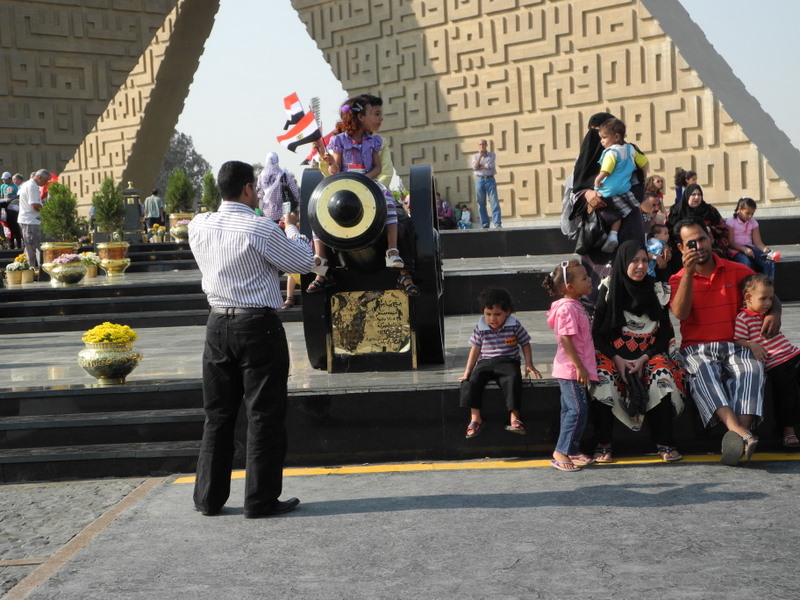
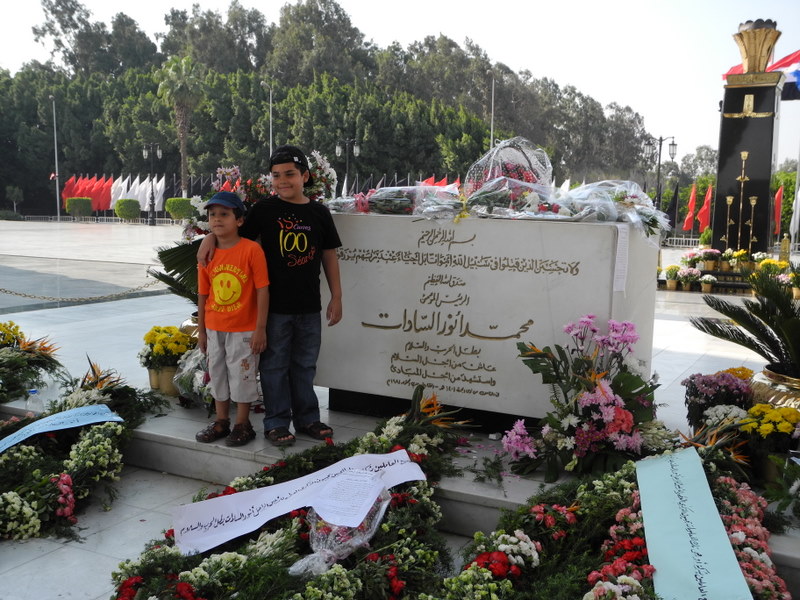
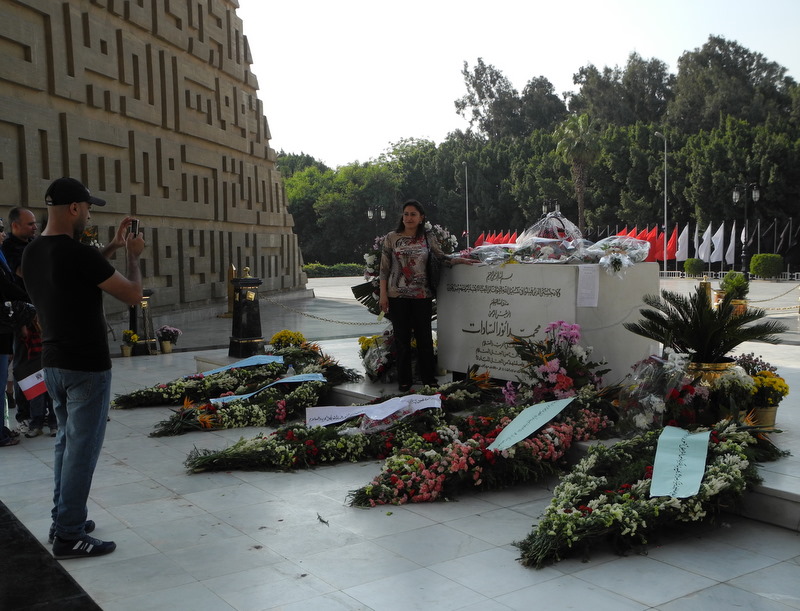
Watch them getting photographed at his grave, open to the public this year for the first time (under Mubarak, one photographee told me, it had been closed: “Only the leaders would come and put wreaths, and we would see it on television”). This afternoon, a marching band, Hizb al-Ghadd members standing around looking official (why?), and a fully democratic photo opportunity:

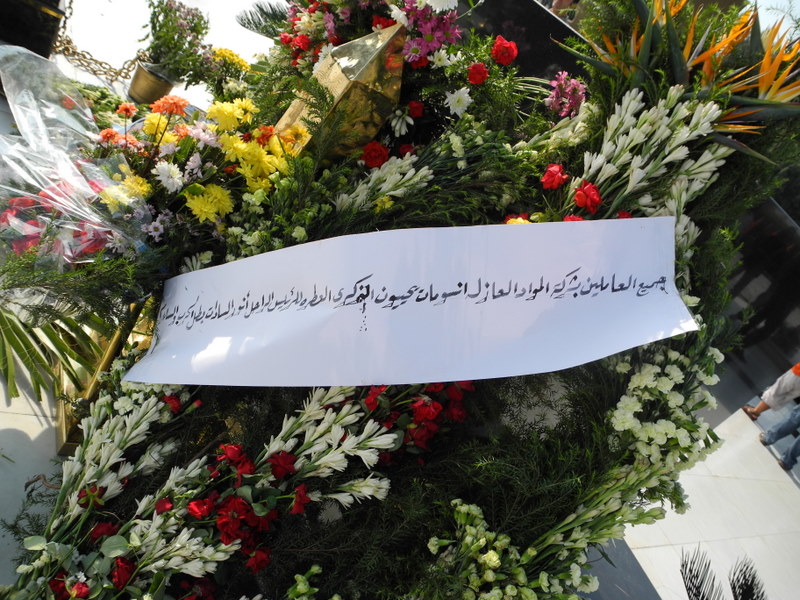
Lots of wreaths, this one from an insulation manufacturer called Insumat:

What to do with the overdetermined symbolism of Sadat? He helped Islamist groups and messages gain unprecedented dominance of the public sphere, yet it was an Islamist group that killed him. His tomb is pyramid-shaped (“I’ve killed Pharaoh!” his assassin reportedly shouted), but those ornamental spirals cut into each stone wall panel are actually letters spelling the first name of one of the casualties of the 1973 war.  (Can you see them? Scroll back up or find clearer images here.)  And that’s before we get into the economic liberalization business. Even without a revolution thrown into the mix, the Sadat legacy would be too complicated to digest. Still deep ambivalence here about 1973 and 1978. Over coffee this morning my friend (in her mid-60s now) recounted her vivid memories of hearing about the miraculous Egyptian advance, despite the Israeli napalm-delivering pipes that, she said, “were capable of turning the Suez Canal into a river of fire” — but then she quoted from a poem by Naguib Sorur:

ياخوفي في يوم النصر ..
نكسب سينا ونخسر مصر !

(“I am so afraid on Victory Day… We win Sinai, but lose Egypt!)

In his official speech today, a very put-together-looking Tantawy compares the Egyptian people’s fortitude in this “transitional period” to its fortitude in 1973.  Not altogether promising, given the eventual results.  On various TV channels, slender earnest young hostesses interview various gray-haired men (that’s who traditionally appears on TV, I think) about “Sadat’s role” in the 1973 war, and the effect of the Camp David Accords.  In the newspapers, everyone from onetime Sadat assassination plotter and current Gama3a Islamiyya leader Aboud ElZomor (fascinating long interview) to Sadat’s widow Gehan (still trying to rehabilitate her husband’s presidency – also in Arabic here) reflects on the phenomenon of Mubarak’s rule as an unintended consequence of Sadat’s. Meanwhile writer-activist Ala’ al-Aswany deploys a “salon” as a cultural protest on the sidelines of the official SCAF celebration to bring out some less-told stories of October 1973. All fascinating. Has there been a rash of scholarship on this period at some point, which I’ve somehow missed?

Marking 6 October

Today was the 6th of October, 38th anniversary of Egypt’s “victory” over Israel in the October War of 1973 (known from the Israeli point of view as the Yom Kippur War). I’ve always written the word “victory” in sarcastic quotation marks, without giving it a second thought (since actually Israel won the war, striking back and driving Egyptian forces back across the Suez Canal after their amazing advance), but today — and if you’ve ever served in a military this might sound really stupid — I had to recognize the intensity of emotion attached to that word for many Egyptians. Even my secular, skeptical, open-door-policy-hating theatre critic friend described the crossing of the Bar-Lev Line as miraculous.

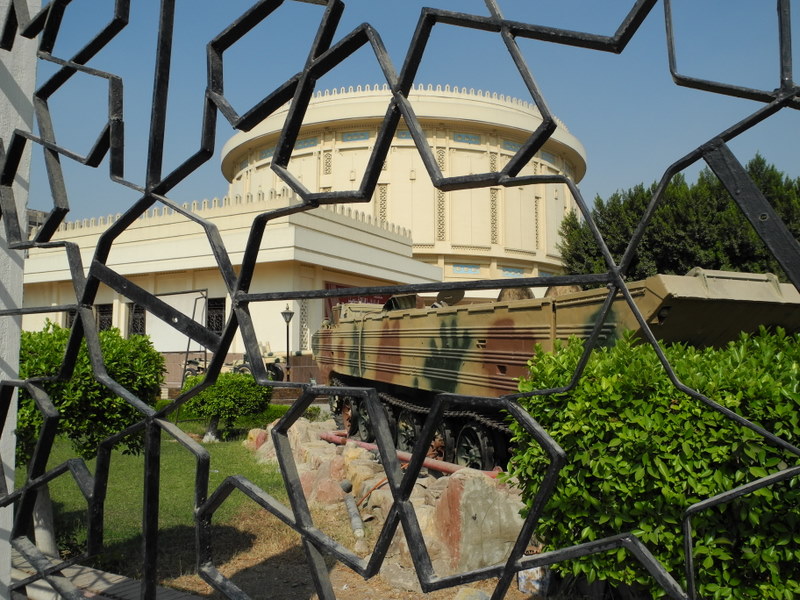
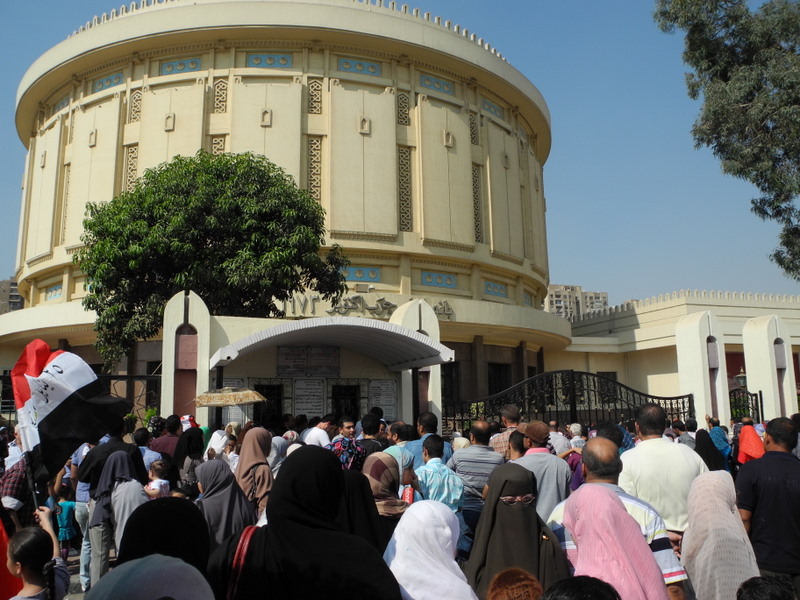
I made my best effort to get into the October 1973 War Panorama [official site – scroll down] on the Salah Salem Road.  For curiosity/kitsch value, I thought. I’ve always driven by and wondered what it was like. One of my favorite articles [full text requires subscription] on the revolution had been a New Yorker piece whose ironic lede took author Wendell Steavenson to the cavernously empty Panorama. Well, clearly August was not October. Today the place was mobbed, jammed, with Egyptians seeking entry tickets, which were free on the occasion of the anniversary.  Normally they are 2 pounds (30 cents) for Egyptians, 10 pounds for Arabs, 20 pounds for foreigners.

Most people were very orderly and patient as they waited in line. One woman with a napping baby in her arms had been waiting for two hours!  Everyone I asked was coming for the first time, or hadn’t been since a long-ago school trip.  Why were they here?  عشان نتفصح… عشان نحتفل … عشان النهارده اجازة.  To sightsee!  To celebrate!  Because we have a day off!
But there was an undertone of discontent. Some people started to complain, even one man started to orate, about the poor organization, how there was “no system.”  You had to line up to get a free ticket, then line up again to get in the gate; meanwhile the people coming out, sandwiched between two pushing lines of increasingly overheated people trying to get in, complained that the show hadn’t been worth it: “You watch five minutes of it and khalas, you’re done.”
(All this recalled an old Nasser-era joke about a new system to sell chicken through a cooperative: the customer stands in a series of queues to choose whether he wants a rooster or a hen, live or slaughtered, befeathered or plucked, whole or in parts, etc. — only to be told at the end: “Well actually, there’s no chicken. But اي رايك في النظام how do you like the system?”)
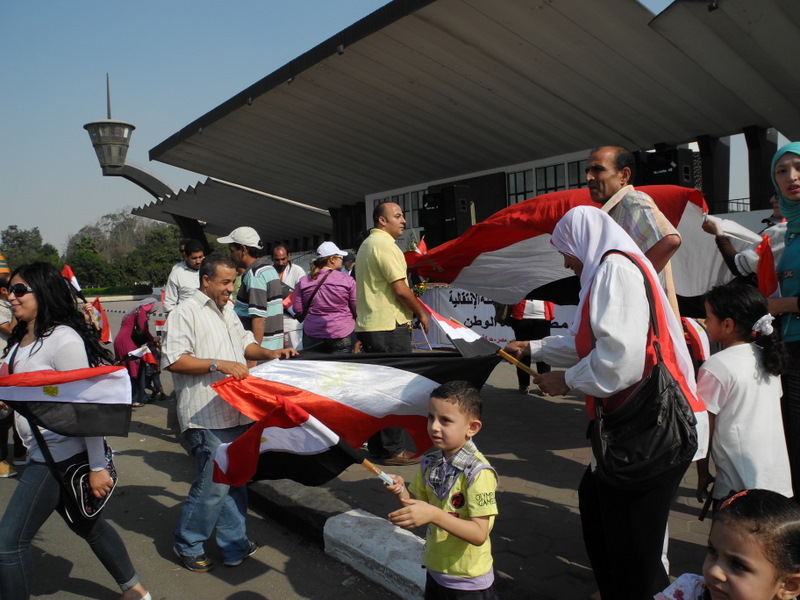
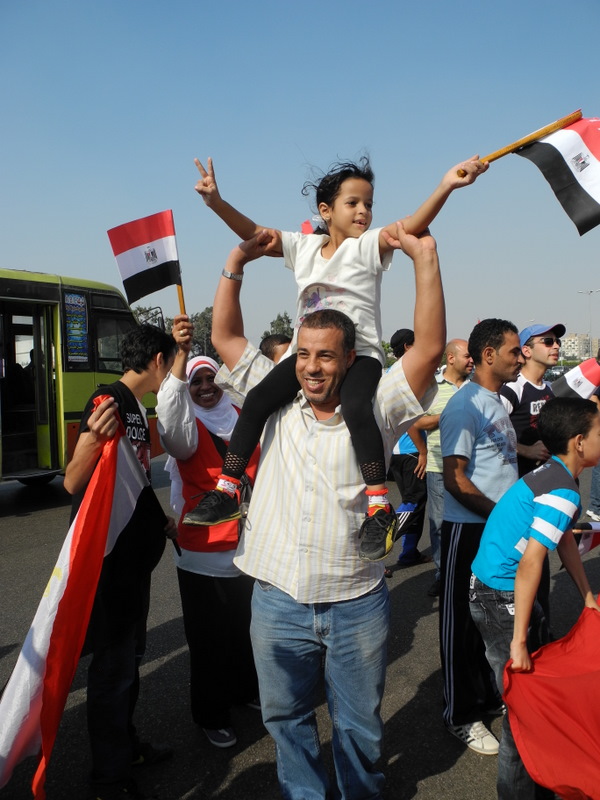
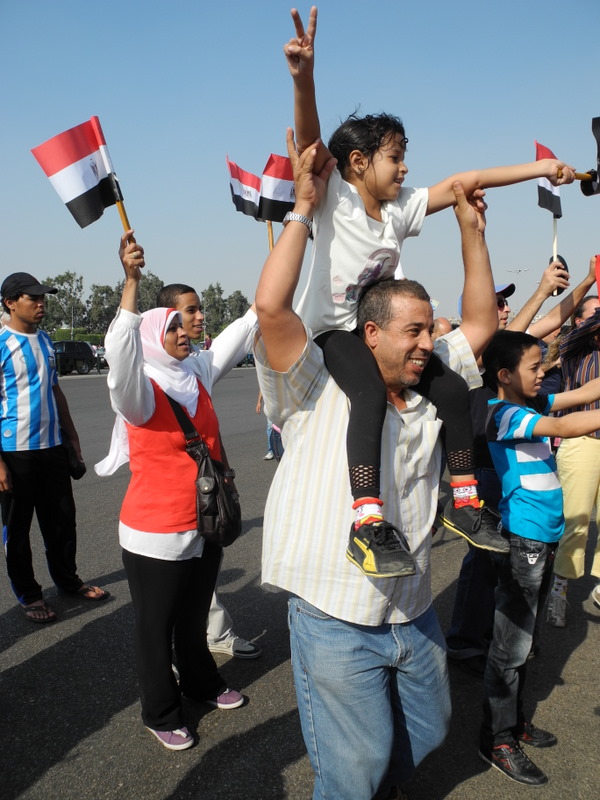
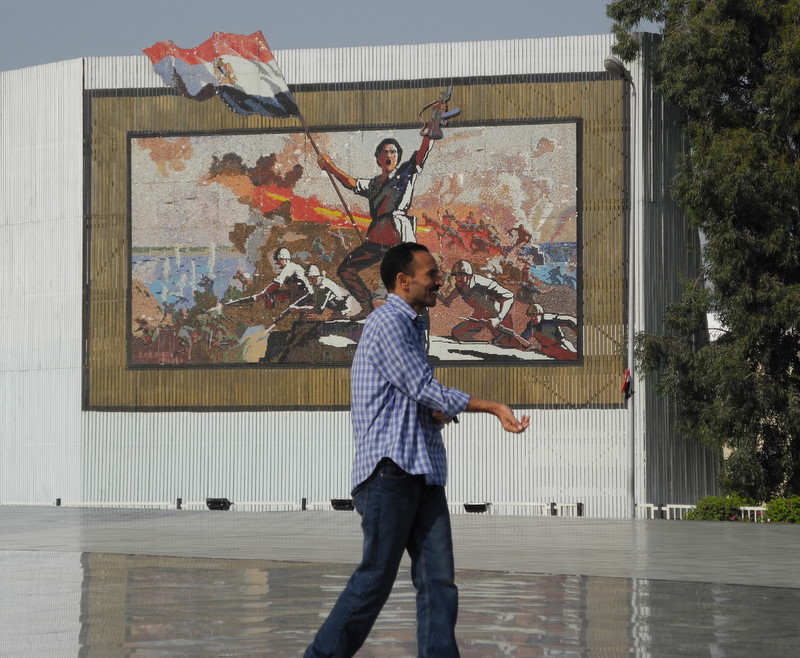
But on the whole people wanted to feel patriotic. Flags, lots of red-white-and-black clothing, and even these kids, 4 1/2 and 2 1/2, dressed up as Sadat, in full regalia, complete with toy guns. His nametag said Sadat; hers said Gihan.

(Baby Gihan looks a wee bit grumpy: “It’s just the sun,” her proud father explained.)

Off the hook for the Panorama’s multimedia propaganda show (“Tickets are free today, but foreigners have to pay for tickets, but we can’t sell you a ticket today because they’re free, so why don’t you come back tomorrow?”), I asked a family nearby how to get to the Manassa, the Tomb of the Unknown Soldier and Sadat’s grave. They kindly gave me a ride. They had driven all the way in from Faysal, by the Pyramids, “to celebrate our armed forces” – عشان نحتفل بفواتنا المسلحة. To my amazement (but why?) they said this entirely without irony. Mom, dad, three kids ranging from college age to 7. Had they known it would be a pro-SCAF demonstration? They were thrilled to join (that’s mom and dad waving the flag).

Today was not only a sort of PR show for SCAF (which organized a big official celebration in Tahrir, and whose warplanes have been buzzing the square for three days) but also a chance to meditate on the beginning of Mubarak’s rule.  precisely the 30th anniversary of Sadat’s assassination: he had been reviewing a parade on the occasion of the 8th anniversary of the war when an Islamist conspirator had run up and shot him; then-Vice President Mubarak reportedly dived under a chair and survived. Today the stand bore a banner: “Na3am lil-thawra, la lil-fawda” (“Yes to the revolution, no to chaos.”)

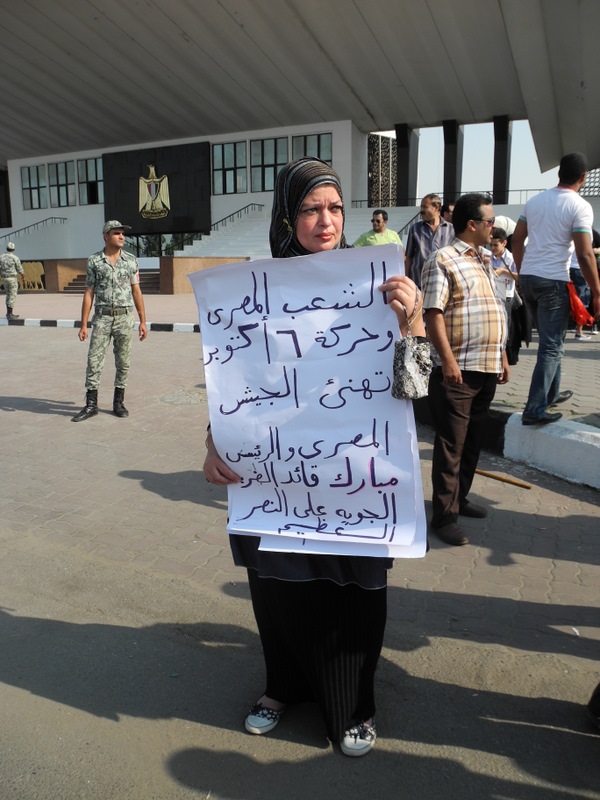
You could argue that there is a fine line between supporting SCAF now (deploying the “it’s them or chaos” trope) and supporting the old Mubarak system. And indeed, one lady had a pro-Mubarak sign:

I don’t even live here, but at the sight of those signs I felt my “takfir siyasi” (political excommunication) reflexes rising. Didn’t even say goodbye to the sweet family who gave me the ride, who had been so thrilled about my being American and speaking Arabic. Certainly didn’t exchange phone numbers or get photographed with them as they had intended. Yet somehow all these people have to live together, and devise some kind of public rituals to convince them that the revolution belongs to them all.

What is to celebrate? I thought as I ran across fast-moving Salah Salem Street to Sadat’s tomb. Hold on tight to your seats.

There is still a tough crossing ahead
(and yes, that is a newborn baby in his arms).

Silence and noise

Off to Wales tomorrow, of all places, for my friend Katie’s wedding. Mabrouk, Katie!
So I will miss whatever happens with the announced “Friday of Terrifying Silence” demonstrations called by activists to protest SCAF’s re-imposition of Emergency Law. The organizers have proposed that demonstrators wear black and march with their mouths taped shut.

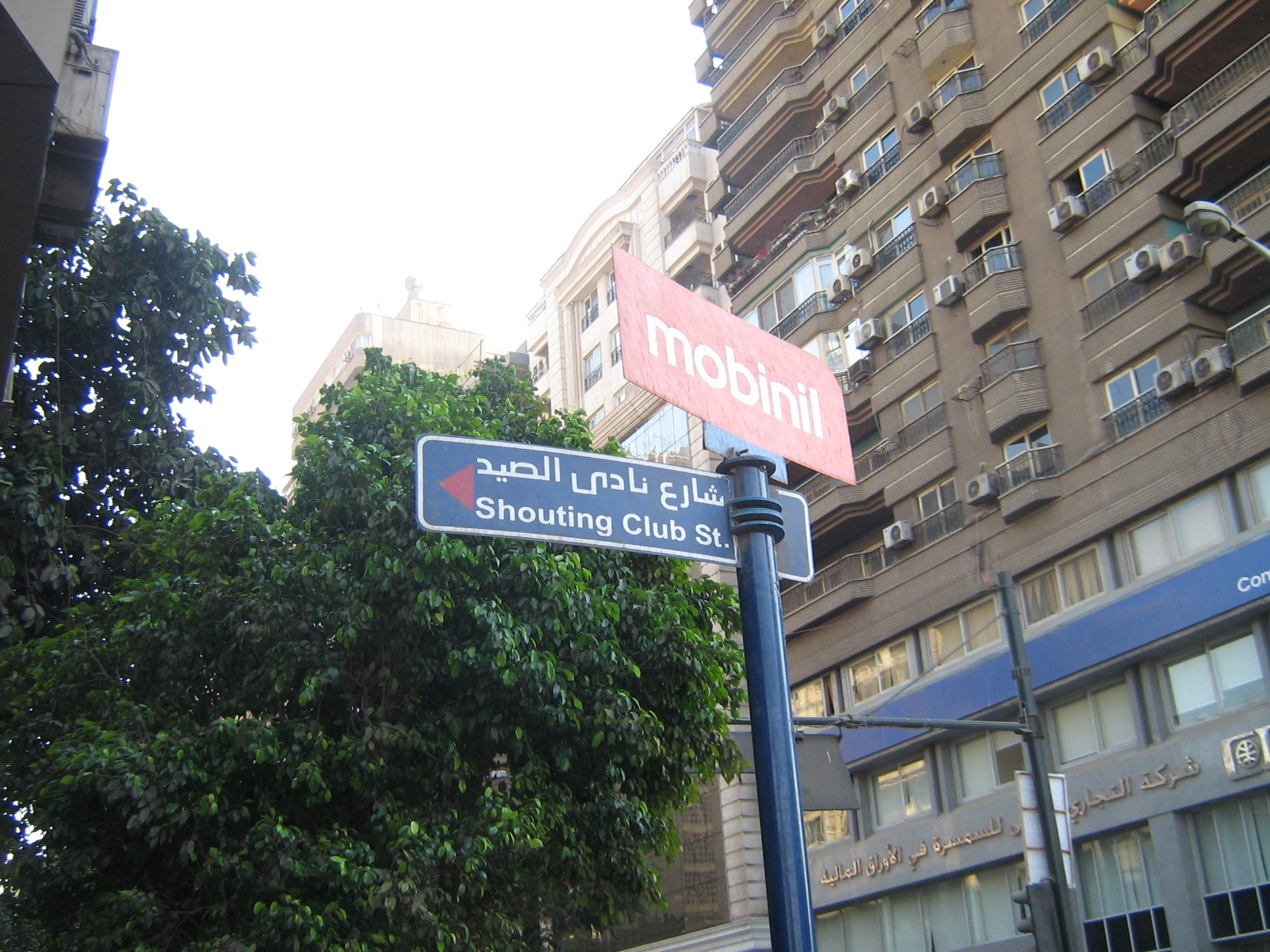
Shouting Club

Or is it back to the Shooting Club?


There’s also been an edict criminalizing certain election-related behavior including “spreading false information” with intent to defame a candidate or party — sounds good, but one imagines it will be selectively applied.  Could we really be back to the status quo so soon?
Hadith on Silence

"If you can't say anything nice..."


The papers have a certain amount of coverage of the different parties and groups: who’s going to the protest, who isn’t (the Salafis), who hadn’t decided yet until tonight (the Brotherhood) but is now skipping it. I have to think everyone knows that the protests are losing efficacy, that the real action is elsewhere. It was happening even before the Israeli embassy thing. As Steve Negus points out (and his analysis of the events makes a lot of sense to me), the would-be revolutionaries would probably do well to think more about the ballot box and less about the street.
(Although: SCAF has this weird tendency to reverse itself. The much-decried election law may now be amended (though the “50% farmers” provision is staying, for now). The alarming plan to make tourists apply for visas before their arrival was hastily abandoned because — who knew? — it would hurt tourism. They seem to be just improvising policy here. So maybe some pressure from time to time is a good thing.)
The trials of former interior minister Habib el-Adly and of Mubarak, too, are starting to feel like a distraction. From what?
Anyway. It will be interesting to come back early next week after being away someplace cool and green for a few days.

My old building

My CASA buddies, some of them even now reminiscing on Facebook about the complicated autumn we spent here ten years ago, may smile as they recall my ridiculous apartment on the roof at #2 Amir El-Kadadar Street.
Apparently the building now houses a hotel…

…though happily it has not lost any of its original charm.

Go East, young AUCians!

“I’m gonna go where the desert sun is
Go where I know the fun is…”

My husband and I are studying downtown, but last week we had to go obtain our university ID cards (which flatteringly said “graduate student” – made me feel young again!) at the American University in Cairo’s new campus. It’s located in the middle of nowhere, in a new desert development about 40 km east of downtown Cairo.

AUC location map

As the university’s web site tactfully points out, the suburb of “New Cairo” (not to be confused with old New Cairo, Masr al-Gadida, i.e. Heliopolis) is “designed to be a predominantly middle-to-high-income residential community with schools, cultural facilities, commercial enterprises, government agencies, hotels, open spaces and parks, with the AUC campus at its center.” Students and faculty enjoy either a safe but boring life on or near the new campus, or a 1- to 1 1/2-hour commute from the city. Fortunately, the university has contracted with a company to provide highly punctual, air-conditioned, wifi-enabled buses from many parts of the city, so commuters need never look up from their laptops.

But I was glued to the window. A huge Christian cemetery:

A shiny new building for (ironically?) a Housing and Development Bank.

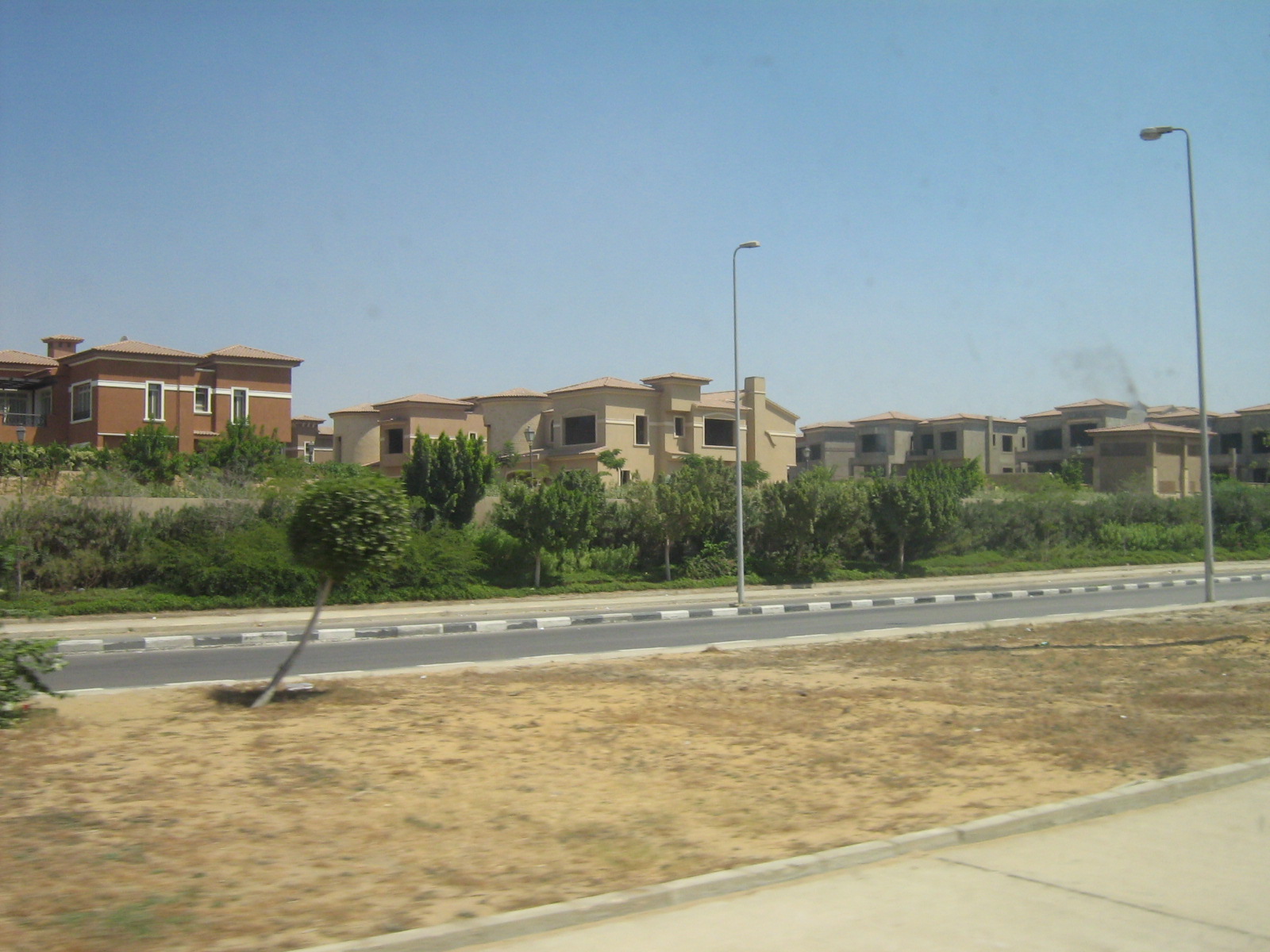
Tons of unfinished construction on very fancy-looking gated communities. (Some of these had pretty elaborate guard towers too. They could be taken for high-security prisons, except I suppose that if they were ever inhabited, the guards in the towers would aim their guns outwards rather than in.)

The curious thing about these construction sites was that, driving by mid-morning on a weekday, we did not see any actual construction occurring on any of them. Were they halted because of the legal gray area that has followed the revolution? Or did they run out of capital long before that? Anyway, it doesn’t matter much; I’m sure it will fill in eventually, and the congestion and pollution will get as bad out there as they are in the city center now. Or what are they going to have, zoning laws?

As my husband points out, Cairenes have a history of this sort of behavior. Fustat getting too small? Repurpose it as a garbage dump and build a new capital a little further north. New dynasty? Build another one.

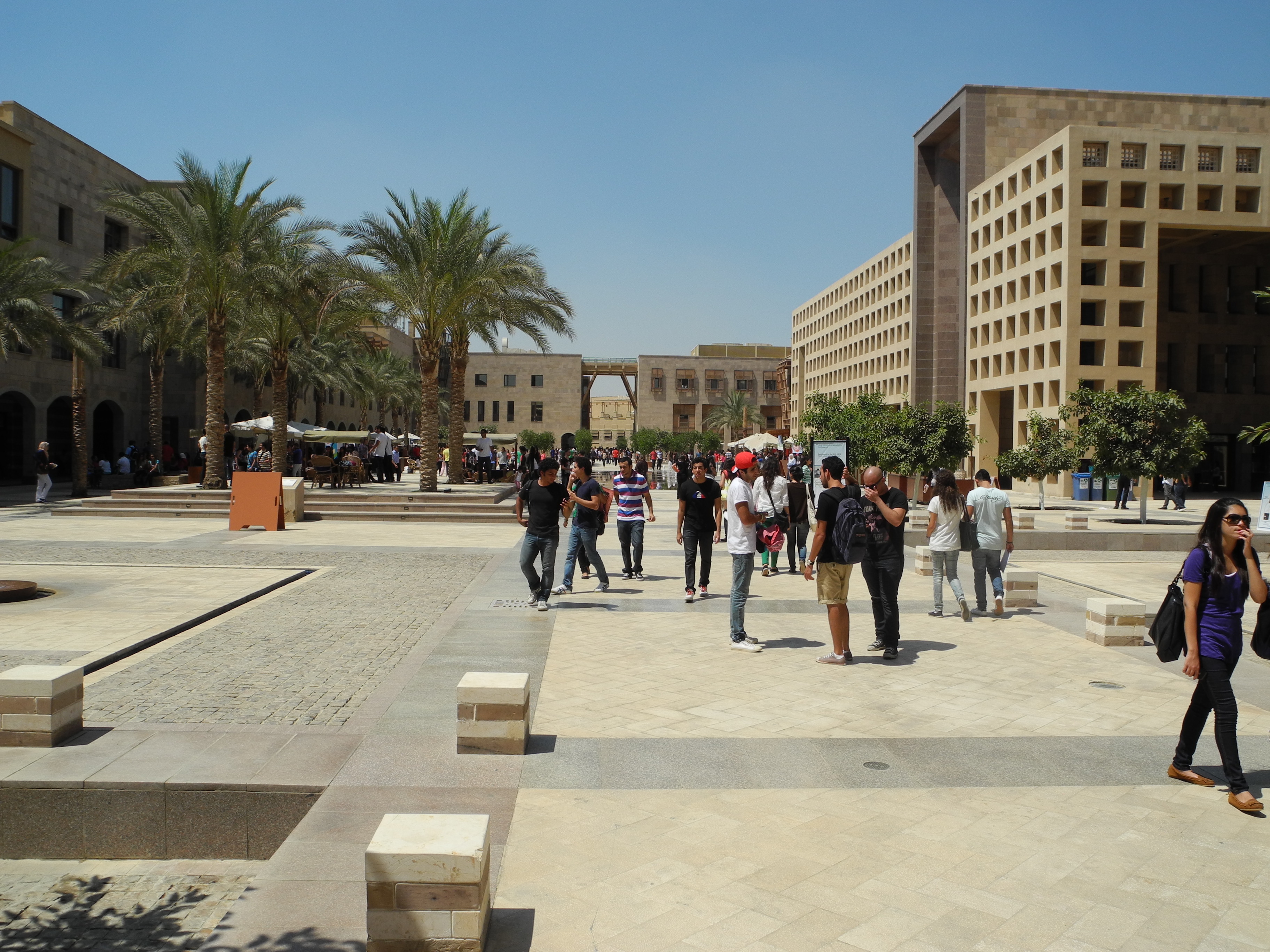
The university itself is quite lovely, apparently well-designed for an undergraduate experience, full of food courts and cheerfully interacting students, and also, at the moment (even as it largely vacates its Tahrir campus), trying hard to associate itself with the Jan 25 Tahrir movement through an enormous display of artwork based on iconic photos of the revolution.