Tahrir Square in the baking sun yesterday. Wonder if this guy also attended the really big celebration/protest this evening.

“I’m not Brotherhood and I voted for Morsi for the revolution”
Reply
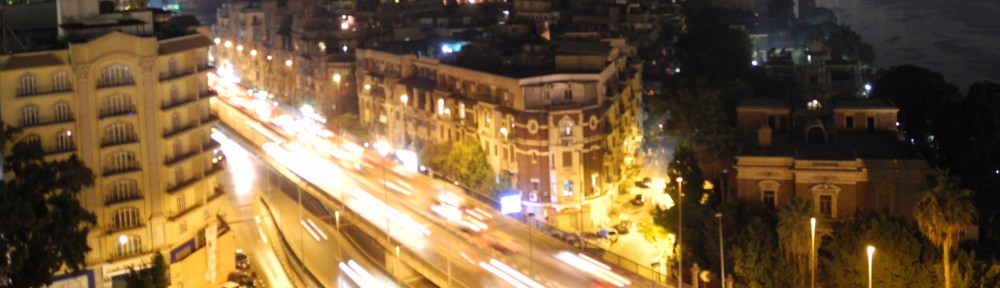
Tahrir Square in the baking sun yesterday. Wonder if this guy also attended the really big celebration/protest this evening.
As I sat with friends today in the chic, laid-back and very upscale Cafe Cabana in Maadi, a woman sat down with her laptop at a well-located table in the shade, near the bar. “That’s her table,” my friends told me. “She comes every day, sits there for hours. But if someone else takes her table, she raises hell, or just stands there glaring until they leave. They always do.” Apparently she’s a good enough customer to make it worth the management’s while. And indeed — how does one remove a power figure who simply (unlike my two-year-old) lacks the manners to know what sharing is?
Tonight it is becoming clear [update 3am at least it seems?] that SCAF has decided not to rig the presidential elections: preliminary tallies, from manual vote-counting being shown live on TV, show the Brotherhood’s Morsi with a strong early lead. (Live tallies here; have not seen tallies of spoiled ballots anywhere.) Instead, SCAF has decided to string up the whole presidency on puppet strings: a supplementary Constitutional Declaration, revealed tonight (Arabic here), takes away virtually all of the future president’s powers, including the power to act as commander-in-chief, name the defense minister, oversee the military budget, or declare war. It seems constitutions are being lowered from the sky here article by article, as the need arises; new articles abrogate the old ones; sound familiar maybe?
And there’s this bizarre status of forces declaration:
Article 53/2: If the country faces internal unrest which requires the intervention of the armed forces [ya’ni ey, dah?], the president can issue a decision to commission the armed forces – with the approval of the SCAF – to maintain security and defend public properties. Current Egyptian law [i.e., the martial law declaration revealed last week?] stipulates the powers of the armed forces and its authorities in cases where the military can use force, arrest or detain.
Also SCAF has revealed that it plans to push through a new constitution and install a new parliament in the next two months, i.e. force elections (yay! another pointless referendum! more pointless elections! and during the heat of Ramadan, why not?):
Article 60 B: If the constituent assembly [i.e, constitutional convention] is not completely formed within a week’s time, the SCAF will form a new constituent assembly – representative of all factions of society – to author a new constitution within three months from the day of the new assembly’s formation. The newly drafted constitution will be put forward after 15 days of the day it is completed, for approval by the people through a national referendum. [What if they reject it?] The parliamentary elections will take place one month from the day the new constitution is approved by the national referendum.
All of which gives SCAF at least two and a half branches of the government – three if Cairo goes for Shafik. Then what? Some revolutionaries and fellow-travelers are proclaiming that the revolution must continue. But the grisly news from Syria is an effective cautionary example (just as the example of US-led “maqrata” in Iraq probably delayed by several years any Syrian efforts to pursue democracy).
As I came into my hotel a couple of hours ago, the two men at the desk (the older one had voted for Shafik holding his nose and fearing theocracy, the younger for Morsi holding his nose and hating military dictatorship) were watching returns on TV and eager to vent. We went back and forth for a while: could the Brotherhood be trusted to relinquish power four years from now (but what power?), having broken every promise they’ve made in the past year and a half? But then it was the Shafik supporter who said, commenting on the Constitutional Declaration and the figurehead presidency it creates: “We’ll be like England now. He’ll be like the Queen.” I said maybe we could celebrate his birthday every year. We all laughed ruefully and said good night.
Pretty quiet at Zamalek polling stations this morning. Older ladies, experienced now, come with stools for waiting in line – but barely need them. It seems that people who are boycotting (spoiling their ballots as a protest vote) will tell you they’re doing so; Morsi voters will tell you they are voting for the Brotherhood; but people who are voting for Shafiq (like one Coptic colleague I ran into, who displayed her inky finger but wouldn’t tell me how she voted) will sometimes hide their shame behind the sanctity of the secret ballot. (Others brag about it, couching their decision as fear of the MB or a reasoned critique of Brotherhood hypocrisy.) It seems likely Shafiq will win. Somehow the logic of “preventing an Islamist takeover” by counterbalancing the MB parliament, sold very hard by the Shafiq camp in recent weeks, seems to have outlasted that parliament itself.
But I could be surprised. I haven’t seen any journalist be entirely right about any phase of this election process so far, starting with mis-predicting the parliamentary vote last fall (overestimating the felool voice, undercounting the Salafis) and of course continuing into this presidential process. Did anyone predict the runoff would be between Morsi and Shafik? (On walls in Zamalek you can still see, ripped and tired now, posters of Amr Moussa and Abdelmoneim Abolfotouh – remember them?)
Was jet-lagged last night so got to read various wrapups of the revolution: either flat-out obituaries (including Sarah Topol’s cogent piece from 10 days ago, before the parliament was dismissed, this analysis of voters’ impossible situation between the known evil and the feared one, and a bunch of articulate folks self-criticizing to the NYT) or attempts to spin the Bitter Choice into something positive, or at least take stock of the lessons supposedly learned. Activists are, rightly, suffering from what they call “Tunis envy.”
Speaking of counterbalancing: If Shafiq wins, as people keep pointing out, the military will officially control all three branches of government again. It will not seem too early to write the obituary. One of the main “lessons learned,” one fears, will be about the futility of trying for change.
BU’s spring semester is over and I am at the Frankfurt airport, en route to Egypt for a brief visit. I’ll only be there a little over a week. It might look like I’m flying in now in order to report on the presidential election runoff (or, more accurately, on the third round of military coup since the revolution, the first two having been SCAF’s “constitutional declaration” last summer’s and violent crackdown on Maspero/Tahrir last October-November — and we could make it the fourth if we count the Feb 11 coup itself) but actually — shall I tell you the truth? — it’s because my daughter’s babysitter’s sister is visiting the US from Nepal, so the babysitter took next week off, so Ken and the kids went to Wisconsin to visit grandparents and… I bought a ticket to Cairo. Some politics (not all) are local.
Excited to see friends and actually do some interviews for my literary-historical research project, but… I wonder if the rising tide of ham-fisted authoritarianism will just swamp all other conversations, as it did last November. Lots of outrage flying around. One liberal Egyptian expat friend told me he’s glad about the Supreme Constitutional Court ruling that called for the dissolution of the (MB-dominated) lower house of Parliament. And, albeit reluctantly, he hopes SCAF pushes forward with the election and Shafik wins. That seems to be what will happen, but no one should be happy about it. Certainly the Brotherhood’s behavior at every point has been arrogant, opportunistic, even craven. Certainly those planning an election boycott, without some way to be counted and make a statement (e.g., the option of a write-in candidate), will just marginalize themselves. But abandoning any hope of democracy and falling back into the arms of the military, after everything Egypt has been through…!
Can’t wait to arrive and read in. From afar it all seems very confusing and seems legally topsy-turvy: how is it the political isolation law is being ruled unconstitutional only now (and under what constitution?? it’s like playing croquet with a flamingo!), after former VP Omar Suleiman was disqualified from the first round, denying him the chance to split Shafik’s vote? Meanwhile El Baradei has (very belatedly) formed a political party, calling (yet again) for a temporary president and a national salvation government or a presidential council. Calling for it where? On Twitter. The MB, denied the presidency, will push for a top spot in the Cabinet, maybe a more parliamentary system overall. Meanwhile the putative separation wall between the military and the police has come down, collapsing the difference between foreign enemies and domestic opponents. And so on.
At the newsstand here only the International Herald Tribune had Egypt on the front page (David Kirkpatrick continuing the excellent reporting he’s been doing) — none of the European papers did. It’s all Greece. Seems they’re up to Angela Merkel’s eyebrows in Eurowoes.
“What was it like to be there during all those events?” has been the recurring question from students, colleagues, and friends since we got back from Cairo. It’s a good question, and I want to end this blog — which I am hereby doing — by starting to think through this business of “being there.”
Aristotle and Rousseau were preoccupied with the possibility of large-scale politics. How, they asked, is it possible to identify and discuss with a group of people so large that you cannot personally see each member face to face? Out of sight, out of mind. Isn’t any community over 100 too big? But scriptural traditions, then print capitalism, and now Facebook have taken care of that. I spend maybe five hours a day (facing my children or my students) living in a physical space; the rest is virtual. My friendships are epistolary; my communities, imagined. I am not one of those people, like Anthony Shadid (a terrible loss!) who travel and report for real, people so gifted and so committed to bringing out details from literarily and politically cut-off places that they may die getting there. Despite having little kids, despite the asthma; amazing. That is not (to my great shame sometimes) the life I have chosen. What I mostly did in Cairo was read and write. So then, why was physical presence so important? Why is it significant to be in the same time zone as a particular subset of one’s friends if one is too busy, or too stuck in traffic, to see them anyway? Or, as a worried U.S.-based interlocutor asked me when the revolution’s second wave broke, “Can’t you tweet and do Facebook from Massachusetts?”
Physical presence created some interesting moments, to be sure. Perhaps the weirdest were the four “Hamlet on the Barricades” lectures I gave at different universities around Cairo in the week between November 17 and 24, even as the Nov 18 protests and downtown violence starting Nov 19 affected everything from traffic patterns to the city’s political mood. It was educational to fiddle with Shakespeare while Cairo burned. Each host department and campus, with its specific facilities (sometimes lacking things like photocopiers) and faculty culture (who knew the Helwan drama department was so paranoid about students viewing theatre performance as un-Islamic?) and student body (sometimes all-female, not from segregation but because language departments are low-prestige) mixed in my mind with the ongoing events, shaping the questions people asked and the details I noticed. On Nov 19 at Cairo U, it was almost exclusively faculty, plus a few grad students and my friend the theatre critic Nehad Selaiha — bless her! — who stuck around for my 5pm seminar with director Hani Afifi; our good but ultimately not urgent conversation (which you can now watch, more virtuality, on YouTube) was overshadowed by people’s very real worries about driving home that night. Later that week I saw pro-SCAF graffiti in Abassiyya en route to Ayn Shams, where some members of my audience (and the professor who was my host!) adjourned almost directly from the Hamlet lecture to Tahrir; I was amazed they bothered to go to an evening lecture on Hamlet at all. At AUC, on Nov 21, students were mobilizing to support one of their peers who had been arrested in the protests, 38 kilometers away (he was released the next day); the energy at my noontime talk was amazingly high; one student who came in late with an eye-patch and a doctor’s note received admiring glances.
So yes, even in a place as well-networked and well-reported-on as Cairo there are things to be learned from “being there.” The crush on the metro, the endless taxi conversations, the ironic comments in passing, the clothes people wear, the hours at which there are lines at food kiosks, the age of the cars and telephones, the theatre performances, the layering of new over old graffiti, the phone conversations with people who could Skype with me in Boston but don’t, the (rare but valuable) experience of noticing something in person first — primed to notice it, of course, by what one has read; I don’t believe in any such thing as direct unmediated experience — and only then seeing how it is reprocessed online.
But the most significant experience for me — and this is why I’m ending this blog — has been the refocusing of attention. As Aristotle said: out of sight (or really, it’s the smell) out of mind. Others can parallel-process, or divide their caring between two places at once. The “Egyptians in Boston” Facebook group is testament to that. So were my friends in Cairo, able to live their normal lives even while being consumed with what they experienced as a historical process of change: my journalist friend whose preschooler still made it to karate class at the Ahly Club, my fashionable professor friend who stopped at the hairdresser’s on her way to her morning class, to wash out the tear gas from her night in Tahrir. I’m not like that, have you noticed? Miss my Cairo insomnia, but can’t recreate it in Boston. Didn’t find time to post during any of the interesting anniversary stuff, the inauguration of parliament, the continuing Occupy Cabinet protests, the anniversary of the Battle of the Camels or Mubarak’s resignation (but Feb 11 is also my mom’s birthday), the soccer match violence, any of the constant wavelets of news and commentary breaking unmarked over the electronic shores. Have hardly even been on Facebook for the past month; only the news about Shadid rattled me briefly back on. (One of my students had just written a paper on a chapter of Night Draws Near, sparking a long conversation yesterday about the strategic deployment of details in war narrative; relating to events at two removes is, after all, my job.)
So, back to the swing of professorial life in this oddly snowless Boston winter. More when there’s something else to report.
Amid protests outside and various theatrics, the newly elected lower house of the Egyptian parliament convened today (photos and updates of the political posturing here). Their supposed main task will be to designate a constitution-writing body, which will have only a few weeks to draft a constitution ahead of presidential elections. But this task is less important than it seems, because 1) an already congealing SCAF-Brotherhood deal will prevent any serious changes to the existing constitution’s protections for both rights/freedoms and privileges (if this deal wasn’t inevitable before, it was made so by the Salafi Nour party’s 24.7% share of lower-house parliamentary seats) and 2) it remains to be seen, anyway, whether the constitution will be respected at all, or whether some new sort Emergency will allow SCAF to abrogate parts of it at will or simply throw the whole thing out the window. (Rremember the whole fight over the constitutional amendments last March, which SCAF’s “constitutional declaration” later overwrote without a trace?)
Thus the resigned tone of veteran human rights activist Hossam Bahgat (quoted in the NY Times article on the deal): “We feel that because of the military council’s mismanagement of the transition, we have been robbed of a historic opportunity to go through a transformative, healing process of asking who we are as a country and what we want our constitution to look like. . . That is a distant dream now.”
Meanwhile, don’t miss Robert Worth’s fascinating profile of Mohamed Beltagy, “Egypt’s Human Bellweather.” Just a glimmer of hope that there are relatively powerful decent people still willing to fight (even within the Brotherhood!) for a marginally more just political system. Otherwise, the situation one year after the “revolution” is making many of my friends wish aloud that Facebook had a “DISLIKE” button (actually I dislike this cartoon too):

(“We chose him, we endorsed him, we’re with him to whatever God wills…”)
Everyone is gearing up for the Jan 25 anniversary. To be followed by a series of loaded dates that SCAF must be busy strategizing how to handle: Jan 29, Feb 2-3, Feb 11. In Cairo, plans for official celebrations and rival protest-celebrations, and Baradei’s withdrawal from the presidential race (in recognition of the fact that the deck is stacked and his presence was giving legitimacy to the process – will be interesting to see what other reasonably decent prez candidates do). Activists entered the new year envying Tunisia and, despite a well-attended and joyful New Year’s Eve concert in Tahrir, feeling generally sad.

In Boston, plans for a small rally Jan 21 in Copley Square, with the well-meant if unpersuasive slogan “We are All One Hand” under the umbrella of the “Global Day to Support the Egyptian Revolution.”
Happy New Year! Blogging from home (near Boston) now, trying to record-before-I-forget a backlog of vignettes accumulated in Cairo. Here’s one:
One day as I was walking home from the metro I saw a crowd of people standing around on my street. A huge tree had cracked in half and fallen, crushing several cars.
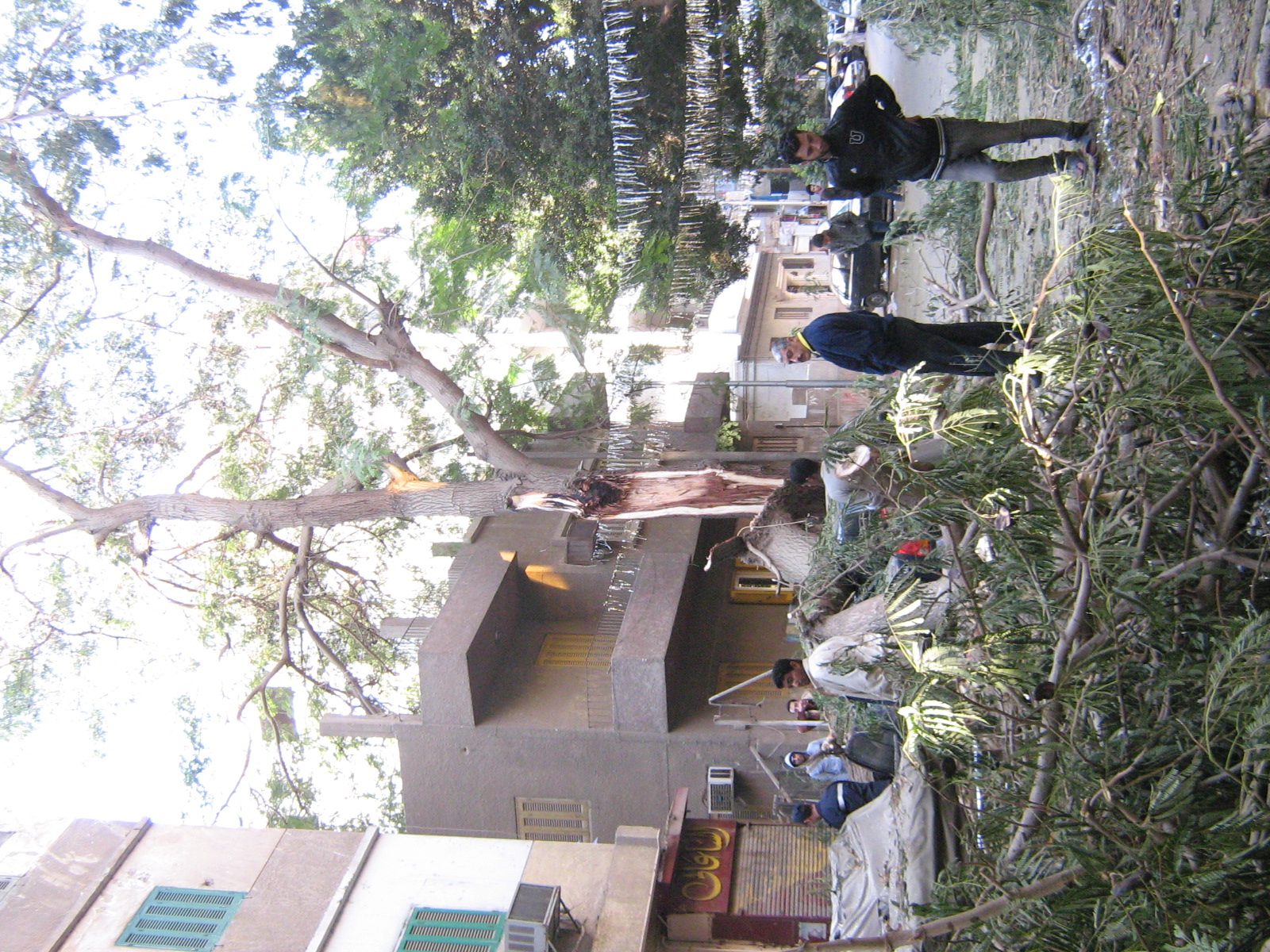
I asked the neighbors what had happened. “Oh my God, can you believe it, the tree just fell by itself, there was no storm or anything, not even a very strong wind!”

“God just willed it to fall!”
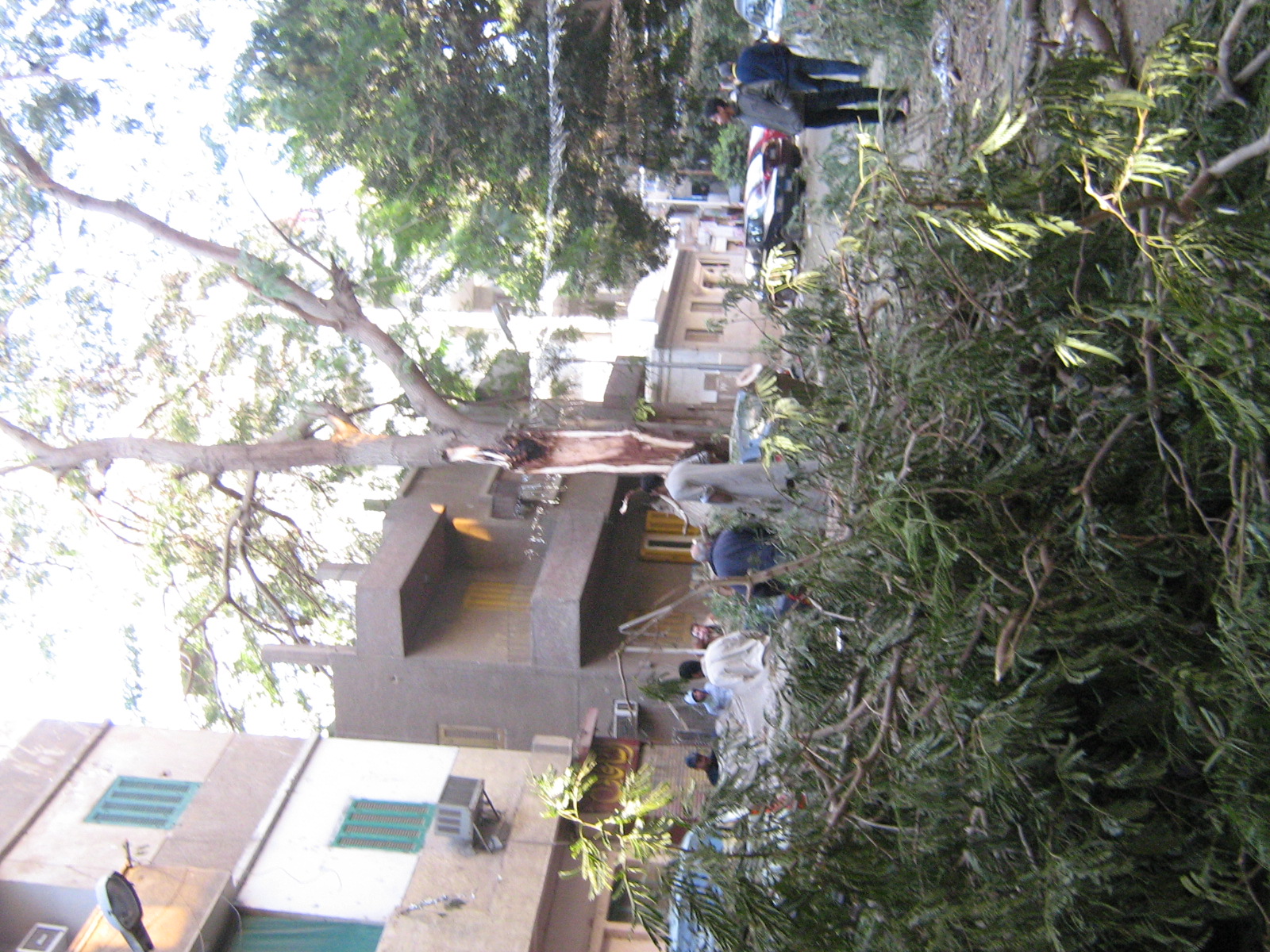
But the old lady who always sat outside her store, wearing the same kerchief and the same facial expression, showed no surprise. “That type of tree. They always crack and fall over. It’s known. That species of tree — I don’t know what it’s called. They are always like that.”
The next morning I saw two men chipping away at the huge trunk with tiny hatchets. By 5pm the whole thing was gone.
Were we the only professorial-class people in Cairo without a maid? While we were in Cairo, the “maid went to vote story” became one fairly developed subgenre of liberal handwringing, typically used to illustrate either the ignorance of the Egyptian electorate or the disjunction in priorities between the educated elite and the poor majority (or both).
Here’s the classic version: “So my maid went to vote. I asked her, ‘Why not vote for the Kutla or something?’ [Al-Kutla = the generally liberal Egyptian Bloc.] But she said, ‘Ya madame, what has the Kutla ever done for me? Have they helped me with our medical costs or my children’s after-school private lessons? No, Madame, I will vote for the Brotherhood.”
A variation: “There’s all kinds of fraud! No one is even checking IDs! For instance, my maid went to vote. But she was in a hurry to get back to work (umm, why?) and didn’t feel like standing in that long line. So she left her ID with her sister and told her to vote for her. I asked, ‘Do you even know who she’ll vote for on your behalf?’ and she said she didn’t know. Imagine the Parliament we’ll get?”
And my favorite, from a beloved longtime AUC Arabic teacher: “So my maid went to vote. She’s a Copt, like me. She told me she voted for the Salafi Nour party. I was like, ‘How is this possible?’ She said, ‘Well, the man giving out the election information told me it was the party of Umm al-Nour, the Mother of Light, the Virgin Mary. How could I not vote for her?'”
For what it’s worth, this morning’s LA Times tallies up the informal second-round election results:
The Muslim Brotherhood said it won about 47% of 180 seats in the second round, about the same percentage it took in the first round. The Al Nour party, part of the more religiously conservative Salafi movement, told the Associated Press that it won 20% of the second-round vote, also matching its performance during the first phase in November. Secular parties are believed to have garnered less than 10% during the second round of voting, which took place Dec. 14-15. Election officials said turnout was 65% in the nine provinces voting.
Hmm. Merry Christmas, y’all!
 Send Down the Basket!
