More from Tahrir

Protesters slip easily into what the Egyptian Gazette called “the Friday routine” of demonstrating.

People kept cool however they could, some putting newspapers on their heads. (A whole range of different newspapers, from Al-Sha3b to Al-Masry al-Youm.)
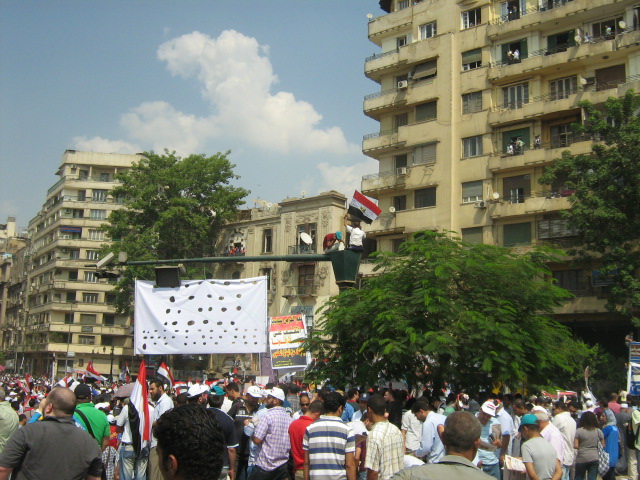
The Central Security forces occupying the “bowl” at the center of the square and the military vehicles in the surrounding streets had disappeared at midnight on Thursday; the only sign of government presence were some ambulances. Since it has been reported (or at least rumored) that Egyptian security forces have used ambulances to hide weapons to give to thugs to use against the demonstrators, this did not arouse a lot of confidence.
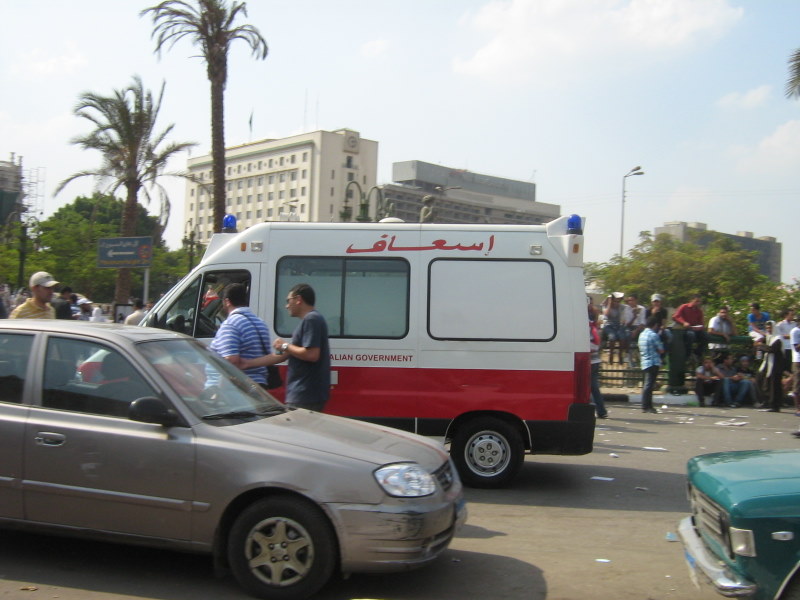
Ambulance at Tahrir
But when I was there no one was nervous either. The atmosphere was like a block party, with friends greeting each other happily (many of these friendships seem to have begun in Tahrir in the first place), vendors selling water and snacks as well as all sorts of souvenirs, and people of different ages and social classes (notably the better-dressed “civil state” demonstrators and the rowdier Ahly crew) greeting each other with great courtesy: Munawwareen!
Some slogans against America and Israel, notably rare (though not absent) in the original Jan-Feb protests, have begun to surface. Check out the intricate collage this guy made!

And this sign condemns “The Tel Aviv plan” and “the children of Uncle Sam” trying to “sow dissent (fitna) in the Egyptian street.  (I thought only foreigners called it “the Egyptian street” anymore?)

Graffiti: “Egypt will not become another Afghanistan!”

Tahrir Square, Sept 9, 2011

Some photos from Tahrir Square today. I was there in the early afternoon shortly after Friday prayers, long before the unpleasantness with the Israeli embassy that happened later. The group that was the loudest and best organized were the Ahly Ultras, supporters of Al-Ahly soccer club whose `asabiyya (group loyalty, ibn Khaldun’s term) and personal courage, not to say plain thuggery, was essential in winning and holding Tahrir Square during the 18 days.
Ultras at Tahrir
Their big sign appealed for the release of some Ahly supporters detained by the police after scuffles around a match on Tuesday.

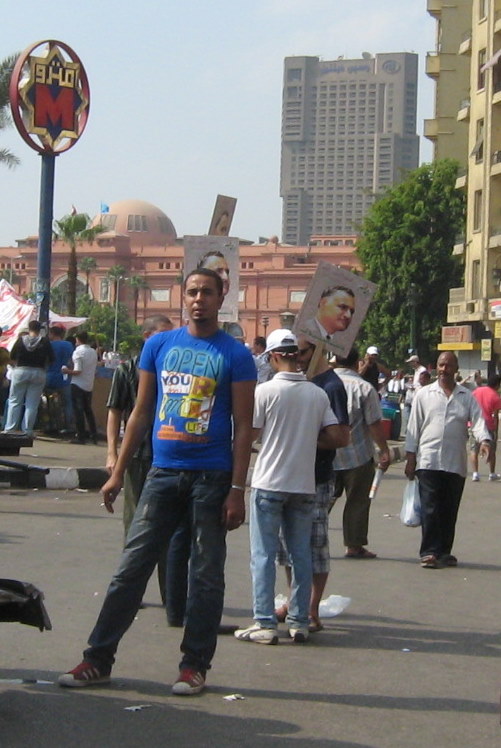
Another group of young demonstrators, closer to the main stage (there was only one today) carried pictures of Gamal Abdel Nasser!

Nasserists at Tahrir

Nasserists at Tahrir


This was billed as the rally to “Correct the Course” of the revolution, but there was a feeling of confusion about it, at least at the beginning, and even nostalgia for earlier protests when the goal was completely clear. Some people wanted to talk about election districts or judiciary independence or an end to military trials for civilians, others about whether the state should be religious or “civil” (madani – don’t ever say ‘almani, secular, or they’ll think you mean laique like France!), and others wanted to talk about Israel, a few guys even marching with hammers and chanting “The people/ want/ the demolition of the wall!” (Meaning the protective wall recently built around the Israeli embassy.) There was much disagreement over whether this was relevant to the revolution’s goals at this point or not.
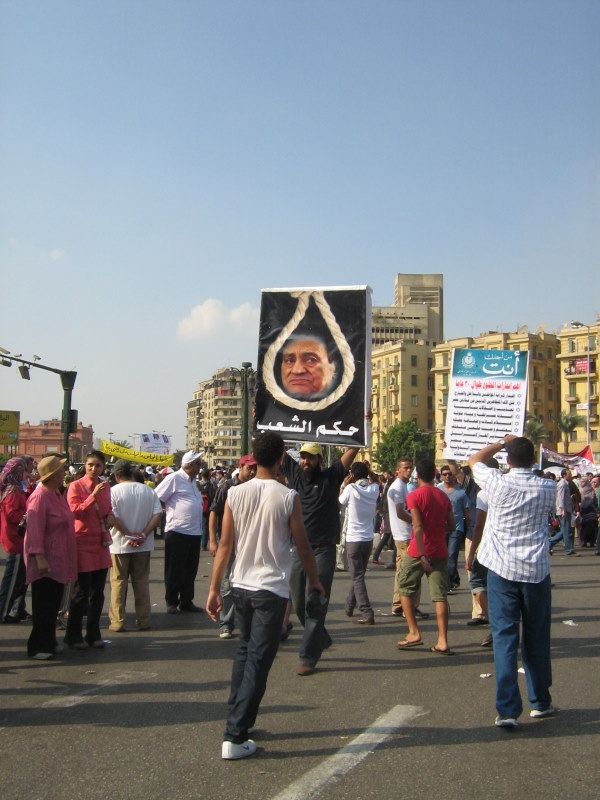
In general these are policy questions, not easily decided by demonstrations. It’s not like the military could announce any particular edict that would “satisfy all the revolution’s demands,” so the demonstration’s end (also in the sense of goal) was unclear. So some people tried to re-focus attention on the revolution’s unifying theme:
Mubarak noose poster
But the abundance, variety, and occasional subtlety of political opinions is a joy to see. People (not just intellectuals) read newspapers, listen to the radio, think, take an active interest in politics. I still think what happened in February was technically a military coup, the SCAF deciding that it would best serve their interests to put Mubarak on a helicopter. If there has been a real revolution, it is happening in people’s minds, their souls, their voices. Perhaps in a few years, a couple of decades, it will translate to a better system of government.
AUC wall graffiti
I didn’t stick around to see what this man was painting, but there was a heated (occasionally humorous) argument about it.
Debate in the streets

At a crossroads

In a discussion of an al-Jazeera segment on “religion and politics” today, it finally came home to me what it means for a country to have an opportunity to write itself a constitution from scratch.  Yes, I had known it before, but realizing it was huge.  Imagine what would erupt if the U.S. were facing a moment like that, now, today, not in 1783? What kind of gruesome compromises would we come up with this time? (Assuming they were compromises at all and not fast-forward to the Civil War.) What an amazing crossroads to be at.

Tahrir, Sept 5, 2011

Midan Tahrir, Sept 5, 2011

This doesn’t happen so often in history. Unlike Iraq a few years ago, Egyptians have a relatively clean crack at a constitution, with no occupying army breathing down their neck.

Or at least, only occupied by their own army. The military presence is far more obtrusive than before January 25. Look at the “Siniyya” (tray, or bowl) in the center of the Tahrir traffic circle in the photo above: ringed with state security guys even on an ordinary day. The next big demo (“miliyoniyya”) isn’t planned till Friday. I’ve heard several people use the word “qishra,” like a thin skin or vegetable peel or facade, to describe what this “revolution” has peeled off from the reality of praetorian rule — apparently this is enough of a cliche to have merited a whole Marxist analysis on Facebook months ago.

Happy Eid, y’all!

Forgive the primitiveness and textiness of this site for now; I am still figuring out WordPress. Also need to learn how to upload photos properly through my uncooperative Vodaphone portable connection.

So, stay tuned for proper blogging.

Meanwhile, may I just rhapsodize for a bit about the Azhar Park, built by the Aga Khan Trust for Culture?  We got to Cairo just before the Eid and went to visit the park on the first holiday evening.  I had seen a BBC Earth special on it before, but never experienced the place for myself.

Al-Azhar Park (daytime)

A daytime view here - imagine how much more beautiful it is at night

Amazing!  One of those projects that transforms the possibilities of life in a city.  Clean, beautifully designed public green space, in an area (Masr el-Adima or Islamic Cairo) that one previously visited in the August heat only when it was really necessary. The Eid celebration included a family-friendly traditional music troupe, dressed-up families, couples, groups of boys, groups of girls.  (I was especially impressed by one woman standing in front of me in the crowd gathered around the musicians: she was dressed all in pink, holding up in the palm of one hand her five-month-old baby, also dressed all in pink, bobbing her up and down in time to the music while her husband looked on with trepidation.)  It was quite crowded but not overwhelming or threatening the way crowds can be, e.g., at holiday times in Hussein Square; really magical.  The park frames the monuments of Islamic Cairo just right, and something about the layout seems to encourage people to treat each other nicely.