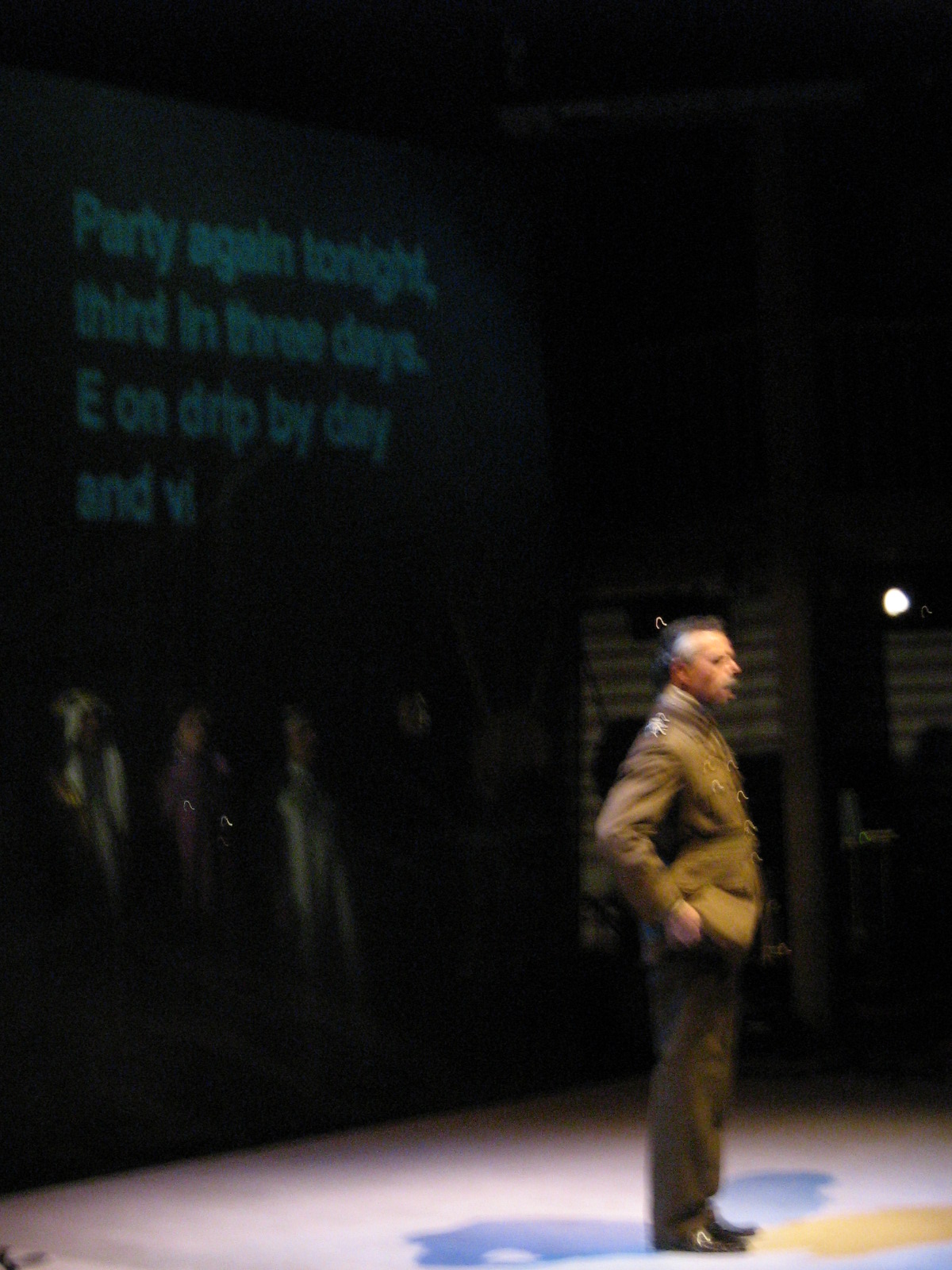
Al-Bassam’s RIII plays in the Gulf

Sulayman Al-Bassam speaks to The National (Abu Dhabi) ahead of the UAE performance of Richard III: An Arab Tragedy. http://www.thenational.ae/article/20090319/ART/799109576/1042/SPORT

Some nice bits:

I think one of the good things about the piece is that you don’t need to
know Shakespeare to appreciate it. I think a lot of people in the Arab world
have never come across Richard III,” says al Bassam.

Really? It would be interesting to ask an audience member who has never heard the plot of Shakespeare’s Richard III what s/he got out of Al-Bassam’s play. I think it would lose a lot of its depth without the York/Lancaster background.

Richard III: An Arab Tragedy is hardly the first reimagining of Shakespeare’s
popular play. The Elizabethan tale of unbridled power lust has been set in Nazi
Germany, in a crime-ridden American ghetto and even rendered in Japanese
animation, or manga, as a graphic novel. This, however, is the first time that
Richard III speaks in Arabic while in the contemporary Arabian Gulf, and al
Bassam worked with a number of writers and a poet who specialises in Bedouin
verse to get the cadence of the English adapted into Arabic. He says his focus
was capturing the rhythm, if not the word-by-word translation, of Shakespearean
verse.

The claims for the novelty and cultural representativeness of this adaptation have been scaled down over the past two years, I’m glad to report.

Because of its bilingual presentation, Richard III: An Arab Tragedy can seem
at times to be two plays in one. “For the Arab audiences, they are much more
tuned into the comedy of the piece and there is a quite comic element. So
the satirical elements come out a lot more clearly when we play to Arab
audiences,” says al Bassam. “Some of the western audiences, because of their
unfamiliarity with the culture that is being presented, they are a little
bit shy of laughing.”

This is a great point. They’re shy (and so they should be! Isn’t this hesitation before laughing at stereotypes of the other exactly what our post-Saidian culturally sensitive university teaching strives to inculcate?), and they can’t always distinguish what’s meant as satire from what’s meant as straight documentary presentation of cultural facts. Which is not their fault. But it’s a fact.

Hard not to feel that Sulayman has gotten a lot savvier about the way the same piece plays to different audiences. Well, 35 performances in nine (or is it more?) countries would do that for you.

Review of Al-Bassam’s R3 in DC

I’m happy to report that our Arab Shakespeare panel last week went very well, thanks to the gracious moderating of Kristin Johnsen-Neshati and the wry presence of Michael Kahn of the Washington Shakespeare Theatre. (“Shakespeare’s culture is foreign to me, too, as an American, even though I may speak his language. I’ve always thought it would be liberating not to be bound by his language…”) Good attendance and interesting questions, too.

That night, the WaPo reviewer had mixed impressions of the show.
http://www.washingtonpost.com/wp-dyn/content/article/2009/03/08/AR2009030801643.html?hpid=artsliving
He’s not wrong…
Since I last saw the show (Stratford 2007), Sulayman has made a major change in a key character, the US ambassador/General Richmond. He has fused the two (hard power in the Middle East is no longer even nominally separate from soft power, it seems) and brought in Nigel Barratt (the creepy Arms Dealer from his Al-Hamlet Summit) to play the resulting US official. Then in the last few days before the Kennedy Center opening (I am told), he rejiggered Mr. Richmond 180 degrees, from a sleazy Arms Dealer-type operator into a total incompetent schlub of an apparatchik: bathrobe&slippers, coffee mug, vaguely phrased Evangelical convictions expressed in a sloppy drawl. The idea of the bumbling occupier (not malicious, just high-handedly clueless) was nice, but the product wasn’t quite fully cooked when I saw it. Barratt’s acting seemed parodic: way too broad for the Kennedy Center audience, one as finely attuned to political semiotics as any you’d find in Damascus. It had none of the subtlety of Fayez Kazak’s Richard or Monadhil Daoud’s Catesby. I think they will surely tone it down for the BAM performance in June.

Meanwhile, the trail of journalists and documentarians around Sulayman continues to grow. At a post-show reception I met someone making a documentary film about him. (There have been others.) “Ah, hello. So you’re my competition!” he said when I introduced myself as an academic who has written on Al-Bassam. (Hmmm.) And have I already posted the link to this segment on PBS’ NewsHour? (Part of their very extensive coverage of the festival.)

Kuwaiti Theater Director Finds Modern Inspiration in Shakespeare
In the second of a series of reports on the Arabesque arts festival at the Kennedy
Center, Jeffrey Brown talks to Kuwaiti writer and theater director Sulayman al-Bassam, whose company is presenting a Shakespeare play with a twist, “Richard III: An Arab Tragedy.”

Transcript and streaming video here.

Al-Bassam in Damascus

Have to ask Sulayman about this (from the Abu Dhabi-based, English-language National. It must have been hair-raising and very satisfying. Not because of any “catch the conscience of the king” effect — current rulers can sit brazenly through anything. Rather, perhaps, because of the effect on the rest of the audience watching the play in the ruler’s presence. (Especially since Fayez Kozak is such a stage and film star in his native Syria.)

The play’s the thing… and so is a president in the audience
Hamida Ghafour

President Bashar Asad and his beautiful wife Asma, a former investment banker, are frequently seen on Damascus’s cultural circuit.
Recently, Shakespeare’s Richard III was brought to the Damascus stage after the city was named the Arab cultural capital of 2008. The Kuwaiti director, Sulayman al Bassam, reworked the play…
A good friend of mine related this anecdote to me after he watched the play. It was due to begin at 8pm but the crowd grew restless as an hour went by without any sign of the play starting.
“Two seats were being kept empty, obviously for someone senior,” he related. Finally who should walk in but Mr Asad and his wife. The president gave a gangly wave of the hand before sitting down. My friend was quite nervous at what he would make of the play. But he followed it intently and visibly cowered when a pistol was pointed at “Emir Gloucester”.
The audience waited expectantly during a sarcastic scene near the end when Gloucester, with mock reluctance, accepts the crown after a vote in which 99 per cent of the population endorses him. “What happened to the other one per cent?” someone asks. “Oh,” came the dry reply, “they were trying to vote by phone or online but ran out of credit.” Mr Asad – endorsed by 97 per cent of the vote in the last referendum – laughed heartily.

More here.

Al-Bassam’s Richard III staged in Kuwait

As far as I know, this is the first staging in the Arab world of one of Sulayman Al-Bassam’s Arabic-language Shakespeare adaptations.”Unfortunately it was staged for only three nights at the Dar Al-Athar Al-Islamiya, while it played for months in different countries,” Al-Bassam noted during a seminar on the play held at Kuwait University’s Faculty of Arts. The Kuwait Times has a little article about it.

Al-Bassam’s RIII coming to Kennedy Center

Announcement via The Associated Press. Watch how Sulayman’s play is again appropriated as the “bridge” between cultures or even “two great civilizations.” Both the Kennedy Center’s president and the Arab League ambassador do it. (I am trying to write an article on this phenomenon.)

Tuesday, March 11, 2008
WASHINGTON: A retelling of Shakespeare’s “Richard III,” set in the contemporary Arab world of desert palaces and oil-rich kingdoms, is among the highlights of a three-week Arab arts and culture festival that will mark the 2008-2009 season of the John F. Kennedy Center for the Performing Arts.
The “Arabesque: Arts of the Arab World” festival — a name inspired by a calligraphic style from ninth-century Iraq — was announced Tuesday. It will feature artists from all 22 Arab nations in February and March 2009, and will be the largest presentation of Arab arts ever in the United States, Kennedy Center president Michael Kaiser said.
Themes from “Richard III,” for example, take on new meanings in the Arab context and can help bridge cultural divides, he said. “In this world of tribal allegiances, family infighting and absolute power, the questions of leadership, religion and foreign intervention are at the heart of Shakespeare’s play,” Kaiser said.

[Sulayman’s familiar quote, of course, but look at the “cultural divides” stuff -ML]

The programming slate also includes dance ensembles from Lebanon and Syria as well as traditional belly dancing, [we hasten to reassure people] while exhibits will feature Arab photography, sculpture and fashion. Theater and musical offerings include diverse religious sounds of the region, and the more provocative “Alive From Palestine: Stories Under Occupation,” a play produced by the only professional theater in the Palestinian territories.

. . .

The Arab festival in 2009 follows similar international events focused most recently on Japan and China. The festival is being coordinated with the League of Arab Nations, though still a “daunting” task to bring together 22 different nations, said Alicia Adams, vice president of international programming. She said the visa and customs process alone would probably be most challenging. [You think?-ML]

Arab League Ambassador Hussein Hassouna said the festival will promote
better understanding between Americans and countries ranging from Iraq to Sudan and Somalia. [Hmm, especially Sudan. -ML] “It shows that the Arab world belongs to a great civilization that wants to be interactive with other cultures,” he said.
Kennedy Center officials continue to search for more artists to join the festival, though planning for the project began four years ago after the center brought the Iraqi National Symphony Orchestra to perform in Washington.

Holderness on Al-Bassam

Graham Holderness has an article on Sulayman Al-Bassam’s Shakespeare adaptations in the current European Journal of English Studies (Vol 12, No. 1, April 2008 , 59 – 77). Abstract:

This article addresses the writing and performance work of Anglo-Kuwaiti director Sulayman Al-Bassam, tracing the development of his various adaptations of Shakespeare’s Hamlet into English and Arabic ‘cross-cultural’ versions between 2001 and 2007. Al-Bassam’s work presents English as a ‘language in translation’. His works move from early modern to modern English, from Arabized English to Arabic, from one linguistic and geographical location to another, their forms moulded and remoulded by complex cultural pressures. The study focuses on specific examples from three adaptations to show in practice how in these works English is ‘constantly crossed, challenged and contested’.

My review of Al-Bassam’s Richard

Almost a year later (who knows how the production has evolved by now?) my review of Sulayman Al-Bassam’s Richard III: An Arab Tragedy is out in the Winter ’07 Shakespeare Bulletin. Online through Project MUSE here: http://muse.jhu.edu/login?uri=/journals/shakespeare_bulletin/v025/25.4litvin.html

And here are the nut grafs:

Included in the Complete Works Festival, Richard III: An Arab Tragedy was billed as a “response” to the main RSC production. It was an inspired commission. The Kuwaiti-British Al-Bassam oversaw a new Arabic translation of Shakespeare’s text and assembled a gifted pan-Arab cast. He
worked with costume designer Abdulla Al Awadi to reproduce (and parody) a variety of regional fashions, dressing Queen Elizabeth (Carole Abboud) in Qatar-esque “sophisticated hijab” and punctuating Lady Anne (Nadine Joma’a) with a pink handbag in the shape of a poodle. He recruited Kuwaiti musicians to perform a powerful score that drew on a range of Gulf Arab musical styles, offset with eerie post-modern compositions by Lewis Gibson. And, as he had done in his earlier Shakespeare adaptation, The Al-Hamlet Summit (staged in English in 2002 and in Arabic since 2004), Al-Bassam sought out contemporary Arab and Muslim
correlatives for Shakespeare’s treatment of rhetoric, religion, family, and politics.

However, Al-Bassam’s take on Richard III went a step deeper than allegory. Tickets were originally sold under the title “Baghdad Richard,” but Al-Bassam wisely decided against producing an adaptation centered on Saddam Hussein. Instead Richard III: An Arab Tragedy used Shakespeare’s play to orient Western viewers to some traits of Gulf Arab culture and politics. It also commented (pessimistically, I thought) on the chances that such an orientation could somehow make sense of the violence and suffering in the region. In fact, by showing how the very tokens of cultural exchange (traditional costumes, music, prayers, food rituals, rhetorical tropes, etc.) were cynically theatricalized and exploited by those in power, the production undercut its own ethnographic lessons even as it imparted them.