Unknown's avatar

About ml

A comparative literature professor interested in how Arabic literature has worked, throughout its history, as a part of world literature

On machine politics

By the way: my father-in-law, as a young man in Chicago, went to his voting place. “Here,” said the helpful campaign volunteer. “We have these new voting booths now, let me show you how they work.”  The worker went into the booth with him, behind the curtain. “You see, the levers work like this. So, say, if you wanted to vote a straight Democratic ticket, you would just go like this–” and he proceeded to pull them for him!   I have not, so far, heard of anything like that happening here.  All the reports we’ve heard of the Brotherhood employing children to distribute leaflets, driving voters to the polls, directing them to polling places with maps printed on FJP stationery, etc. etc. pale in comparison.

And who’s getting the next round?

Hey friends who are political scientists or Lebanese: how do multi-round elections, with staggered dates for different parts of the country and well-publicized early rounds, tend to affect voter behavior and election results?

Egypt’s amazingly cumbersome parliamentary election process, as though designed (like Iraq’s) to produce gridlock and purple-finger fatigue, is scheduled to go on till March. (The Al-Jazeera graphic linked above looks like something developed by Rube Goldberg — and it’s not AJE’s fault.)  Monday and Tuesday’s voting was only for the first of three rounds of the lower of two houses. Individual-candidate results are supposed to be released today, but list-based results won’t be available till January, and the Shura Council (upper house) elections won’t start till after that.  Oh and some candidates are running for both (imagine, like campaigning simultaneously for the house and the Senate?)

The problem is that meanwhile, someone needs to put together a government, because the (non-)care-taker Essam Sharaf government has, you will remember, tendered its resignation.  The Muslim Brotherhood, on the strength of (its own) exit polls giving its Freedom and Justice Party 40% in the first round, has claimed the right to form that government.  The Salafi Nour party has contested this, claiming (plausibly) that it stands to pick up a lot of seats when the voting finally gets to Upper Egypt.  And SCAF points out that under (its own) constitutional declaration, the executive (in this case SCAF – surprise!) gets to form the government, with no binding input from the recently elected parliamentarians.  But they did convene a group of political “symbols” (those presidential contenders and activists who didn’t skip the meeting) to advise them on its makeup.  If the Brotherhood decides to take on SCAF, it could be interesting.

October Mag: "Who Will Rescue Egypt?"

A word on “national salvation,” the term still being used to describe the hypothetical next government. No one calls it “national unity” government, because that would imply getting differing parties together and making them actually listen to each other. Instead it is a rhetoric of a single body politic (Hobbes, anyone?) in danger, in need of “rescue.” Anyone who wants to throw a conflicting view into this underlying unanimity — like the protesters still camped in the Midan — is accused of having “private interests”; these, ever since Nasser’s leftist fascism pre-empted Egypt’s liberal project, have been a dirty word.

A week ago, I thought that putting the parliamentary elections first was a terrible move.  The opposite process would have produced less instability, less animosity: quick presidential elections within 60 days as mandated by Egypt’s 1971 constitution, then a constitutional convention, and then parliamentary elections once it was determined what the political system would look like.  Or even something like Tunisia’s process.  Instead Egypt got a summer of mud-slinging and dirty campaign tricks, largely eroding the much-vaunted “spirit of Tahrir.”

But now I think the opposite argument is nearly as valid.  With a real choice at the polls (albeit in most cases only between the machine-politics Islamism of the Brotherhood and the ultra-moralizing Islamism of the Salafis) perhaps Egyptian voters may start to feel that differing opinions, even differing interests need not pose a fatal threat to national cohesion. That it is possible for two citizens to disagree politically without one of them necessarily being a traitor.  This is a hope rather than a prediction; such tolerance is hard to achieve even in places with a long history of liberal politics. But you do hear people on the phone with their relatives discussing whom to vote for, or reacting to the election results, and it is not all “we are obviously right and they are obviously evil.”  This may be precisely because there are so many flavors of Islamism on offer, and likewise so much fragmentation among the liberals, two facts that commentators have generally seen as bad.

Meanwhile the “interests=treason” rhetoric (which I hate, can you tell?) may have its uses, too.  The independent weekly Sawt Al-Umma (unfortunately not available online) ran a big investigative piece last week with lavish photos of the villas owned by Field Marshal Tantawi and other SCAF members, and the deeply discounted contracts under which they bought them. Front-page headline: the word “VOID” in gigantic letters, under Tantawi’s signature olive-green cap.  An inside subheading: “How the SCAF leaders changed from living in humble apartments in officers’ residence blocks into billionnaires and palace owners in the Mubarak years.”  Still doesn’t get to the military’s stranglehold on the economy as a whole, but it’s a start.

Meanwhile, at Tahrir

The movement to boycott the elections seems not to have gained much traction; Thanassis Cambanis’ post yesterday quotes some voters explaining why.  The popular blogger Sandmonkey (aka Mahmoud Salem) is even running for parliament himself!  But a number of activists remained in Tahrir yesterday, or showed up there after voting.  As I went to take the metro around 4pm yesterday to pick up my kids from school, I saw them organizing themselves to perform the protest recorded here (Activist Gigi Ibrahim’s video: Tahrir, Nov 28 2011):

The video includes an interesting argument about the Salafis.  Says the man on the left: “They were with us in Tahrir from the first days. Some of the young guys are quite sincere. Those are the people we want.”  His interlocutor is skeptical.  These are some of the divides these activists will have to bridge (and it will require some ideological nose-holding of which almost no one I know would be actually capable!) to be effective rather than just self-righteous.

This slideshow requires JavaScript.

Mohamed Mahmoud Street, home of the AUC side gate (through which we would normally enter for our classes on the Downtown Campus) has been renamed “Ayn al-Hurriyya” street: Eye of Liberty. It looks like a sort of modified war zone now: cleaned up, but the field hospitals are still in place (that’s the guy in the blue helmet with the goggles and the piles of donated blankets) and you can see where the pavement has been torn up for rock-throwing ammunition. The guys checking passports at the entrances to the square were exceptionally polite to me. The young man in the white t-shirt and red keffiyyeh encouraged me to take a photo over the tape divider into Mohamed Mahmoud Street.  He said he is not voting: “I lived in England for two years, and when there were demonstrations there, the cops hit you, but they were civilized.  Here, it was like… [a gesture of severe beating].”

Iconized already

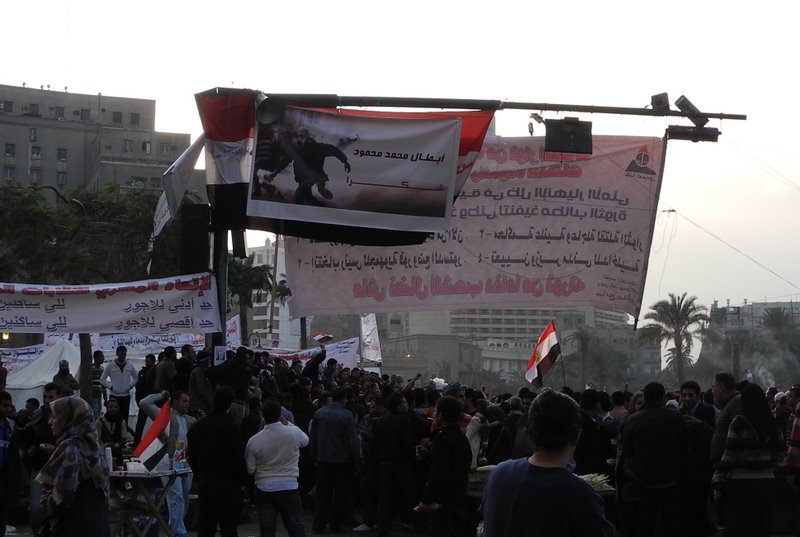
Again you can see the revolution iconizing itself in almost real time, and with excellent graphic design help coming from somewhere: the big poster with the running man and the tear gas says: “Heroes of Mohamed Mahmoud Street, Thank You!”

Voting in Zamalek

People in the women’s line at a school in Zamalek had been waiting up to five hours, since 7:30 am, when I arrived.  They seemed happy about the process; the weather was beautiful; things were relatively well organized; some clever people had even brought folding chairs and/or sandwiches. It was unclear how the would-be voters stretched for six blocks along July 26 street, then around the corner and another several blocks on the parallel street, would all get in before the 7pm closing time.  But when I passed by later the line had shortened a lot, and anyway the polls are open tomorrow as well.

The polling place itself was secured by the same type of army guys I’d seen at Maspero last week (olive uniforms, helmets, etc), but all the security and organization I saw outside was taken care of by the young men (and I saw one woman) of the Popular Committees, the (mostly) unarmed neighborhood watch groups spontaneously organized when police were withdrawn from the streets in late January.  They wore no uniforms – in some cases not even a laminated nametag – but people respected them and followed their instructions.  As in: “I’m sorry, ma’am, this line is only for those who are over 60 or pregnant. You’ll have to go down that way, around the corner, second left.”  And the person would immediately go.

Amid the underlying uncertainty over what exactly this Parliament will do, one feels odd playing a role in this scene, running around with a Nikon and taking the sort of photographs that play into the usual narrative, so familiar to newspaper readers and so often leading to disappointment. Not only Iraq (try Googling “purple finger elections”), but even the best cases (like South Africa: who can forget the images of people lining up to vote in the first post-apartheid election in 1996?).  Yet there they are by the hundreds and thousands, lined up and smiling, calling friends and relatives to discuss whom to vote for. The elderly woman emerging from the polling station with her face aglow.  Who can resist?  [Note: having trouble with slow Internet right now, but will try to upload photos in a few hours.  I didnt get the glowing face by the way; didn’t dare interrupt. But Al-Masry Al-Youm and tons of other photogs were on the scene.]

Bottom line is that at least today there’s a free choice, even if its ultimate impact will soon be canceled by gridlock, bickering, continuing dictatorship and dispossession.  At least none of the candidates on the election posters is wearing sunglasses.  A year ago, instead of all those faces of folks who have decided to run for Parliament (some of them quite ordinary people), the banners and posters would have some variation of “Yes, Mubarak!”  Not a lot to be excited about, but people are doing their best.

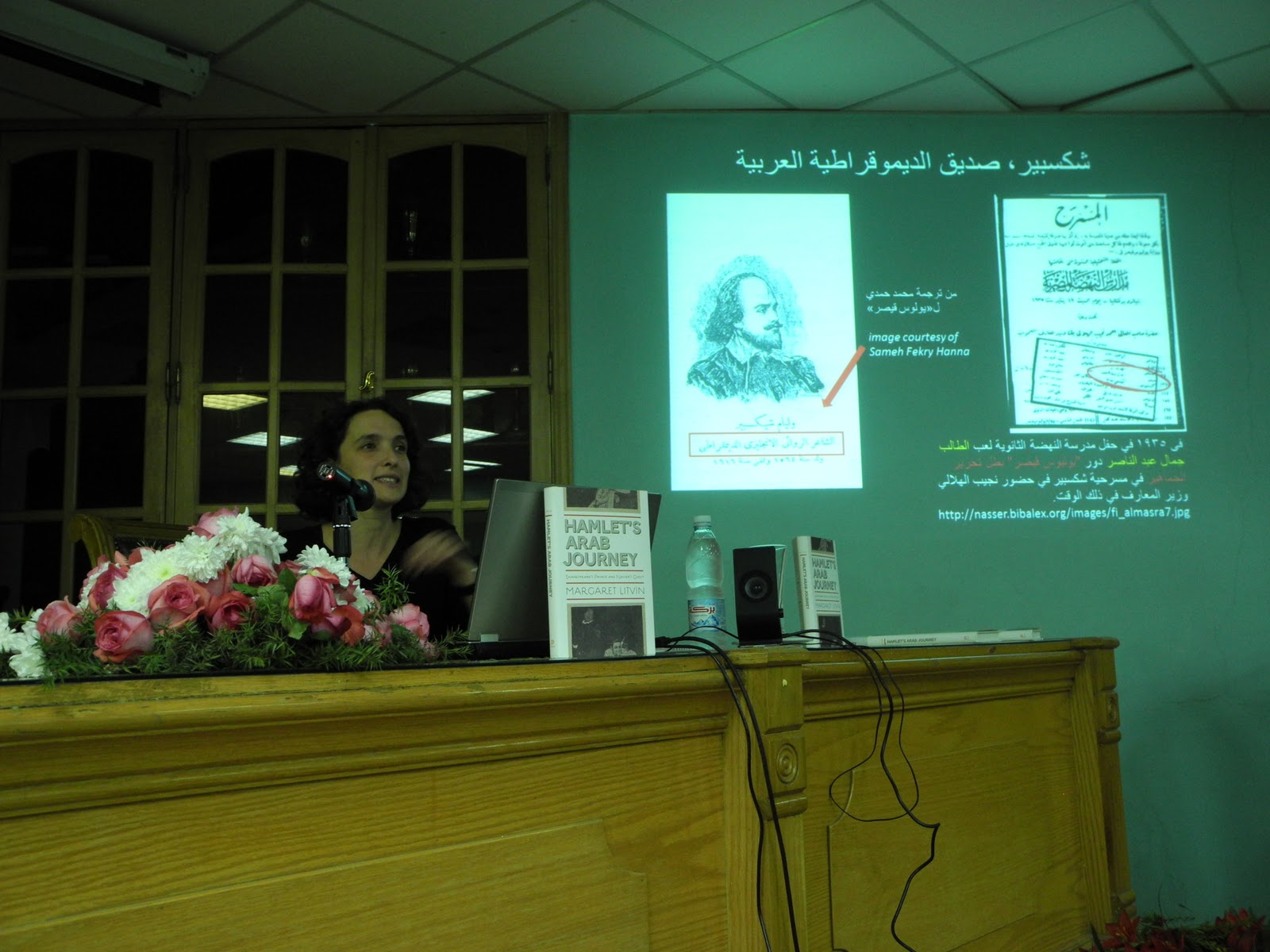
"Shakespeare, friend of Arab democracy"


Thanks to all who helped organize or who attended my recent talks at Cairo U, Ayn Shams (Al-Alsun and Drama Dept), and/or AUC. It was humbling and mind-sharpening to do them in light of everything that was happening in Cairo. And is still happening. Happy (to the limited extent possible) Election Day!
Thanks also to Sameh Fekry Hanna from whose dissertation I lifted the 1912 image at left: “Shakespeare, the democratic English dramatic poet.”
One more talk coming up at Helwan U on Dec 8.

Election day

Going out now just to look around a bit.  An employee at the Dutch Institute Library in Zamalek says her family in the Hussein neighborhood (their voting place is the Wikalat El Ghoury, where the whirling dervishes perform) are reporting a lot of crowding at the polls, especially in the women’s line. She finds this a very good sign but jokes (it’s 10am here): “The men are still sleeping!”  There is a 500-pound fine (nearly $100 dollars, or 80% of the monthly salary of a low-level state bureaucrat) for not voting, so the turnout may be higher than the political situation would otherwise warrant.  It seems that people considering a boycott have decided against it – a smart move, I believe.  It is impossible to tell right now how high or low the stakes might be.

You can read pieces in the Times etc and live coverage in a few places (notably at The Arabist and Al-Masry Al-Youm.  Meanwhile, here are a few misc photos of the election campaign posters.  Note that each candidate and party has a “symbol” on the ballot, presumably for less-literate voters (though with hundreds of individual candidates plus party lists to choose from (and some are listed as “farmers” or “workers” to fill those quotas) even the more literate could use some help. Some of the symbols are funny. Heliopolis candidate (polisci professor and well-publicized partner of a film star) Amr Hamzawy has an engagement ring. Others I’ve seen: screwdriver; fishing rod; suitcase (seems like a bad message to send, no?), CD, sports car, hoe, oversized apple. A blonde candidate with a charming sunflower got her Zamalek posters defaced by someone who scribbled “filuul” (old regime remnant) all over them.  So it goes.  Of the posters we’ve seen, only Gamila Ismail’s lack the little symbol; presumably she is not courting illiterate voters.

This slideshow requires JavaScript.

What went wrong?

Last February, SCAF held all the cards. The military was the only state institution to survive the “revolution” with its credibility intact, even enhanced. The people and the army were one hand. SCAF’s actual powers, freed from the pretense of a civilian government to answer to, grew and multiplied.

What the hell happened? The fight that the police and then the military picked with a handful of wounded Jan-Feb protesters asking for compensation last Saturday Nov 19th, on the eve of overhyped but important-for-show elections, showed an oddly weak and defensive SCAF. The scenes of the past week — flying rocks and heroic motorbike ambulances in front of the American University gate, clouds of poison gas all over downtown (and blowing into Garden City and as far as Mohandiseen), the army and the police acting as “one hand” against a diverse and incredibly brave group of protesters — all these things were eminently avoidable.  Everything about the Revolution’s second wave (link=Ahdaf Soueif’s eyewitness account) showed how much credibility SCAF had lost; every wave of gas lost it some more.

Was the military (SCAF) unable to control/restrain the police (Ministry of Interior)?  Or did it order the brutality? Either way, the response looks reptilian: not calculated violence but the last stand of a cornered lizard. Even the people going about their lives elsewhere in the city who say they don’t want an immediate end to military rule (“This time I am not with the square”) can find nothing good to say about SCAF, except that they really can’t imagine an alternative, they want “stability,” or they want elections to go forward on schedule. When pushed on what kind of stability they’ve actually seen in the past nine months of SCAF rule or what how much power (the word on everyone’s lips is صلاحيات) the elected parliament would actually have, nearly everyone I’ve talked to immediately folds.

Yet despite the sarcasm of commentators on yesterday’s pro-SCAF counter-demo in the neighborhood of Abassiya  (my friend Mohamed Shoair, hilariously, on Facebook: “Breaking News: Abassiyya Leaders Relocate Their Million-Man Demonstration to a Friend’s Apartment”) these were citizens, not rent-a-crowds.  Such remnants of support just underline how many Egyptian people wanted to trust and believe SCAF after Feb 11.  Had the generals played their cards right over the spring and summer, they could have negotiated everything they wanted: a peaceful wealthy retirement, immunity from prosecution, probably continuing behind-the-scenes control over the economy (at least through the ends of their own lifetimes), and of course the people’s lasting gratitude as the saviors of the Egyptian Revolution.  Instead there was a series of weird policy leaps (into bed with the Brotherhood, then briefly out, then apparently in again with the run-up to the elections that only the Brotherhood has persisted in supporting) and various high-handed edicts and “constitutional” or “meta-constitutional” declarations. And then Maspero. And then the poison gas. Okay, SCAF has 30-plus members and God knows how many advisors and I’m sure they’re not unanimous (why haven’t we seen any resignations??) but… no matter what their internal dynamics, the net idiocy is impossible to comprehend.

Yesterday, as we were headed out for a nearly-all-Egyptian dinner party to celebrate Thanksgiving (!), Al-Jazeera Mubasher was showing an estimated 1.5 million people in Tahrir, shouting الشعب يريد إسقاط المشير – the people/ want/ the downfall of the field marshal.  A few mins earlier it was showing prime-minister-appoint Kamal Ganzouri’s press conference, declaring that he would have “full powers” (under SCAF) to form his government (on which he offered no details) and pursue his policies (ditto).  Images of Tahrir alternated and interwove with the ongoing full-scale massacre in Syria: no longer so distinct.

On Friday my son’s swimming instructor at the Shooting Club showed me (from inside the pool) his scars from flying rocks and a rubber bullet; the lifeguards all left immediately after work to head to Tahrir; so, for that matter, did some of the professors hosting my lectures and some of the dinner guests at Thanksgiving.

This morning’s newspapers took various spins on the two demonstrations yesterday (photos soon). Al-Masry Al-Youm claimed the nation was “torn.” Al-Gumhuriyya showed scenes of both demos framed to look as though they were of similar size, under the misleading headline “One prayer, one nation.”  Brotherhood’s new daily Hurriyya Wa 3adala (Freedom and Justice, same as their political party) led with the rather disingenuous headline “48 Hours Until the Start of Transfer of Power to the People” (because Elections Are the Answer) and declared on Page 1 that the health ministry had found the first two Tahrir casualties to have died from “homemade firearms” (i.e., thugs killing each other, not the army or police).

And now? Even refreshing Twitter and all the newspaper sites every second (my husband and kids would like Mommy back – sorry dears!), it’s impossible to keep up with the news. Protesters in Tahrir have declared an alternative government headed by El Baradei and two other respected presidential candidates. The Salafi Nour party apparently refuses to accept this government. Other revolutionary parties do too. But most groups (including a splinter group of young Muslim Brothers, very promising) also seem to be refusing to accept Ganzouri.  Will these groups boycott elections (this would be unwise and is unlikely)? Or, more interestingly, try to get them postponed?  Or (one rumor I’ve heard) personally man the polling stations to assure voters’ safety?  This morning the activists sat in outside the Cabinet building to prevent Ganzouri from taking his seat; Central Security Forces ran over one protester with a military vehicle; he died of a broken pelvis.  Another martyr’s mother led a march and sang a highly resonant song about (check out the layers of self-reference) a martyred protester who tells his own mother not to be upset, because he gave his life for Egypt…

The protesters pick up their rocks, the mothers embrace their roles.  The martyrology comes around full circle and eats its own tail. The art to commemorate the revolution feeds smoothly into feeding its next wave.  How many waves will it take, people?
More on the tear gas

Alex Tylecote kindly shared this surreal bit of research on the Cairo Scholars (CS) listserv.

There has been a lot of discussion about the use of tear gas against the protesters and on its legality according to international treaties and further, the signing of a petition against its use.
I looked carefully at the Paris Convention and at previous conventions. The 1972 Biological and Toxin Weapons Convention (BWC) banned CR gas for use in military operations, but the use of the gas in internal matters is not prohibited.

On the issue of CS gas, the 1997 Chemical Weapons Convention (which Egypt was not actually a signatory to) prohibited the use of the gas for use during military operations, but again not for domestic use, and thus whether Egypt was a signatory to the treaty is irrelevant in this case.

I hope this clears up a few issues for everybody.

So apparently it is not prohibited for use on unarmed civilians, though it is illegal for use on enemies in combat?! That will make for an interesting war crimes trial if it ever happens.

As you can imagine this sparked much discussion on the listserv, with various human rights conventions being cited etc.  It seems a matter of simple logic though.  Plus, the stuff is being used in inhuman amounts. You can get a mouthful of it – enough to make your eyes and throat burn – just driving slowly on the 6 Oct bridge behind the Egyptian Museum, like a kilometer from Mohamed Mahmoud Street.  (Unbelievable to see people going about their daily business under the flyover: filling microbuses with passengers! Selling vegetables!!)  People in Garden City (where I haven’t been) have reported gas reaching their apartments. Here in Dokki, miles from everything, there is a weird heavy haze that could be normal pollution… or not… at this distance it is hard to separate sensation from apprehension.

For details on the gas and more you can read Amnesty International’s report on the SCAF and Ministry of Interior abuses.  The Arabist’s summary of the gas issue, which says basically what I said but with more details and personal experience, is here.

This is Not a Play

Last Friday night we went with my friend Maha, whom I’ve told you about, to see a performance called “Tahrir Monologues” at the Rawabet Theatre downtown. (Strong review here, less admiring review here.)  “This is not a play,” declared the program notes: it was documentary theatre, a pretty moving series of monologues based on interviews with participants in the Eighteen Days that toppled Mubarak. It started hesitant and built to triumphant: the boy who put on four layers of clothes so he could “withstand police beatings and keep going,” the girl who felt mildly guilty because she went home to sleep each night instead of camping out in the square, the young people who saw something within themselves change as they gained courage by confronting the regime’s brutality.

Rawabet was packed, and some of the energy probably came from the fact that many in the audience had been to that day’s unified and celebratory (though Islamist-dominated) demonstration in Tahrir. Audience members who had lived the Jan-Feb events nodded, laughed, and quietly commented: yes, it was exactly like that. But their feeling of nostalgia competed with an odd sense of unfinished business. There they were, back in Tahrir.  The show’s voice-over intro had stressed the psychological achievements of the 18 days, the sense of dignity and fearlessness that Egyptians would carry “regardless of whatever happens after this.”  For the moment, having successfully mustered a huge number of protesters to demand SCAF hand over power to a civilian government, they felt engaged again.

Then on Saturday the violence started. Yesterday (Tues) I texted Maha to check in. She texted back:

Thank u Marg. I go to work in the morning and Tahrir in the evening. Talk to the media if u can, Arabic or English, public or private. Tell them the people in Tahrir r butchered savagely. Tell them we r not thugs. No thug will carry on with the fight for so long.

The Rawabet Theatre collected dropped-off blankets and medical supplies.

Today we texted again.

It’s a war zone there Marg. U can’t imagine.


Pray for those on the front line and those on motorcycles carrying them outside when they r injured. They r so brave Marg. No masks, but they whiz in to the front line and come back.


I have seen more bravery in 2 days than I saw in my entire life.

What was this business about needing to tell people the protesters are not thugs?   (“Thugs” here, baltagiya, often means not just troublemakers, but people paid to be violent.) That’s certainly not how the media in my country are covering it (look, Anthony Shadid is finally here!). British papers either, I think.

But tonight I talked with my downstairs neighbor, a respectable woman in her 70s. She had the TV going, an independent channel but on mute, so just huge images of chaos in Tahrir. She shook her head. “It’s just wrong,” she said. I thought she meant the tear gas and live ammunition.  Instead: “These people have lost their minds. Isn’t there someone reasonable to tell them that this is wrong, that they should go home and stop ruining the country?”  And that is the charitable view, basically the one advanced by Tantawi in his speech last night.  Those poor misguided children.  I’ve heard versions of it even from people sympathetic to the protesters (but concerned that the elections go ahead on time, or worried that the economy is at a standstill and the country almost bankrupt, etc.).  A short hop from there to thinking these naive or too-stubborn protesters are open to being manipulated or paid.

As long as I’m reporting vicariously through Maha, let me tell you what she once told me about the eighteen days. The hardest part, she said, was after Mubarak’s Feb 2 speech where he offered all the apparent concessions, offering to resign in September and promising Gamal would not run to replace him. That’s when people started calling the protesters terrible names, blaming them for being stubborn and unreasonable, unwilling to compromise, for destroying the country. The same words some people are saying now.  “But he gave you everything you were demanding! What else do you want?” Then came the camel battle; Mubarak resigned 9 days later.