My review of CIFET

Just out in the new PAJ: A Journal of Performance and Art
https://muse.jhu.edu/login?uri=/journals/performing_arts_journal/v031/31.2.litvin.html

War Stories, Language Games, and Struggle for Recognition
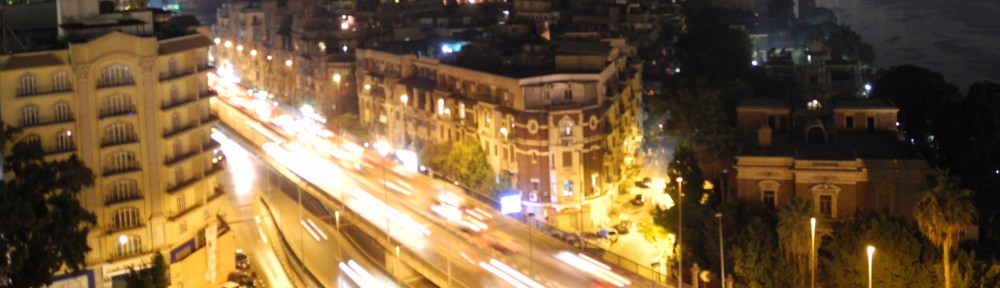
Located on the Nile Corniche, the Semiramis Intercontinental Hotel reveals only a picture-window slice of Cairo. Guests of this year’s Cairo International Festival of Experimental Theatre (CIFET) entered a security fortress: concrete barriers, bomb-sniffing dogs, metal detectors, and handbag searches. Inside, the cappuccinos were perfect; the sunset, through a double filter of pollution and tinted glass, looked magical. Some visitors wondered if this wasn’t too sumptuous a place for the Egyptian Ministry of Culture to lodge the foreign guests it had invited for the festival’s accompanying three-day seminar on “Challenges Facing the Independent Theatre and Threats to Its Survival.” Having lived for a year (2001-2002) as a student in a rooftop flat in downtown Cairo, listening to a constant din of mosque loudspeakers and taxi horns, I appreciated the change of scene that came with being an invited seminar…

More in
PAJ: A Journal of Performance and Art – Volume 31, Number 2, May 2009 (PAJ 92), pp. 65-71
Volume 31, Number 2, May 2009 (PAJ 92) The MIT Press. 20th Cairo International Festival of Experimental Theatre , Cairo, Egypt, October 10-20, 2008.

El Attar at CIFET

The Cairo festival also includes a show called F*** Darwin, Or How I learned to Love Socialism, by Egyptian playwright/director Ahmed El Attar. Unaffiliated with any state-funded theatre in Egypt, El Attar’s Temple Independent Theatre Company is producing the show under the banner of Montenegro. It’s actually a co-production with a Montenegrin group.

El Attar’s postmodern collage, About Othello, Or Who’s Afraid of William Shakespeare (co-written with Nevine El Ibiary) was produced in Geneva last November. Earlier (Sept 13-18, 2006) it played to mixed reviews at AUC’s Falaki Theatre, the only venue in Cairo that could handle the technical complexities of its 2.5-ton industrial set and many projection screens.

According to El Attar, the whole of F*** Darwin involves a family sitting on a couch, very static, in contrast to the many moving parts of his Othello. When the father speaks to the son, it is with excerpts from Gamal Abdel Nasser speeches. Which is kind of nice.

UPDATE 6/23/11: The link to the About Othello review has gone dead, but I found another one, by Waleed Marzouk for the Daily News Egypt.  Clips of this visually not very interesting show soon to come at MIT’s Global Shakespeares archive – stay tuned.

Sameh Hanna on two nationalist Egyptian Othellos

Sameh F. Hanna, Othello in Egypt: Translation and the (Un)making of National Identity. In Translation and the Construction of Identity (St. Jerome, 2005), 109-128. (This is the First Yearbook of the International Association of Translation and Intercultural Studies.)

Abstract:

The long held view that national identities are natural entities whose
formation is not conditioned by human agency, and hence are constitutive rather
than constituted, has been challenged by a whole range of scholarship which
underlined the constructedness of national identities and the role of
intellectuals in their formation. The role of translators, as intellectuals, in
fashioning and subverting versions of national identity is discussed in this
paper in relation to two translations of Othello in Egypt, one by Khalil Mutran
(1912), and the other by Mustapha Safouan (1998). The translation strategies
adopted by these two translators are deployed towards the (de)construction of
the national identity of the target culture. In reading the two translators’
(un)making of national identity, this article relates their translation
strategies to their discourse on translation.

Some parts of this article (on Mutran) are recapped in Sameh’s contribution to the 2007 Critical Survey volume. But this piece is really good on the language politics guiding the two translations: Mutran’s Levantine Christian need to forge an identity that is larger than Egypt yet not premised on Islam; Safouan’s post-Nasser and post-Gulf War reversion to Egyptian identity and use of the play for collective political psychoanalysis. Using Othello allegorically in just the opposite of an anticolonial way, Safouan casts him as the delusional Arab nationalist leader so caught up in his own glory that he murders his willing and competent nation (Desdemona). If Safouan is washing any dirty linen, he doesn’t care — anyway for an `ammiyya translation his public would be small.