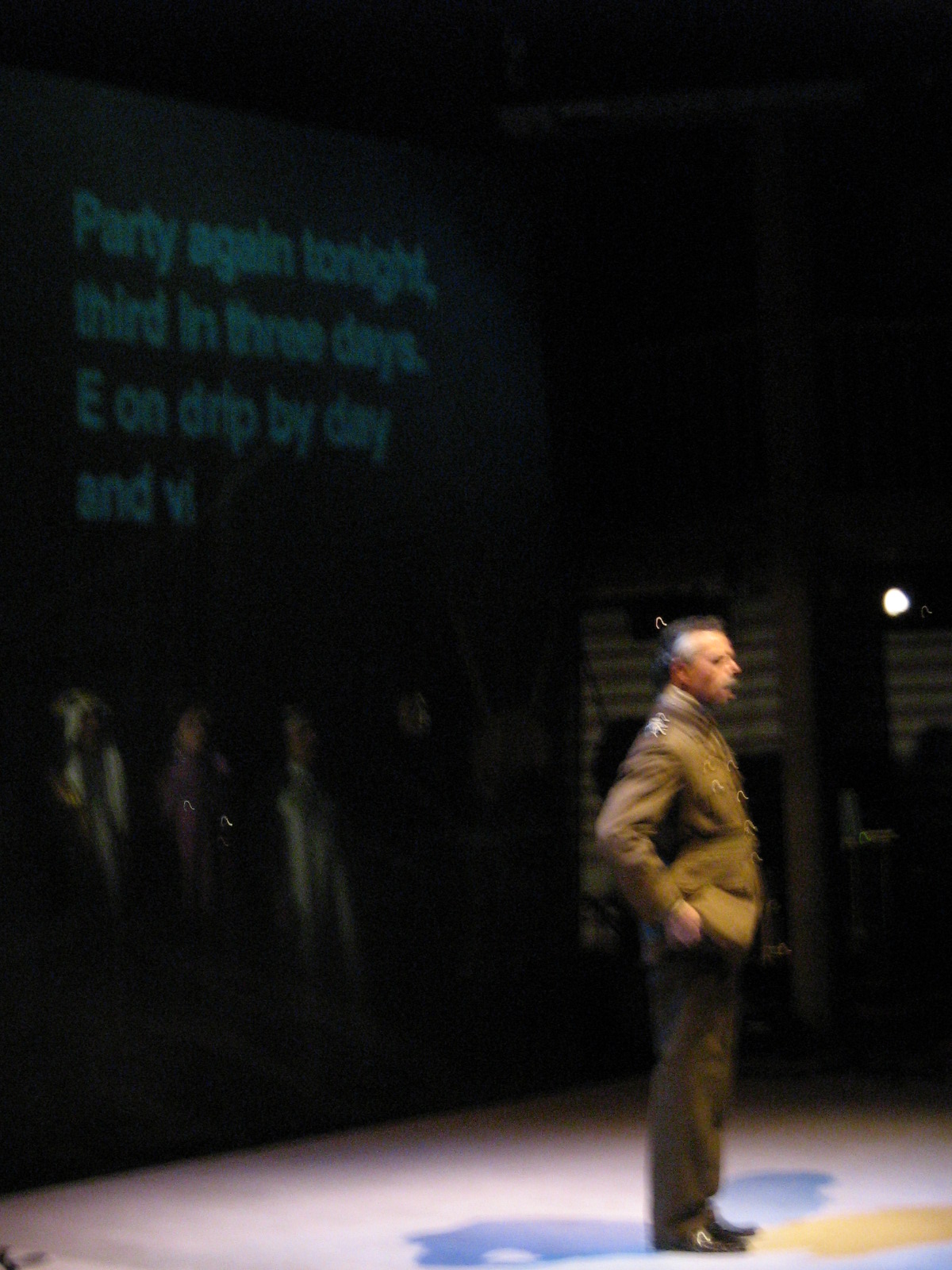
An article by Sondos Elgatit in the Tripoli Post (24/11/2007), titled, “Shakespeare in Arabia,” reads Sulayman al-Bassam’s version of Richard III against Khalid Amine’s analysis of two plays by Abdelkrim Berrchid.
http://www.tripolipost.com/articledetail.asp?c=4&i=1411
Classicism as experiment (Blood Horse)
Sonali Pahwa sent me her review of the Iraqi Macbeth, performed at the Cairo International Festival of Experimental Theatre this week. She makes the point that staging old-school classicized Shakespeare in today’s Iraq is a pretty daring experiment in its own right. As my teacher Farouk Mustafa once put it: “art for art’s sake, for life’s sake.” Thanks, Sonali!
On entering the Miami (formerly Fuad el-Mohandes) theatre to watch the Iraqi play Hussaan al-damm (Blood Horse), I thought it inevitable that the performance would draw a gathering of Iraqi expatriates. But I didn’t expect to see a large satin Iraqi flag hung at the entrance, signalling that this was no ordinary CIFET event. Inside the theatre, the air echoed with the distinctive ‘j’ and ‘ch’ sounds of Iraqi Arabic as groups of early arrivals waited for the show to begin. The crowd was considerably more elegant than your average intellectuals. Men in suits and women with fulsomely coiffed (and uncovered) hair comported themselves as if at an embassy party. Only the well-loved oudist Nasseer Shamma came in his customary t-shirt.
The Patriotic Troupe for Acting presented a much-abbreviated adaptation of Shakespeare’s tragedy Macbeth, seemingly a relevant text through which to comment on the power struggles of contemporary Iraq. It was done in classical fashion, however. The performance was composed of a series of monologues and dialogues, enacted in dramatic lighting, which relied quite straightforwardly on the power of the text. The actors playing the adumbrated cast of Macbeth, Banquo, Lady Macbeth and Macduff all delived their lines with a creditable command of fusha and with visible passion. Perhaps the lone experimental touch was the use of a video screen to stage Macduff’s version of the prophesy of Macbeth’s death. In much of the play, the conception was stagey and the monologues delivered in the textbook style taught at acting schools.
On the other hand, I felt that the insistent classicism of Blood Horse was intended to demonstrate that Iraq did still have theatre, according to cherished old norms that validated Shakespeare in fusha translation as a benchmark of high culture. Those of us who came looking for an experimental performance wanted to see the fragmentation of Iraq dissected on stage, but others in the mostly Iraqi audience cheered the grand Shakespearean performance, perhaps in memory of days when they could go to the theatre in their finery and watch tragedy in measured
cadences rather than the violence now seen on the streets and on television.
At the end of the half-hour performance, audience members who had been clicking away on their digital cameras gave a rousing ovation and rushed onstage to greet the troupe. Many had their pictures taken with the better-known actors and with Shamma. Reporters from the al-Iraqiyya television were among a handful of satellite television crews interviewing the director and cast. There were smiles and hugs all round. At this effusion of national feeling the non-Iraqi critic was something of an outsider. I left, but trust that a party followed and that a good, nostalgic time was had by all.
El Attar at CIFET
The Cairo festival also includes a show called F*** Darwin, Or How I learned to Love Socialism, by Egyptian playwright/director Ahmed El Attar. Unaffiliated with any state-funded theatre in Egypt, El Attar’s Temple Independent Theatre Company is producing the show under the banner of Montenegro. It’s actually a co-production with a Montenegrin group.
El Attar’s postmodern collage, About Othello, Or Who’s Afraid of William Shakespeare (co-written with Nevine El Ibiary) was produced in Geneva last November. Earlier (Sept 13-18, 2006) it played to mixed reviews at AUC’s Falaki Theatre, the only venue in Cairo that could handle the technical complexities of its 2.5-ton industrial set and many projection screens.
According to El Attar, the whole of F*** Darwin involves a family sitting on a couch, very static, in contrast to the many moving parts of his Othello. When the father speaks to the son, it is with excerpts from Gamal Abdel Nasser speeches. Which is kind of nice.
UPDATE 6/23/11: The link to the About Othello review has gone dead, but I found another one, by Waleed Marzouk for the Daily News Egypt. Clips of this visually not very interesting show soon to come at MIT’s Global Shakespeares archive – stay tuned.
Iraqi Shakespeare at CIFET
This year’s Cairo International Festival of Experimental Theatre will include an Iraqi adaptation of Macbeth.
It’s called Blood Horse, presented by the National Acting Troupe (more details as I get them):
Shakespeare’s Macbeth is well known among intellectuals and those interested in theatre. However, we’ve presented here a new view of the play, modernizing the events and making them speak of the reality of our world. We deal here with absolute power, presenting it out of space and time, so we see Shakespeare’s personae out of their worlds, flying in spaces of unknown worlds, surrounded by smoke, fear, and darkness, in a tension that harmonizes with the thematic of the show.
Sulayman in Stratford
Sulayman al-Bassam outside the Swan Theatre.
(Using) his kingdom for a horse
Some photos from Richard III: An Arab Tragedy
Syrian ambassador to Pakistan Riad Ismat on directing Shakespeare
Syrian playwright, cultural bureaucrat, and diplomat Riad Ismat is now Syrian ambassador to Pakistan. In this capacity he addressed a local Shakespeare society at Greenwich University. His (not very well covered) remarks there seem to have been quite general, as befits a diplomat; for more details see his essay هاملت كما اخرجته in his collection شيطان المسرح.
Hamlet’s "Something is Rotten" used in controversy over Danish cartoons
The photo is missing for some reason, but there is a striking entry about the use of Shakespeare in the Danish cartoon controversy on Kristine Steenbergh’s blog, Serendipities. Here it is:
The Dutch newspaper NRC Handelsblad this week featured this photo :
The photo captures a moment in a demonstration in the Syrian capital Damascus, one of the many demonstrations protesting against the cartoons placed in the Danish newspaper Jyllands-Posten. We see a large group of male demonstrators carrying signs in Arabic, signs that I cannot read. The male protestors are captured either with their eyes closed, or looking at each other and each others’ signs. In the foreground of the picture is a woman who looks straight into the camera of Dirk-Jan Visser, press photographer at Reuters. She carries a sign that I can read, with a quotation that is immediately familiar.
What is Shakespeare doing in Damascus? What do Marcellus’ words, spoken in the depth of night on the watchtower of Elsinore, mean in this woman’s hands? She is looking us into the eye, addressing us in English, and she speaks in the words of one of Europe’s most canonical authors. The authority – the cultural capital – of Hamlet’s canonical status is strategically entered into the demonstration, to make a point about the decadence of European culture. The Tragedy of Hamlet, Prince of Denmark is thrown back at the Western world. Shakespeare’s revenge tragedy, as a symbol of European culture, is here appropriated with a vengeance.
Sameh Hanna on two nationalist Egyptian Othellos
Sameh F. Hanna, Othello in Egypt: Translation and the (Un)making of National Identity. In Translation and the Construction of Identity (St. Jerome, 2005), 109-128. (This is the First Yearbook of the International Association of Translation and Intercultural Studies.)
Abstract:
The long held view that national identities are natural entities whose
formation is not conditioned by human agency, and hence are constitutive rather
than constituted, has been challenged by a whole range of scholarship which
underlined the constructedness of national identities and the role of
intellectuals in their formation. The role of translators, as intellectuals, in
fashioning and subverting versions of national identity is discussed in this
paper in relation to two translations of Othello in Egypt, one by Khalil Mutran
(1912), and the other by Mustapha Safouan (1998). The translation strategies
adopted by these two translators are deployed towards the (de)construction of
the national identity of the target culture. In reading the two translators’
(un)making of national identity, this article relates their translation
strategies to their discourse on translation.
Some parts of this article (on Mutran) are recapped in Sameh’s contribution to the 2007 Critical Survey volume. But this piece is really good on the language politics guiding the two translations: Mutran’s Levantine Christian need to forge an identity that is larger than Egypt yet not premised on Islam; Safouan’s post-Nasser and post-Gulf War reversion to Egyptian identity and use of the play for collective political psychoanalysis. Using Othello allegorically in just the opposite of an anticolonial way, Safouan casts him as the delusional Arab nationalist leader so caught up in his own glory that he murders his willing and competent nation (Desdemona). If Safouan is washing any dirty linen, he doesn’t care — anyway for an `ammiyya translation his public would be small.