Unknown's avatar

About ml

A comparative literature professor interested in how Arabic literature has worked, throughout its history, as a part of world literature

The street and the square

They caught three foreigners in the square this morning and paraded them on state TV – Americans, with ID cards from AUC.  [Update – Leila Fadel & co at WaPo have a good article on this and surrounding events.] You can’t trust the broadcast (which claimed the protesters “apprehended and handed them over” to security forces), but perhaps these guys really had been stupid enough to be agitating on the front lines, throwing Molotovs.  SCAF, desperate for a narrative after three straight days of shooting Egyptian demonstrators in the face in front of video cameras, trotted out the old chestnut about foreign conspiracies and “invisible hands.”  Since my husband and I are also Americans with AUC IDs, we reluctantly but quickly decided not to go to today’s milyoniyya. Our presence there would help no one.

Of course it has been impossible to do much of anything else, either.  However, parts of our neighborhoods (today we were in Dokki and Mohandiseen) do appear to be functioning as usual.

On the way to the Samar restaurant to buy my son a foul sandwich tonight (what could be more nutritious than pita bread with beans? should I complain that he sometimes won’t eat my cooking?), we walked past a group of men sitting outside an ironing shop.  They were glued to the TV, which for several hours had been announcing that the Mushir (field marshal) was “about to deliver a speech to the nation.”  (Remember the final days of Mubarak?)  They wanted to know whether we were heading to Tahrir (we explained why we weren’t). There did not agree on what should happen next.  One guy (maybe in his 50s) thought the Mushir should resign. An older man didn’t even understand the proposition: “Resign? Why? And then who will rule?”  Others seemed torn between hand-wringing and anticipation, but they clearly didn’t have a strong opinion about what should happen next.  (We live in a normal perhaps lower-middle-class-but-beginning-to-gentrify neighborhood in Dokki.)

So perhaps SCAF’s latest scheme of forming its own “national salvation government” will appease Mohieddine Aboul Ezz street, if not Tahrir Square.  Early reports suggest they’ll try to form an interim government under some generally respected prime minister like Baradei or Abdel Moneim Abdel Futouh (two very different options – I’m amazed they would be willing to get into bed with SCAF but that’s another conversation), go ahead with parliamentary elex next week (!), and hold presidential elections in July.  No word yet about the constitution, which helped spark this whole thing.

CR Gas: combat-class chemical weapon, made in the USA

People recovering cannisters in Tahrir and indep news outlets are reporting that the military may be using CR gas, not regular tear gas, on protesters. It’s causing side effects (like spitting blood), unseen in the January wave of protests.  [Update: I posted this last night and then took it down because someone Tweeted saying it was something else, a variant of CN gas, which seems to be less carcinogenic. Does anyone have verification?

But I’m putting this post back up: there are still reports from the square that it’s CR gas.]  According to Wikipedia this stuff is a suspected carcinogen, one reason its use is banned in the United States.Yet it is made (for export?) in the USA. Further (still from Wikipedia): “The U.S. military classification for this chemical agent is combat class chemical weapon.” And also: if a space is poorly ventilated, a lethal dose can be inhaled in minutes.
Bikyamasr adds: “The company producing the gas being used in Egypt, Combined Tactical Systems of Jamestown, Pennsylvania in the United States, refused to respond to Bikyamasr.com requests for information pertaining to expired canisters and its effects on people.” (Click the link inside the quote to browse CTS’ impressive “non-lethal munitions” catalogue.)   An interesting ProPublica backgrounder on U.S. State Department approval of “dual-purpose” (military and civilian) crowd-control gas exports to Egypt, written back in February, is here.

Despite the reports that the cannisters are past their expiration date, Youm7 reports (which may be even more worrying) that they were manufactured in August 2010 for use before 2015.  Which means they were sold to Egypt exactly when?

Call your congresspeople, folks! And the White House.  In the past, our elected leaders have had strong opinions about a ruler using combat-grade chemical weapons on his own population.  There’s also a petition to the company’s CEO circulating online; consider signing, for what it’s worth.

Last night, cartoonist Carlos Latuff was already on the case. More anger than wit here, but that’s understandable: the moment seems to call for direct projectiles.

[This was around 2 or 3am.  Meanwhile Naguib Suweiris’ independent station ON-TV, between cheese commercials and interviews with Tahrir veterans and the mother and sister of an Alexandria martyr, was showing nonstop political ads for the elections scheduled for one week from today.  Does anyone still think these will happen?]

Normal travel (3): A trip to Maspero

Even as widely respected Minister of Culture Emad Abu Ghazi (bless him) was resigning in protest, I was in a taxi heading to the State Radio and TV Building, the famous Maspero. Violence was continuing in Tahrir, but other than some people massed under the bridge, some shouts and whistles, I didn’t see or hear anything.

I had been invited to Maspero by Moatazz al-Agami, host of the weekly radio show Theatre Panorama, to record an interview about Shakespeare in Egypt.  It was pretty surreal: rolls of barbed wire outside the building (has probably been there for quite a while), a line of green-uniformed soldiers with helmets and rifles in the building lobby, more soldiers between the metal detectors and the stairs as we walked up, then every sign of business as usual upstairs. I was introduced to the sound technician and offered tea, then we listened to bits of a vintage radio play of Mohamed Hamdi’s (1912) translation of Julius Caesar and recorded a very polite highbrow conversation about the appropriation of Shakespeare (I explained why I preferred not to talk about Shakespeare’s “influence”) on the Egyptian stage.

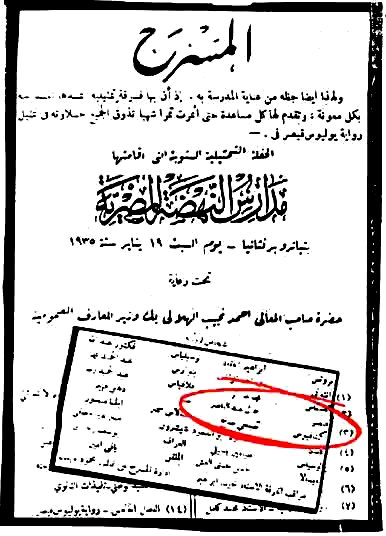
Hamdi, living his own liberationist moment in the long run-up to the 1919 revolution, had described Shakespeare (as my friend Sameh Fekry Hanna points out) as “the democratic English poet.”  Other Egyptian interpreters have read Julius Caesar differently.  Gamal Abdel Nasser acted the role of Caesar in 1935 (yes!) as “the hero of the masses and victor over Great Britain.” And generations of conservatives and co-opted liberals have read the play as exposing the chaos that ensues when rebels, however well-meaning, overthrow an autocrat, however overweening.

The part of the Maspero building I saw was beyond shabby.  “Our facilities are from the Middle Ages,” my host apologized. They don’t yet have Internet, though shiny new jacks have been installed in preparation, right behind a tangle of dusty wires.  Some of the recording equipment looked antique. The women’s toilet was clogged. Pieces of the wall by the stairs were missing.  But my host was graciousness itself, and the recording session seemed to go fine.  It is supposed to air this Thursday at 10:30 on 91.5 FM.

Normal Travel II: On not going to Tahrir

Actually, it is true that “normal travel can continue.” We are in Zamalek today – met with our teacher in the Supreme Council of Culture at the Opera complex, one metro stop and less than a kilometer from our usual classroom in Tahrir, and it was all coffee as usual. Later, at the Beano’s coffee shop in Zamalek, we saw people in business clothes sitting and typing away on their laptops just under big flat TV screens showing a footage loop of protesters in Mohamed Mahmoud Street throwing stones at police (and, since this was state TV, not showing the police firing at protesters, aiming — to judge by the reported injuries – for their eyes).  As though it were happening in some other country.  I wanted a photo of the juxtaposition but was afraid it would make people self-conscious.  In the rest of the city, too, all the action is on TV (except maybe you hear some gunshots at night?  and sirens?).

Although I really want to, I’m not going to Tahrir today.  Because 1) this is not my country, and 2) I’m not a journalist or a doctor, just a literature professor, so I think it would just be voyeurism, not even useful solidarity.  I don’t need to smell the tear gas; I might even be in the way.  You can find the real news on Twitter and Facebook today or look for a live stream of ONTV Egypt or read any of the many wonderful English-language newspapers and blogs. The story is being told so well, by so many articulate voices and talented photographers, in English and Arabic. The situation is not at all like when I started studying Arabic in 1997.

Will post photos from Friday’s demo (the happy peaceful part I attended) when I get a chance. The best chant was addressed by the protesters to each other, not to the regime (which was anyway not listening): “Say it say it, don’t be scared, the Military Council has to go” (قول، قول، ما تخافش، المجلس العسكري لازم يمشي).  It sounded aspirational 48 hours ago, perhaps more imaginable now. Things are evolving fast. (On Qasr El-Nil bridge on Friday, the demand was for SCAF’s long-ago-promised transfer of power to a civilian government by April 2012; the guy trying to push for earlier, starting a chant of “سلم السلطة يا عميل، مش هنستنى حتى ابريل” got shouted down.)

Basically I see two forces in play.  Both involve (well-founded) suspicion and distrust.  The first is the distrust felt by the political groupings for each other: secular vs. Islamist, or organized groups like MB vs. come-latelies like the Salafis.  The second is the distrust felt by all the civilian groups toward SCAF and its tendency to hold onto power.  How will these two types of distrust balance each other over time?  Which will be stronger?

Normal Travel Can Continue

Because our tickets here were bought through a university travel agency, we receive frequent “International SOS” travel notices. These alerts read as though written from a nearby planet rather similar to our own, only, say, with air containing some other element instead of oxygen. They are oddly accurate – even using terms such as “disillusionment” and such phrases as “perceptions of Mubarak-style authoritarianism by the military rulers” and yet impossible to map onto any world we recognize, perhaps from an exaggerated effort to be objective: “Fattah [not Abdel Fattah for some reason] has been detained on charges of inciting sectarian unrest” or “this is despite the SCAF’s recent concessions to protesters.” The other surreal thing that’s hard for me to convey here is the flatness of perspective, the lack of proportion. Major and minor incidents are reported in almost the same tone, as though what interested me was basically their effect on traffic.  Whereas we could be witnessing the “second wave” of the revolution that several of my friends have long been predicting.

Imagine the effect these notices would have on a businessperson who doesn’t know this country well, doesn’t understand Cairo geography, who perhaps doesn’t have great news sources and is traveling to Egypt for the first time on some random business trip or other? What the hell do they mean, “Normal travel can continue,” when all they are doing is scaring people?

We received a couple of them yesterday and so far two today. The security concerns aren’t crazy: Last night I gave a lecture at Cairo University, halfway across town from Tahrir Square where the current violence is localized; it went beautifully (thanks to the presence of theatre director Hani Afifi and his lead actor Mohamed Fahim) but was attended only by those, mainly English dept faculty, who really felt they had to be there — there were plenty of students around earlier in the afternoon, but they seemed to have hurried home to their parents rather than stick around after dark for a 5pm talk. But the cumulative effect of these emails, arriving every few hours now, is pretty surreal.

Without further comment, I reproduce the travel notice here.

Medical Alerts and Travel Security Online

Egypt: Situation remains tense as police clash with protesters in Cairo, Alexandria, Suez

Clashes overnight on 19-20 November continued between the security forces and pro-democracy activists in several urban centres around the country, particularly the capital Cairo, Alexandria (Alexandria governorate) and Suez (Suez governorate); at least two people have reportedly been killed and more than 675 others injured in the unrest, in which security personnel used batons, tear gas and rubber bullets to disperse participants. Reports indicate that related protests also took place in the cities of Damietta (Damietta governorate), Ismailia (Ismailia governorate), Mahalla (Gharbia governorate) and Mansoura (Dakahlia governorate).

The unrest in the capital occurred on Mohamed Mahmoud Street, near the interior ministry building, and in the vicinity of the central Tahrir Square. Unconfirmed reports indicate that demonstrators have erected barricades around Tahrir Square and reoccupied the area after the security forces dispersed encamped activists from the site earlier on 19 November. In Alexandria, several thousand protesters staged a march to the security directorate building. In Suez, demonstrators reportedly engaged in vandalism and marched to a police station before being dispersed by the security forces.

Comment and Analysis

The situation remains fluid and sporadic confrontations between demonstrators and the security forces are likely across the country, particularly in the aforementioned cities. As highlighted by the recent clashes, attendant security force personnel are likely to employ forceful crowd-control measures to disperse unruly protesters; such occurrences would pose indirect risks to bystanders. Traffic disruption should also be anticipated around Tahrir Square and other popular rallying locations in the coming hours, due to the presence of large crowds of protesters or heightened security measures.

The clashes on 19 November, which involved members of the so-called ‘Ultras’ football supporters group, who have a history of violent confrontations with the security forces, were said to have broken out after riot police were deployed to Tahrir Square to clear several hundred protesters that had erected an encampment at the location following a protest on the previous day. The 18 November demonstration, which was attended by tens of thousands of activists and supported by several political groups, was held to demand that the interim ruling Supreme Council of the Armed Forces (SCAF) speed up the process of transition to civilian rule. Demonstrations against the SCAF – mainly over its ambitions and alleged abuses of power – have occurred on a frequent basis in recent weeks, attracting large crowds.

Disillusionment with the interim government remains widespread among the population and protests against the SCAF are expected to continue in the run-up to the parliamentary elections, due to commence on 28 November. This is despite the SCAF’s recent concessions to protesters, including an agreement to alter Article 5 of the country’s electoral law, which stipulates that one third of seats in parliament be reserved for independent candidates. Various other issues remain unresolved, among them are the continued opposition to the emergency laws, the possibility of the SCAF remaining in office until 2013 under a protracted electoral timetable, as well as the role (if any) of Sharia (Islamic law) and the military in the new constitution. In addition, perceptions of Mubarak-style authoritarianism by the military rulers, or the latter’s prolonged governance, have the potential to trigger large-scale rallies and strikes.

Travel Advice

  • Normal travel can continue.
  • Avoid all rallies because of the credible risk of localised unrest. Liaise with your hotel and hosts on the timing and location of any planned activity.
  • Protests, which carry a credible risk of unrest, might occur in response to national political developments. In the event of violence, foreigners are unlikely to be targeted, but may be at incidental risk.
  • Ensure that you are fully briefed on the situation prior to travel and monitor events for signs of rising tension prior to and during your stay. Establish reliable information sources, taking care to distinguish between fact and rumour.
  • Ensure that you know what to do in the event of a security incident, such as localised unrest, during your stay.
  • Exercise heightened awareness in the vicinity of sensitive locations. These include (but are not limited to) government buildings, police stations, military barracks and Tahrir Square.
  • Treat members of the security forces you encounter with patience and respect. Carry photographic identification and follow all instructions promptly.
  • This advice is not exhaustive; liaise with local contacts and consult the Standing Travel Advice for Egypt.

Please do not reply to this email.
SCAF’s strategic (?) failure to make law

The banners keep multiplying and the party alliances shifting, but I find it hard to get too excited about the parliamentary elections next week. Not because of any possible rigging, but because there’s some chance the results will simply be disregarded. For instance it is easy to imagine the parliament being sidelined in the drafting of the new constitution… or the constitution itself being sidelined… like the draft “constitutional principles” document that has provoked a big fight even though no one knows whether it will be binding or not.

Remember all fuss about the constitutional amendments referendum back in the spring? Amendments were proposed to five articles of the 1971 Constitution, and the referendum kept civil society preoccupied for weeks. The “no” side objected, among other things, to the overly broad powers still granted to the presidency – they claimed the amendments were just a “tiny operation” (implication, according to this nasty ad subtitled by my friend Hazem Azmy: the amendments are like a hymen restoration surgery for a basically fallen system of government). The “yes” side spun the “no” vote as an effort to de-Islamize Egyptian law (since Article 2 said and would continue to say that shari`a is the basic reference of Egyptian law) and turned out in force to defend religion, spinning its resulting victory as “ghazwat al-sanadiq,” the holy conquest of the ballot boxes (as in this infamous video also subtitled by Hazem).
All that seems like ancient history now. SCAF just annulled the whole constitution, amendments and all, and issued a new Provisional Constitution. Unclear why. Did they belatedly discover (!) that if the amended 1971 Constitution were left standing then their own rule would have no constitutional legitimacy, since it stipulates the Speaker of Parliament should take over if the president resigns? Or did they have some other reason? Was it their plan all along? Since then they have been ruling by proclamation, trial balloon, and Facebook page decree. Everything they do (as my teacher Sayyed Ismail Dayfallah points out) looks like improvisation but somehow has the effect of increasing their power.

In the “Why Rule of Law?” seminar I taught in the Georgetown government department in 2005 and 2006, we read from a brilliant little book called The Morality of Law by Lon Fuller. Among other things, Fuller presents this list, which I assigned in tandem with an excerpt from Kafka’s The Trial:

Eight Ways to Fail to Make Law
From Lon Fuller, The Morality of Law (1964)

1) Make case-by-case decisions rather than general rules.
2) Make rules, but neglect to publicize them.
3) Make rules whose application is retroactive.
4) Make rules that are too obscure to be readily understood.
5) Make rules that contradict each other.
6) Make rules requiring conduct that is physically impossible.
7) Change the rules so frequently that behavior cannot be guided by them.
8) In your actual administration, disregard the rules.

Fuller’s prose is quaint, but his issues are relevant. The book grows from his deep concern with the legal system in post-Nazi Germany: how to move from a state of no law to a state of law? What to do with the remnants of the old regime (such as illegal laws)? How to create and enforce — and I think this is what the people of all stripes marching to Tahrir right now and tomorrow are demanding, and unfortunately they can do little more than demand it — a government bound by law?

Whose food security?

Back in Cairo, I went out with my kids to buy vegetables and saw a store I had never noticed before, called الأمن الغذائي (“Food Security”), on an obscure block of Mosaddak Street. The man minding the store turned away from the Quran Channel to welcome us effusively and show us all his wares (this is where it helps to bring along a cherubic two-year-old): olive oil, honey, jam, beef, chicken (fresh whole, fresh parts, frozen, breaded, etc.), frozen peas.

Me: What does Food Security mean?
The Man: Food Security of the Armed Forces.
Me: Huh? Everything sold here is produced by the armed forces?
Him: Yes. Top quality!
Me: I’ve never noticed this place before.
Him: We’ve only been here for about six months. (So, May 2011.)
Me: So… are you with the military as well? (He did not look it.)
Him: No, I’m just the agent (wakil). See, we have chicken panee, ready to cook, and also some (pointing to own legs; I love it when people do this) drumsticks, and thighs…
Me: Says on this olive oil it’s from Sinai. And the honey too?
Him: Yes! From the farms of the armed forces there.
Me: Ya salaam.
Him: Yeah, it’s delicious.
Me: And the whole chicken, how much do you sell it for?
Him: 21 LE/kilo.
Me: Wow. That’s really good. Way better than the supermarket.
Him: And it’s baladi (i.e., country; in this context, possibly free-range): from the Armed Forces farms.
Me: Hmm. Too bad I just bought some chicken at the other store.
Him: Well, maybe tomorrow.
Me: Inshallah.

I did buy a small bottle of olive oil. Will let you know how it is; looks a good rich green color. Do we think it has been subjected to an extra virginity test?

I wondered whether I could take a picture of the place – it’s illegal to photograph in military installations. (Then as we were leaving the man pulled out his phone and took a few pictures of my daughter. Who obligingly smiled and waved, like the diva she has become.) But of course there’s no secrecy at all: providing subsidized food products is an official and integral part of the mission of the Armed Forces.  The military-owned Food Security Corporation is listed in the phone book, food price bloggers eagerly follow its prices, and you can find old price lists (from several years back) online.

For what it’s worth: my quick Google search also turned up a commenter on an Ikhwan web forum about food safety a couple of months ago: she complained that she had found an English-language label inside some Food Security meat she had bought, after the store clerk had assured her it was from the Armed Forces’ local farms. The label said “made in India.” Her comment: “Have we resorted to eating the beef of the Hindus?”

By the way, the rumor about military ownership of the beach resort we visited at Ayn Sokna was roundly denied. Which was good, because I liked the place.  “No, no, the owner here is Mr. … Yes, he’s a civilian. You’re thinking of the Petrojet resort down the road.”  Petrojet = the national oil company, whose gas stations dot that beautiful highway.  Like the Food Security Corporation, it’s based in Heliopolis: near the Military Academy and the (former) presidential palace and lots of other military installations, military clubs, parks, etc.  A city within a city for a state within a state.

Drawing a funny moustache on the personality cult

Some wise guy reportedly stole the Field Marshal’s shoe at Eid prayers, providing fodder for a sarcastic news cycle of Facebooking and Twittering.

Fake front page of state newspaper Al-Ahram: "Field Marshal: Egypt Will Pass to a Stage of Stability as Soon as We Find the Shoe."

Latuff weighs in

There have been several of these moments: the fuss about Tantawi’s suit, the Twitter campaign to send him birthday greetings. Some of these comments are very funny, and it’s hard to resist pressing “share” or “like,” but I just want to say (with a shoutout to Lisa Wedeen) that making fun of the Dear Leader is still somehow replicating the ubiquitous image, playing into the nascent personality cult.

The dynamics of containment and subversion are complex, and I can accept that in a real totalitarian system some little moments of caricature and parody can be crucial in reminding people that they are human, that they are smart, that they are not alone. But in Egypt, nine months after toppling Mubarak? Do people really need to be reproducing images of Tantawi, even funny ones of his boxer shorts?  Resuming almost without interruption the 20th-century habit of poking gentle fun at the head of state? The message is, “Down with military rule,” but the subtext is: the military ruler is inevitable.(Maybe his face should instead be replaced by an image of a flower wherever it appears, like the female Salafi parliamentary candidate?)

By the way, what’s so incongruous about the well-tailored suit?  Arguably it’s exactly what Tantawi should be wearing, since SCAF represents what is basically a large corporation (“Military Inc”) with economic holdings in all kinds of “civilian” fields including manufacturing of medical supplies, electronics, and home appliances; infrastructure including the “spanking new” (actually about 10 years old but crazy well-maintained) highway to Ain Sokhna and all the gas stations on it, possibly even the resort where my kids and I are spending their Eid vacation. (This is unconfirmed. But according to the driver who brought us here: “Most of these resorts are run by the military. The waiters who serve you — conscripts. You’ll see. It’s not a problem: the mandatory military service in Egypt creates so many soldiers no one knows what to do with them.”  I reminded him that if this is true, it was his tax money subsidizing this use of underpaid conscript labor to enrich top military brass. But in fact, of course, it’s mine.)

These must be the real issues: SCAF’s internal dynamics (the council has 40 members!), top generals’ fear of losing the vast chunk of the Egyptian economy they control (something no one besides Springborg seems to discuss in detail – and with the prophetic power of pessimism he basically called it on Feb 2!), their fear of fracturing within the military ranks (Nasser and his fellow coup plotters were junior officers). This cogent analysis by Philippe Droz-Vincent lays out the reasons why it may be hard for SCAF to engage in a real handover to democracy – and helps explain, I think, why ridiculizing the SCAF dictatorship will do nothing to remove it.

How did Gamila Ismail get my phone number?

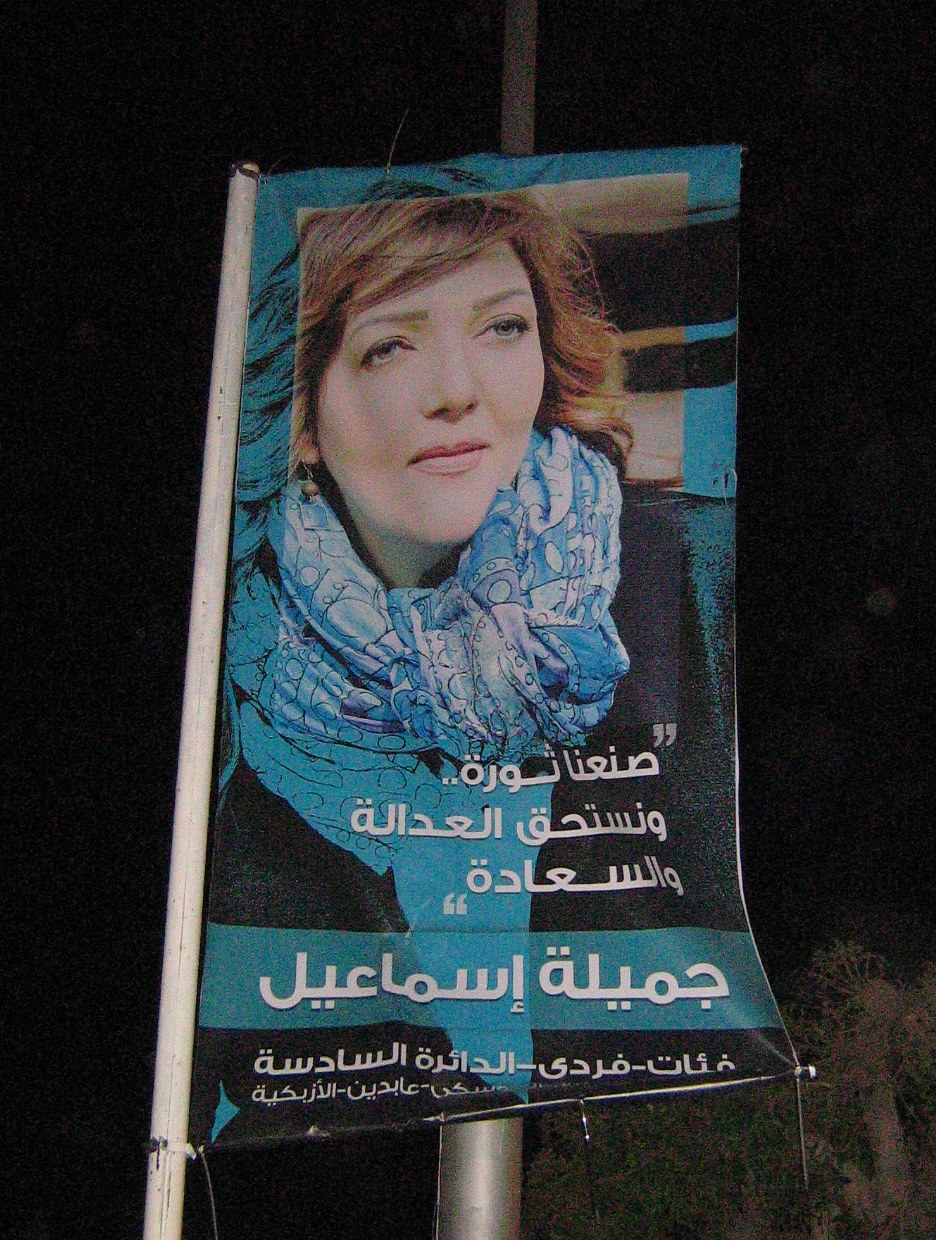
Just got a text message from Gamila Ismail, parliamentary candidate from the downtown district and ex-wife of Ghad Party founder Ayman Nour. “We made a revolution, and we deserve happiness,” the text says: the same charming slogan that appears on her glamorous election posters all over Wast al-Balad.  Here’s one from Abdin Square:

Her son Nour recently said she  had frozen her campaign to protest the detention of Alaa Abdel Fattah, but apparently it’s still going.  How did she get my number? Why does she think SMSing Vodaphone users in other neighborhoods (we’re in Dokki) is an efficient way to target voters in Downtown? Amazing lady, anyway (it’s a profile of three women; scroll down past the inevitable Nawal Saadawi).
Overall it’s been a quiet few days of Eid here. Nothing much happening except a lot less traffic than usual, and a lot more electioneering – in two days I’ve received three separate pamphlets from the Muslim Brotherhood’s Freedom and Justice Party (one of them is interesting – will try to get time to translate), and that’s aside from the little flags for kids, subsidized meat distribution, etc., undertaken in religious venues.  Other candidates have been showing up at prayers to electioneer; Al-Masry Al-Youm called it the “Eid of Elections.”
Have trouble keeping the 3000 parliamentary candidates straight? Bikyamasr has a helpful summary of the different major parties and their platforms.  Must be hell to maintain, as they keep realigning themselves in various coalitions, alliances, groupings, etc.

One relatively trivial example: Does the FJP really still oppose beach tourism, in contrast to Essam El-Erian’s implicit support for it in this rare 1988 audio recording (after the khutba – go to about 46 mins in), from a meeting with constituents in Bulaq when he was just a junior parliamentarian?  (“We need to develop our tourist sector. Even Tunisia has more tourists per year than Egypt, and they don’t have antiquities!”)