Nearby, the sound of chanting and someone shouting into a megaphone. Not demonstrations, just kids chanting their lessons at the school down the street.

From the balcony
Reply
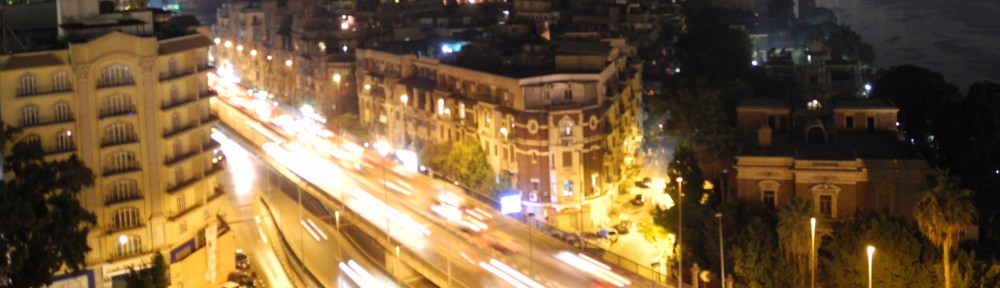

Nearby, the sound of chanting and someone shouting into a megaphone. Not demonstrations, just kids chanting their lessons at the school down the street.
Went to a lovely event at AUC tonight: a totally unpretentious panel discussion called “Translating Palestine,” focused on three takes on Lebanese writer Elias Khoury’s novel Bab al-Shams. Panelists were Khoury himself (in town for a brief visit), Humphrey Davies (who has translated several of his novels, and won Seif Ghobash Banipal prizes for Gate of the Sun and Yalo), and Yousry Nasrallah, who made a nearly 5-hour film version of the novel (Ahram profile here), co-written by Elias Khoury and Mohamed Soueid. Prof. Samia Mehrez, head of AUC’s Center for Translation Studies, introduced.
The event was in English, and Elias Khoury started out by saying that it felt “bizarre to be speaking in English about an Arabic novel and especially to be doing so here, in Cairo, which since the events of last winter has started again to feel like the heart of the Arab world. But if that is how it is, then that is how it will be.” In fact he and Nasrallah (and obviously Davies) were all lexically precise and utterly charming; perhaps having to think in one’s weaker language somehow focuses the mind.
Nasrallah said making the film, as an Egyptian, allowed him to “reappropriate Palestine,” after “years of the regime using Palestine to repress us.” I’ve never heard it put that way.
A thread running through the conversation was the role of metaphor and allegory. Khoury said that most great love stories are about “impossible loves,” so in Bab al-Shams he set out to write, among other things, “the love story of a man and his wife, something usually impossible, since usually we are in love with our friend’s wife, etc.” But of course the situation – Younis lives in Lebanon, Nahila in Israel, they meet in a cave only when he can sneak across the border – makes their love as obstacle-ridden as that of Romeo and Juliet. Anyway, the important thing is that the love story is a love story, the cave is a cave, the hospital is a hospital, not a symbol of something else. The literal object. And even more so, Nasrallah insisted, in the cinema. (Never mind what it “means”: what does it look like? What color and texture is it? How do we light it?) But curiously, literature has its autonomy, too: the stories within the novel refer to each other and to the Arabian Nights, not to any particular refugee’s particular experiences. Khoury: “Literature is not a representation of reality. I don’t like allegories.” Hear, hear!
AUC will eventually put up video of the event – watch for it here.
In Shakespeare’s words, “The fault lies not in our stars, but ourselves.” The Palestinians might as well be relying on astrology rather than looking in their cracked national mirror.Despite their attempted charade at “unity” by Fatah and the Hamas a few months ago, the Palestinians (like Hamlet) are fatally unable to make up their minds. There are two Palestinian presidents, two prime ministers, and a legislature that neither meets nor passes laws.
…the surtitles are projected above and to the back of the stage. This is a problem as one cannot possibly simultaneously read the translation and observe the on-stage action. Forsaking either diminishes the viewer’s experience of the performance, because the strength, wit and entertainment of this play definitely lie in its combination of text, acting and set design.
The envoys commence the performance nervously, on a stage surrounded by bureaucratic apparatus and presided over by The Speaker and a censor who sounds an alarm whenever dialogue is improvised or the action drifts from its state-sanctioned course.
A meter stick is amusingly employed to ensure that the official 90-centimeter distance is maintained between male and female players at all times.
As the play progresses, the spirit of the theater begins to take over. Digressions from the approved performance increase in regularity. The set, lighting and costumes evolve from bleak greys, whites and blacks to colorful oranges, reds and yellows. Eventually the cry rises, in English, “Defect!”
While the momentum is building, alas, the surtitles are falling apart. As they lapse several lines behind the onstage dialogue, it becomes increasingly difficult to understand who is saying what, especially when there are more than two members of the 10-man cast engaged in conversation. It becomes frustrating.
Meanwhile the progressively absurdist nature of what’s happening beneath the translation also grows challenging to follow.
Ironically, Beirut may be a less welcoming audience for this show than Boston and New York (coming up next month!). In Lebanon, from what I gathered last May, no one wants to hear too much about the Arab Spring. Further, Al-Bassam doesn’t get any “exoticity discount” (do you know what I mean?) for directing a show in Arabic. And he has discovered before (with an ill-fated musical Tartuffe adaptation that was cleverly intended for Gulfi audiences who were summering in Lebanon but that ended up playing instead for sophisticated Beirutis, who were underwhelmed) that it can be a tough market to gauge.
On the way home tonight we saw a very small demo on Mohamed Sabri Abou Alam Street just off Talaat Harb Square. Maybe fifty peaceful protesters, guarded by not very many red-bereted military police. They were chanting, among other things: “The people want the downfall of the Field Marshal.” Really, at eleven o’clock on a Wednesday night, that’s what they want?
Apparently, according to some friends of my friend whom we ran into at the scene, the military had picked this fight. Military police had inexplicably arrived at the Borsa pedestrian area and started clearing chairs out of its open-air cafes, making some spurious argument about it being too crowded. This despite the fact that the Borsa area has been pedestrian for years (it’s actually a really nice area), and also that the city is full of other spontaneous cafes and fruit stands etc. that really do tie up traffic and call out for enforcement. As people are tweeting now (do I know these things?), there was also a soccer match on. So the military successfully roused people who had wanted nothing more tonight than to drink their tea and watch their football, and got them to stand up and demonstrate. Well, duh, when you take away their chairs. (My friends said Borsa was the one part of the city where cafes had stayed open even during the revolution. As though nothing was happening.)
As we walked by Borsa on our way to Midan Falaki to catch me a cab we saw the cafes open again: sheesha, tea, plastic chairs and little tables in full swing. As though nothing had happened.
(Later, after we left, more military police would arrive; the lights would go out in Talaat Harb square; a few protesters would head to Tahrir. All this was after I was home in my pajamas.)
Update next morning: even sports talk shows on the radio are touching on the event: why close down these cafes in particular? Why in the middle of a match and not wait till it’s over? why not publicize the new “rules” about public chair-positioning in the newspapers and on TV, rather than leading with the enforcement?
I was sitting at Cafe Riche tonight having a properly literary conversation with some friends when in walks Buthaina Kamel, a TV announcer (apparently known for a call-in show about sex? — this is all news to me) and the only female candidate for the presidency of Egypt. She makes quite an impression. She sat two tables over from us and discussed politics with someone. At some point the owner came over to her with a younger male relative: son? nephew? and chatted for a while. I was tempted to take a picture of her, or rather of my friend with Buthaina in the background — didn’t want to interrupt the conversation and appear shallow, but now regret not doing it. Here is what she looks like:

and talks like. We didn’t talk to her. Although, if she’s really running for president, isn’t it her job to talk to people?
Cafe Riche (photos here, not mine), by the way, seems to be having some kind of post-revolution renaissance. The joint was jumping tonight; several tables of young and especially middle-aged muthaqafeen (intellectuals), the odd tourist, a couple of pairs of middle-aged women catching up earnestly over coffee or lemonade. It’s a venerable part of the literary life of Cairo but had declined in recent years into a caricature of itself, or what was sometimes called “a slice of history”; often it was empty, and at some point in the last ten years it was even threatened with destruction. There’s a nice history of the place, with literary allusions including Naguib Sorur’s Protokolat Hukama’ Riche, in Haaretz of all places. Maybe its regained popularity has more to do with renovation than revolution?
On the plane to the UK I watched a 2010 Egyptian movie, Bintayn Min Masr (Two Girls From Egypt), written and directed by Mohamed Amin (a few details here). It was kind of an earnest social-critique tearjerker melodrama, as you can see from the trailer:
Like all the other cultural production that has come out of Egypt in the past 10-15 years, this film can be said to “predict the Egyptian revolution” of Jan 25 (yes, the linked article is about a supercomputer model!) or at least lay bare the social frustrations that helped contribute to it (Khamissi, Aswany, etc).
The subtitles mistranslated the title as Egyptian Maidens, probably to emphasize that the desperate 30-something heroines were both virgins — a result of social constraints and their inability to find husbands. The least expected (and perhaps the least watchable) scene was a conversation in which a group of young women explained this sad fact to… a visiting researcher from Boston University! Of all things. The American scholar was depicted as blonde and a bit slow, with an exaggerated American accent.
Other highlights. All the men in the film were either scoundrels working abroad, decent men arrested for falling afoul of the regime (two of these), or depressed. The heroine’s brother was nearly killed after an accident sank the ferry that was carrying him to a dead-end restaurant job in Saudi Arabia. Of the female characters young and old, the only one who occasionally appeared happy was a young nurse or doctor involved in a heterosexual relationship, albeit one that was “external” (i.e., sexual but not damaging to technical virginity) and “urfi” (protected by a customary agreement rather than a formal marriage certificate), and consummated mostly in supply closets. Everyone else was single or widowed, and totally neurotic/miserable/psychosomatically ill, trying everything (dating offices, the Internet, airport lounge speed-dating with Gulf emigrants) to land a man.
Since I have kids, airplanes are about the only time I get to watch movies. Sometime I’ll tell you about Al-Dealer, another recent Egyptian film I saw on a recent flight to Beirut. Equally melodramatic but much more exciting, and it touched on the former Soviet bloc!
While I was delightfully off-grid in Wales last weekend (where the only twitter was from the birds in the apple orchard), lots of interesting stuff probably happened here. You can read about it elsewhere. We haven’t talked about last week’s news yet.
So Turkish prime minister Recep Tayyep Erdogan and his headscarved wife Emine paid a visit to Cairo, sort of a victory lap to celebrate Turkey’s new status as a leader in the region. On my way to the airport I saw the billboards — didn’t get a photo, but found one online. They said, somewhat unimaginatively: “Together, one hand for the sake of the future.” (As my friend Hazem noted, this “one hand” business is getting rather overused. The people and the army — one hand. Christians and Muslims — one hand. Now Egypt and Turkey — one hand. Do we even know where that hand has been?)
Erdogan’s authoritarian tendencies are starting to worry my Turkish friends, but never mind. The Egyptian papers duly reported on his spouse visiting a children’s cancer hospital and even noted the increasing popularity of the Turkish-style headscarf at hijab fashion shows in the region. He got quite a hero’s welcome here. (As one Egyptian had tweeted, in Arabic, upon Turkey’s expulsion of the Israeli ambassador: “The world really is round! You make a wish in Giza, and it comes true in Ankara.”)
But Erdogan surprised some of his Egyptian supporters by emphasizing that he is the leader of a secular Muslim state, not an Islamic one. He called for a secular Egypt, which, as The Jerusalem Post among others gleefully reported, led to a certain cooling of the Muslim Brotherhood’s attitude toward their visiting Turkish brother.
On the “one hand” thing, by the way (I’m interested in how metaphors of embodiment are used to rhetorically bind together a body politic, not to say a Leviathan):
“The Believers, in their mutual love, mercy and compassion, are like one body: if one organ complained, the rest of the body develops a fever.” [Bukhari & Muslim]
cf.
“And if your right hand causes you to sin, cut it off and throw it away.” (Matthew 5:30)
Off to Wales tomorrow, of all places, for my friend Katie’s wedding. Mabrouk, Katie!
So I will miss whatever happens with the announced “Friday of Terrifying Silence” demonstrations called by activists to protest SCAF’s re-imposition of Emergency Law. The organizers have proposed that demonstrators wear black and march with their mouths taped shut.
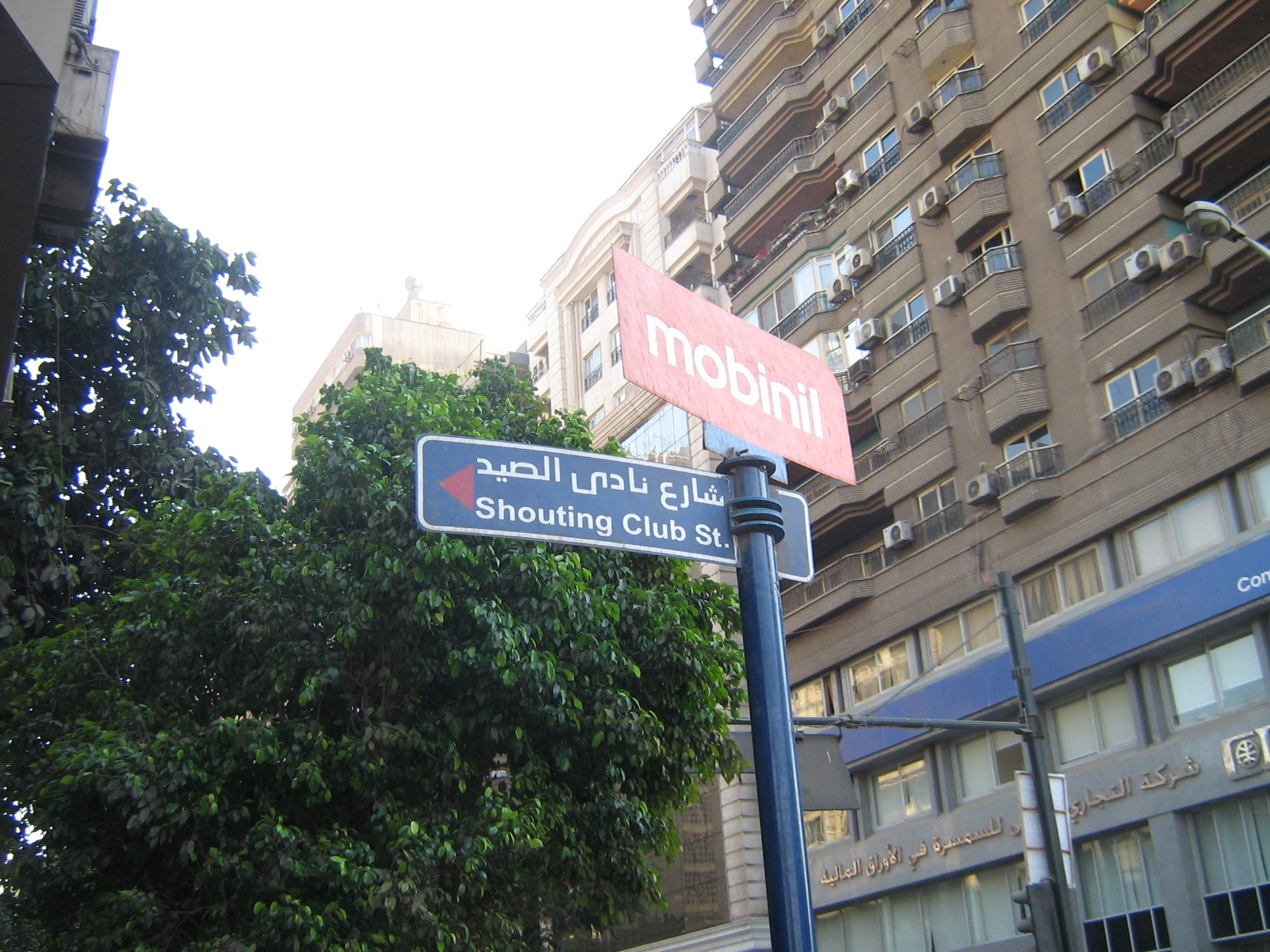
Or is it back to the Shooting Club?
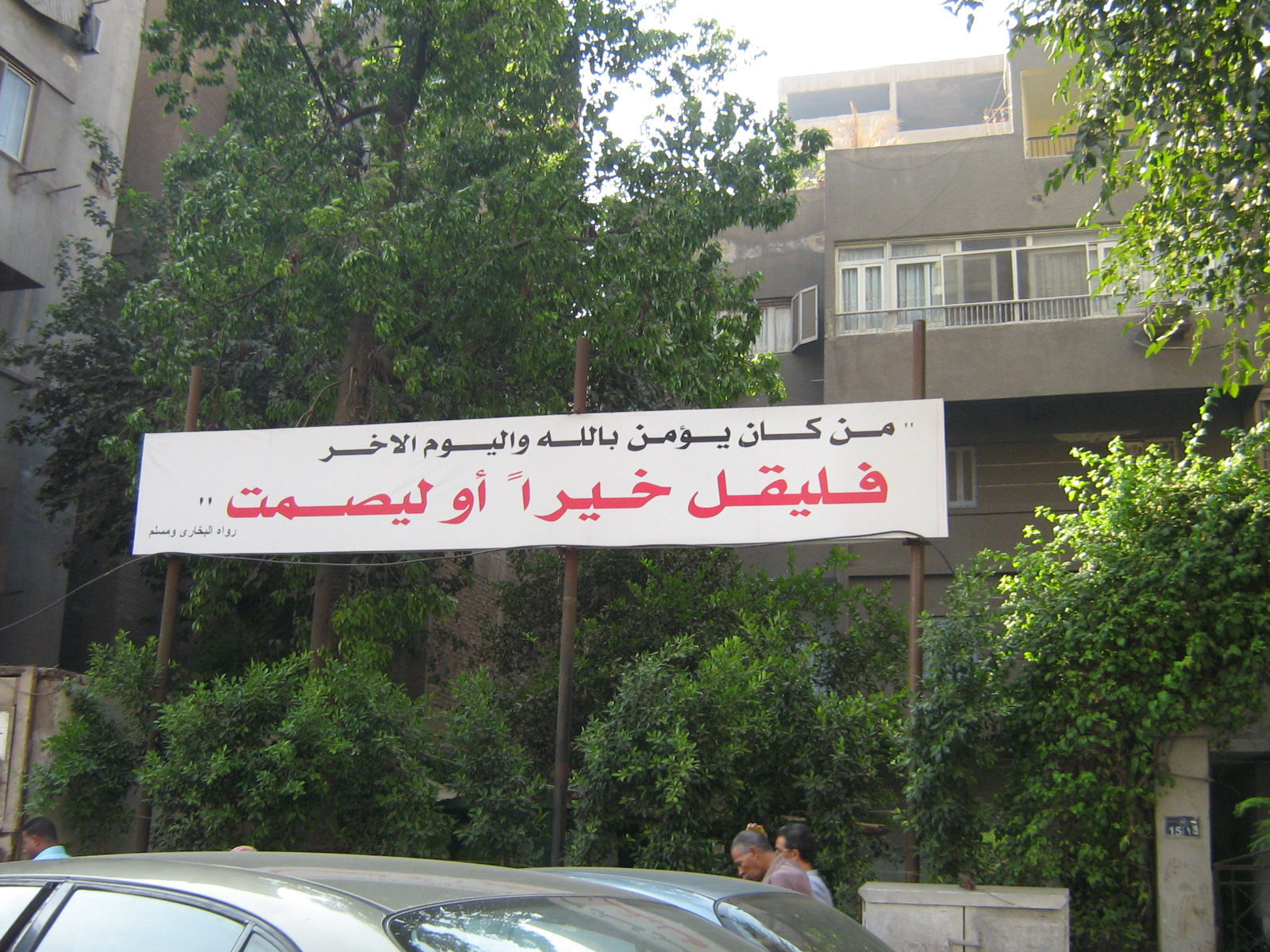
"If you can't say anything nice..."
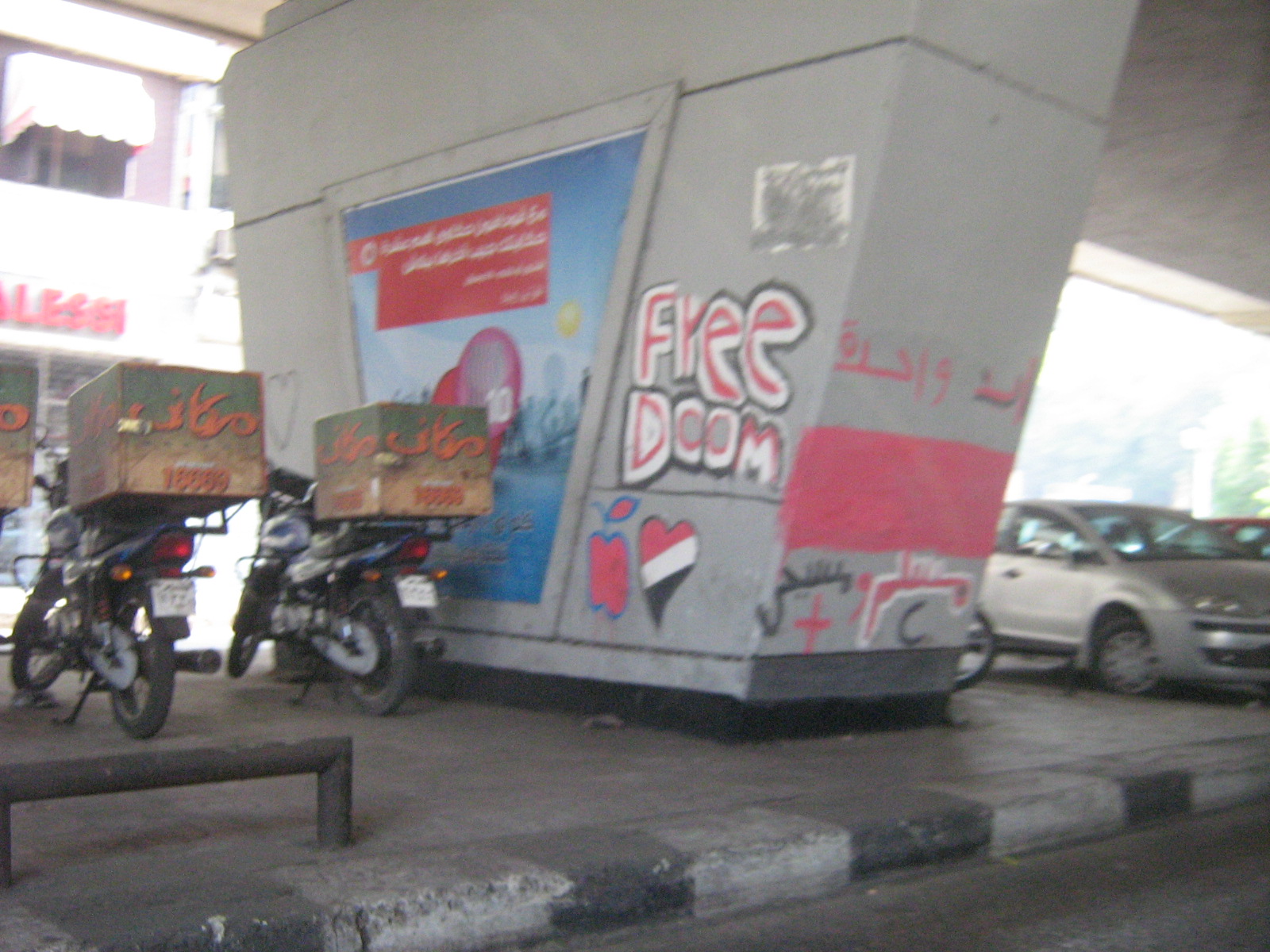
It's just a typo, right?
 Send Down the Basket!