
Reading Mikhail Nu’aymah’s Ghirbal (الغربال), specifically the hilarious essay where he tears apart Khalil Mutran’s translation (published 1922) of The Merchant of Venice . I’ve seen this essay summarized before, but never realized it was so hilarious!
 First Nu`aymah goes after Mutran for various inaccuracies and misunderstandings that suggest he translated from a French translation rather than Shakespeare’s original. (This claim is now widely accepted, though nobody seems to have a specific theory of which version/s Mutran used: please contact me if you do.) Next he attacks Mutran’s use of rarified Arabic vocables “dug up from the lexical graveyard” – these archaisms, he says, are designed mainly to make the Arab reader feel he does not know his own language well enough. He hates Mutran’s intralingual glosses. (Strikingly, Mutran’s footnotes do not elucidate difficult points in Shakespeare, but rather explain Mutran’s own recherché words and expressions.) The unstated assumption behind both critiques is that translations of Shakespeare should be accurate and transparent: the great master’s words and thoughts are so important that the translator should try to convey them as accurately and clearly as he can, without drawing attention to his own style. As though he were translating Scripture. (Translations should also be actable, he says.)
Here’s the interesting thing about Nu`aymah: he both does and doesn’t accept that Shakespeare’s sacred status is culturally constructed. He starts his essay by observing that to translate Shakespeare is a uniquely difficult task. Shakespeare is the literary equivalent of “the summit of Mount Everest”; “The son of literature approaches Shakespeare with the same piety as that with which a son of religion approaches the saints of his religion.” He explicitly refuses to discuss whether Shakespeare deserves this veneration or not. Yet two paragraphs later he is doing it himself: claiming that to mistranslate even a phrase of Shakespeare is to betray “the link between his thoughts and their linguistic reflection” where Shakespeare’s unique genius lies. Nu`aymah insists this is not true of translating Hugo or Tolstoy.
Don’t all scholars in our field end up doing this? Historicizing and analyzing Shakespeare’s prominence, then accepting and subtly reinforcing it?
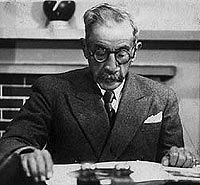
(The photo is Mutran… see how serious he is! For more on him, see Sameh Hanna’s article in Critical Survey 19:3.)
 First Nu`aymah goes after Mutran for various inaccuracies and misunderstandings that suggest he translated from a French translation rather than Shakespeare’s original. (This claim is now widely accepted, though nobody seems to have a specific theory of which version/s Mutran used: please contact me if you do.) Next he attacks Mutran’s use of rarified Arabic vocables “dug up from the lexical graveyard” – these archaisms, he says, are designed mainly to make the Arab reader feel he does not know his own language well enough. He hates Mutran’s intralingual glosses. (Strikingly, Mutran’s footnotes do not elucidate difficult points in Shakespeare, but rather explain Mutran’s own recherché words and expressions.) The unstated assumption behind both critiques is that translations of Shakespeare should be accurate and transparent: the great master’s words and thoughts are so important that the translator should try to convey them as accurately and clearly as he can, without drawing attention to his own style. As though he were translating Scripture. (Translations should also be actable, he says.)
Here’s the interesting thing about Nu`aymah: he both does and doesn’t accept that Shakespeare’s sacred status is culturally constructed. He starts his essay by observing that to translate Shakespeare is a uniquely difficult task. Shakespeare is the literary equivalent of “the summit of Mount Everest”; “The son of literature approaches Shakespeare with the same piety as that with which a son of religion approaches the saints of his religion.” He explicitly refuses to discuss whether Shakespeare deserves this veneration or not. Yet two paragraphs later he is doing it himself: claiming that to mistranslate even a phrase of Shakespeare is to betray “the link between his thoughts and their linguistic reflection” where Shakespeare’s unique genius lies. Nu`aymah insists this is not true of translating Hugo or Tolstoy.
Don’t all scholars in our field end up doing this? Historicizing and analyzing Shakespeare’s prominence, then accepting and subtly reinforcing it?
(The photo is Mutran… see how serious he is! For more on him, see Sameh Hanna’s article in Critical Survey 19:3.)
 Send Down the Basket!