UPCOMING:
Tues, Jan 24, 2024, 4:30-6 Pacific Time (on Zoom). “Russian-Arab Worlds: Intimate Foreign Relations.” Virtual lecture at Stanford University’s Abbasi Program Webinar.

Fri, Feb 9, 3-4pm Central Time (on Zoom). University of Chicago Arabic Circle: أهم الدروس من تاريخ العلاقات بين العرب والروس / Why Study Arab-Russian and Arab-Soviet Cultural Ties?
Friday, April 12, 2024. Farouk Mustafa Memorial Lecture, University of Chicago. Details TBA.
SELECTED PAST:
Friday, December 1, 2023, 3:30-5:15 ET. Discussion of Russian-Arab Worlds: A Documentary History with co-editors Kane and Kirasirova and book contributors. ASEEES annual convention, Philadelphia.
November 2-5, 2023. Roundtable on Russian-Arab Worlds: A Documentary History. Middle East Studies Association annual meeting. Palais des congrès, Montréal, Canada.
Thursday, June 29, 2023, 6-8pm Berlin time: Reading and discussion with Syrian novelist Khalil Alrez خليل الرز, Khan Aljanub Bookstore, Potsdamerstr. 151, Berlin. We will read and discuss excerpts from his two most recent novels, The Russian Quarter/The Giraffe of Damascus (2019) and Strawberry-Spotted Handkerchief (2022).
July 13, 2022. “After Defending Jerusalem in Cordoba: The Unhappy Internationalist Life of Najati and Lotka Sidqi.” Keynote at EUME workshop on Arab-Soviet Internationalism, Forum Transregionale Studien, Berlin.
April 10, 2020. “Tongue-Tied Internationalism: Adventures with a Soviet Setting, an Egyptian Novel, and an Indian Press,” (on translating Sonallah Ibrahim’s Ice). BU Literary Translation Seminar, Boston, MA. Via Zoom.
November 22, 2019. “To Defend Jerusalem in Cordoba: Najati Sidqi and KUTV’s Transnational Afterlives.” Conference on Soviet and/as world literature. Jordan Center, NYU.
November 15, 2019. “Hailed and Haunted: Syrian Playwrights in 2016-2018 Berlin.” Middle East Studies Association, New Orleans.
April 13, 2019. “Why Mephistopheles Never Got Egyptian Citizenship.” World Languages & Literatures Big Fat Books Symposium on the Faust tradition, Boston University.
March 12, 2019. “Sindbad Goes to Kiev: Why Study Arab-Soviet Literary Flows.” Princeton University Department of Near Eastern Studies and Princeton Institute for International and Regional Studies.
March 8-9, 2019. “Arab playwrights in Berlin.” Seminar on Arabic literature and translation, American Comp Lit Association, Georgetown University, Washington, DC.
Feb 7, 2019. “Sindbad Goes to Kiev: Literary Traces of Arab Lives in Motion.” Connecticut College, New London.
Feb 1, 2019. “Whose Arabian Nights? Storytelling and Performance Across Cultures.” Macalester College, St. Paul, Minnesota.
December 2018. “Roundtable: Sourcebook on Arab-Russian and Arab-Soviet Literary Ties.” With Eileen Kane and Masha Kirasirova, Association for Slavic, East European, and Eurasian Studies, Boston.
December 2018. “The Obshchiaga as a Synecdoche for Late-Soviet (Literary) Internationalism: Evidence from Four Soviet Dormitory Novels,” Association for Slavic, East European, and Eurasian Studies, Boston.
November 2018. “Another East: Arabic Literature’s Soviet Archive,” Middle East Studies Association, San Antonio.
August 2018. “Syrian Playwrights in Berlin,” Association for Theatre in Higher Education, Boston. Published in Theatre Journal (Dec 2019).
For the year 2017-8 I was based in Berlin as an Alexander von Humboldt fellow with the Europe in the Middle East-Middle East in Europe program.
June 13, 2018. “Arabic Rewritings of Tolstoy’s Kreutzer Sonata.” Berliner Seminar, Europe in the Middle East-Middle East in Europe, Wallotstraße 14, Berlin.
May 24, 2018. “Sudden and More Strange Return: When Arab Shakespeare Comes into English.” Keynote speaker at Texts and Events across Borders, conference of the Erasmus Mundus joint doctoral programme TEEME (Text and Event in Early Modern Europe). Berlin.
May 14, 2018. “Afterlives of Beethoven’s ‘Kreutzer Sonata’: Tolstoy, Salim Qub`ayn, Rita Dove.” Humboldt University Insitute for Slavistics spring 2018 seminar on music & literature, Berlin.
March 22, 2018. “Hamlet, Friend of Arab Democracy.” Bogazici University, Istanbul. Hosted by Emine Fisek. With Ethan Guagliardo, İnci Bilgin Tekin and Melis Günekan.
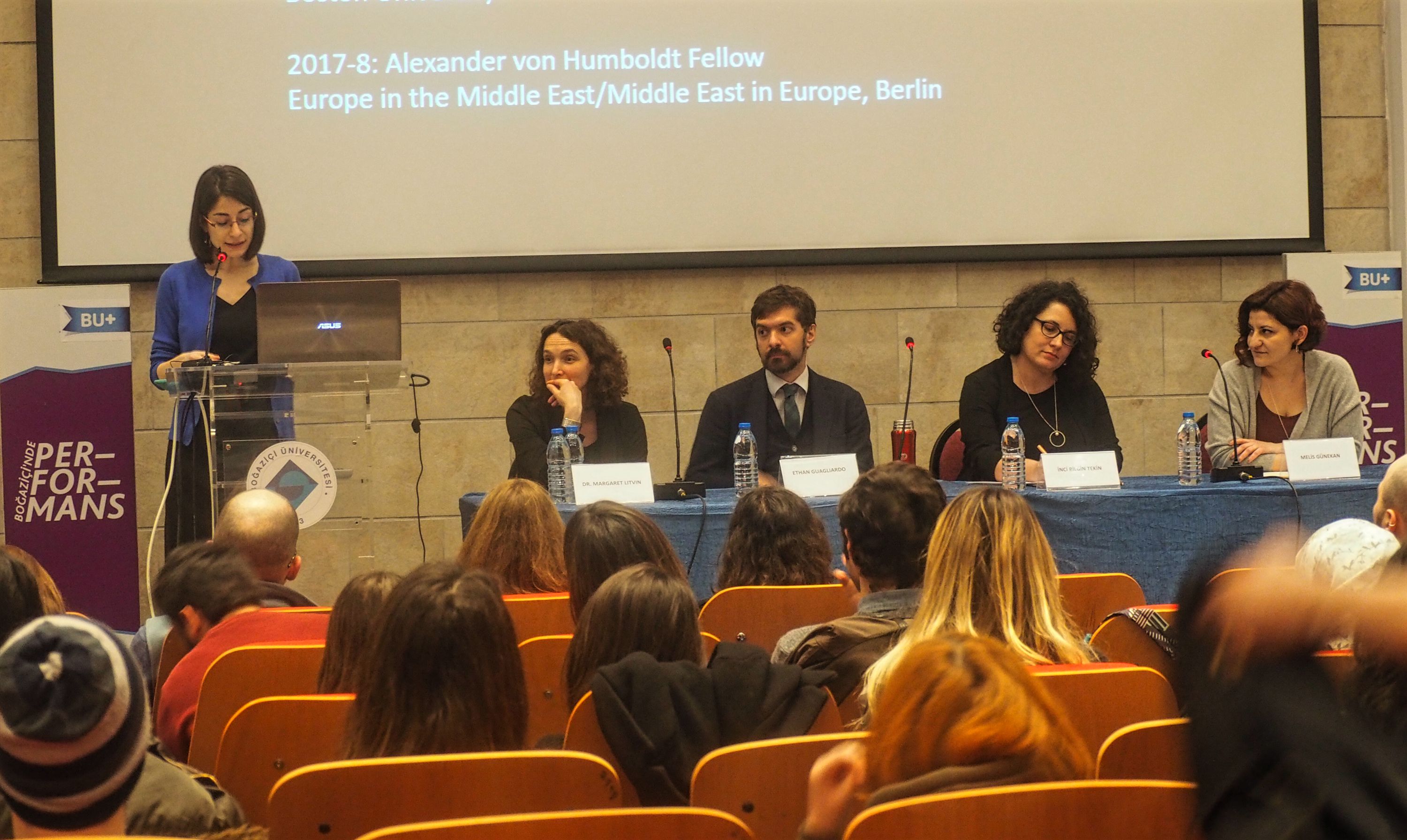
Press report here.
March 6, 2018. Research talk, ZMO-Berlin.
January 16, 2017. Workshop on Structures and Legacies of Soviet Student Dormitories. Co-led with Susanne Frank of the Humboldt University Institute for Slavistics. Forum Transregionale Studien, Wallotstrasse 14, Berlin. Organized by the Forum’s Prisma Ukraina program.
December 1, 2017. Table host (with Botakoz Kassymbekova) at WeberWorldCafé „Russland in Europa – Europa in Russland“. Café des Deutschen Historischen Museums, Unter den Linden 2, 10117 Berlin. Our table focused on “Chances through Exchange.”
November 22, 2017. On Egyptian writers visiting Soviet Moscow. East European History Colloquium, Humboldt University, Berlin.
March 24, 2017, World Languages & Literatures Symposium on Pedagogy, Boston University.
February 17-18, 2017, Hosted Boston University Workshop on “Russia in the Arab World: History, Literature, Arts.”
February 11, 2017, Princeton University: Transnational Relations Between Eastern Europe/Russia-USSR and the Middle East, Late 19th Century to 1991
February 8, 2017: International history workshop, Columbia University.
MLA 2017, “Boundary Conditions”: Philadelphia, Jan 5-8, 2017. Panel 622. Literary Encounters: The Soviet Union and West Asia. Saturday, 7 January, 3:30–4:45 p.m., Independence Ballroom Salon III, Philadelphia Marriott.
Program arranged by the forum LLC West Asian. Presiding: Anindita Banerjee, Cornell Univ.
1. “Reading Tolstoy in Palestine: Tolstoy’s Kreutzer Sonata as a Coal Mine Canary,” Margaret Litvin, Boston Univ.
2. “Soviet Translation Theory and Persianate Poetic Practice: Lahuti and Shengeli,” Samuel Hodgkin, Univ. of Chicago
3. “Vala Nureddin between Turkey and the Soviet Union,” Nergis Ertürk, Penn State Univ., University Park
keywords: Russian literature, Persian poetry, modern Turkish literature, the Soviet Union, translation
November 19, 2016. Middle East Studies Association, Boston. From Arab-Russian to Arab-Soviet Cultural Encounters: Are There Continuities? Organizer and discussant of a panel featuring Nabil Matar, Suha Kudsieh, Spencer Scoville, and Elizabeth Bishop:
The USSR was socialist internationalism’s “Red Mecca” for much of the twentieth century, successfully posing as both a role model and a mentor to progressives from the East, including the Arab world. With methods drawn from political and intellectual history, philology, and literary criticism, this interdisciplinary panel investigates several sets of cultural prehistories that made such a connection appear plausible. We ask: While being careful not to tell a simplistic story positing centuries of Arab-Russian friendship, is it possible to trace any real continuities? Does the recently identified overlap between “Orthodox and Communist” (Mack 2015) have meaning beyond Palestine? To what extent and how did Soviet cultural diplomacy build on a long history of Arab curiosity about and travel to Russia, Arab religious connections to Russia through Orthodox Christianity, and Arab engagements with Russian literature? This panel contributes to a timely and growing scholarly conversation (with successful panels at MESA 2012, MLA 2106, and several Slavics conferences) about Russia’s cultural status in the Arab world.
October 10, 2016. “Who cares about Arab-Russian literary ties?” Inaugural in-house symposium, Department of World Languages and Literature, Boston University.
In 2015-6 I was based in Sweden as an ACLS Burkhardt Fellow at the Swedish Collegium for Advanced Study in Uppsala. In Summer 2016 I began an Alexander von Humboldt Fellowship at EUME in Berlin, to be continued during the summer and academic year 2017-8.
June 2016: “Another West or Another East? Arab Intellectual Life in Soviet Student Dormitories,” MLA International, Dusseldorf, Germany.
June 2016: “Taking Refuge? Arab Migration on Scandinavian Stages.” IFTR, Stockholm.
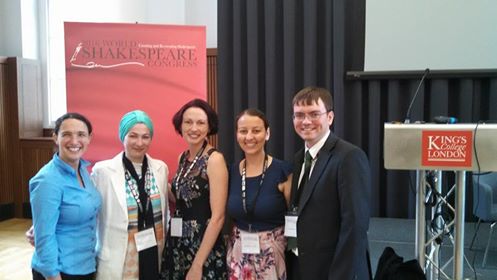
August 5, 2016, Kings College London. Discussant for the Arab/ic panel at the World Shakespeare Congress.
April 22, 2016, Shakespeare’s Globe Theatre, London. “Why Make Political Theatre In Dark Times? Arab/ic Shakespeare Reaches for Europe.” Part of a daylong workshop on Intercultural Shakespeare Performance.
April 24-27, 2016, University of Bristol, UK. Fast-Track Benjamin Meaker Visting Professorship lecturing on “World Literature from an Arabic Point of View.” Hosted Prof. by Rebecca Gould, Dept. of Foreign Languages. Two public lectures including one from the Tolstoy project:
Attracted to the Orient and ambivalent about European modernity, Leo Tolstoy (1828-1910) made a perhaps paradoxical bearer of modern literary forms. Why, then, did Arab readers receive him as a great harbinger of social and artistic progress? Why did the Mufti of Egypt write to inform him, “The light of your thought has illuminated us, and the suns of your ideas have risen in our skies”? Why did The Kreutzer Sonata, a bizarre polemical novella, get translated into Arabic long before any of Tolstoy’s other fiction? On Tolstoy’s death in 1910, why did Arab poets compete to eulogize him? And how did later Arab writers deploy his oeuvre and his personal legacy? Attending to the contingencies and ironies that mark all international literary reception, this talk will explore some of the resources that Tolstoy’s long and tangled career offered to would-be modernizers of Arab societies and Arabic literature.
April 28, 2016, Postcolonial Seminar, University of Cambridge, UK. On Arabic Shakespeare.
April 11, 2016, NYU Abu Dhabi Institute, NYUAD campus conference center. Timed to coincide with their International Shakespeare Student Festival. “Arabic Shakespeare: Three Lessons.”
April 5, 2016. “Approaches to Intercultural Literature.” Presentation to Litteraturvetenskapliga institutionen, Uppsala, Sweden.
March 14, 2016. Book launch, reading, and discussion of Four Arab Hamlet Plays. Martin Segal Theatre Center, NYC. Watch the Livestream here:
February 16, 2016. “Arabs and Other Foreigners in Moscow Dorms: Echoes in Literature and International Relations.” Uppsala Centre for Russian and Eurasian Studies, Uppsala University.
Feb 2, 2016. “Unify and Conquer: The Metaphor of the Body Politic.” Litteraturvetenskapligt forskningsnätverk (LILAe) workshop on rhetoric.
December 10-11, 2015. Discussant, workshop on “What’s in a Year? Reflections on 1967.” Research group on Figures of Thought: Turning Points, Cultural Practices, and Social Change in the Arab World, Center for Near and Middle Eastern Studies, Philipps-Universität Marburg, Germany.
December 8, 2015. Spectators to their Own History: Sonallah Ibrahim and Mohamad Malas, Moscow 1973.” Seminar for research group on Figures of Thought: Turning Points, Cultural Practices, and Social Change in the Arab World, Center for Near and Middle Eastern Studies, Philipps-Universität Marburg, Germany.
November 24, 2015. “Shawqi’s Arabic Elegy for Tolstoy.” Uppsala University Semitiska Seminariet, Institutionen för lingvistik och filologi.
November 17, 2015. “Arabic Shakespeare and the Global Literary Kaleidoscope,” Litteraturvetenskapligt forskningsnätverk (LILAe) seminar, Faculty of Languages, Uppsala University.
October 28, 2015, Berliner Seminar for EUME: “Arab Intellectuals Encounter Another Europe: Sonallah Ibrahim and Mohammed Malas in Moscow.” Forum Transregionale Studien, Berlin.

October 22, 2015, at SCAS (Uppsala, Sweden) “Frosty Utopia: Arabic Literature’s Russian Connections.”
October 13, 2015. “Leo Tolstoy and the Modernization of Arabic Literature,” Profilseminarium inom Transkulturalitet vid Institutionen för språk och litteraturer. Department of Languages and Literatures, Gothenburg University (Sweden).
May 14, 2015. Boston University. “True Stories from the Moscow Dorms.” At “Illusion and Disillusionment: Travel Writers in the Modern Age,” a Boston University Department of Modern Language and Comparative Literature conference on travel writing.
Monday, November 3, 2014, 7pm. Panel discussion on Sayed Kashua’s hit sitcom Arab Labor with Kashua and Michael Loman, professor at the BU School of Communications. Photonics Hall, Boston University. Also see the interview Simon Rabinovitch and I conducted with Sayed Kashua (photo below).

Wednesday, October 8, 2014, 6pm. “Frosty Utopia: Russian Connections in Arabic Literature from Mikha’il Nu`aymah to Sonallah Ibrahim.” American University in Cairo Center for Translation Studies, Oriental Hall, AUC, Cairo. You can watch the video at https://www.youtube.com/watch?v=Cbc_34FKseU
Wednesday, October 1, 2014, 5pm. “Do American Students Need Global Shakespeares?” Wellesley College, co-sponsored by Wellesley College Shakespeare Society and Middle East Studies Program.
Thursday, May 8, 2014, 2pm. ‘“Forgive me, Tolstoy!’: Russian Literature and Russian Reality in Arab Writers’ Lives.” Conference on Translation and Comparative Cultural Studies: East-West in Dialogue. At University of London: Institute for Modern Languages Research. Room 349 Senate House, South Block, Malet Street, London.
Friday, March 7, 2014. “Do American Students Need Global Shaksepeares?” Part of Practicing the Future of Shakespeare Studies. Conference Organized by the Columbia University Seminar on Shakespeare. Seminar Room 1, Second Floor. The Faculty House, Columbia University. 64 Morningside Drive, New York, NY 10027.
January 10, 2014, 8:30-9:45 am. “Sindbad’s Happy Wreck: ‘Global Shakespeare’ Meets ‘Arab Spring.'” Part of a panel on International Shakespeares with Alexa Huang, Anston Bosman, and Garrett A. Sullivan at the Modern Language Association annual meeting, Chicago.
Saturday, October 12, 2013, 11:00am, New Orleans. Discussant for Middle East Studies Association panel P3370 “Revisiting Arab Theater: The Construction of Resistance.”
June 20-21, 2013: Workshop on Arab-Russian and Arab-Soviet Literary Ties at the Oriental Faculty, St. Petersburg State University, St Petersburg, Russia. (Very interesting exploratory workshop. Stay tuned for conference video and follow-up call for papers – or stay in touch via our Facebook group – email me to join.)
May 30, 2013, 4:30pm: “Egyptian Theatres of Revolution.” Husni Haddad Lecture (and talk in memory of Farouk Mustafa), University of Chicago, Center for Middle Eastern Studies. Stuart 105, 5835 S. Greenwood Ave, Chicago, IL.
May 6, 2013, 4-5pm: “Other Russias,” discussion with Jacqueline Loss as part of a day on The Politics of Polyglossia, Center for the Humanities, City University of New York. (My talk was not recorded, but you can listen to a fabulous lecture by Motoyuki Shibata and a couple of other great panels here.)
May 2-3, 2013: “Innocents Abroad: Sonallah Ibrahim and Muhammad Malas in Moscow.” At “Midans of the Self,” a colloquium on Sonallah Ibrahim organized by Elliott Colla and the Department of Arabic and Islamic Studies, Georgetown University, DC.
April 7, 2013, 6pm: “Arts in Protest: The Arab Spring.” Phillips Exeter Academy, Exeter, NH.
March 28, 2013. “From Tahrir to ‘Tahrir'”: a talk in the Doomed by Hope Theatre Series, Yale University, New Haven (Canceled)
March 1, 2013, 5:30-7:30pm: “The French Source of the Earliest Surviving Arabic Hamlet.” A talk on the Arab Hamlet Tradition at Harvard’s Mahindra Humanities Center seminar on Shakespearean Studies, William Carroll and Coppelia Kahn, chairs.
January 30, 2013, 12:30pm:“The ‘Arab Spring’ and the Arts”: a talk in the Boston University Alumni Association’s “Arts, Culture, and Ideas” lecture series.
Friday, Jan 4, 2013 at the MLA Convention in Boston:
Paper in “Cultures of the Arab Uprisings” session: “Between Tahrir and ‘Tahrir’: Some Paradoxes of Memorializing a Revolution in Real Time.”
November 17-20, Middle East Studies Association conference (Denver)
Paper, “Letters to Tolstoy: Arab Writers Between Prophesy and Fiction,” in session on Russian and Soviet Strands in Arabic Literature co-organized with Spencer Scoville.
October 4-5 – Rhodes College, Memphis
Symposium on “Global Hamlets” at Rhodes College organized by Scott L. Newstok and colleagues
September 27-30, St. Andrew’s College, Scotland
Presentation on Russian-Arab cultural ties at the 1st Honeyman Conference: “At the Crossroads of Arabic Literature: The Arabic Literary Heritage in the Context of World Literature.”
Sunday, March 25, 2011 at George Washington University, Washington, DC
“What Can Arab Shakespeares Teach the Field of World Literature?” at symposium on “Cultural Translations: Medieval, Early Modern, Postmodern”
hosted by the GWU Department of English and the Medieval and Early Modern Studies Institute (MEMSI)
Photos (by Alex Huang and his indefatigable co-organizers) are here.
Wednesday, February 29, 2012, 4:30pm, Anthro Department, Tufts University, Medford, MA
Hamlet on the Barricades: Shakespeare and Arab Revolutions
Tisch Library 304
Part of a series on “Degrees of Belonging”
February 21, 2012, 12:15-1:15pm, at Trinity College, Hartford, CT
Workshop on early Arabic Hamlet translation as part of “Translating the Canon” event, Trinity Institute for Interdisciplinary Studies
Friday, February 3, 2012 Kevorkian Center at New York University 12:30-2pm
Hamlet’s Arab Journey: Shakespeare’s Prince and Nasser’s Ghost
Details at http://neareaststudies.as.nyu.edu/object/kc.events.hamlet
December 15, 4pm at NYU Abu Dhabi conference on World Literature and Translation. Panel on “Tragedy and Translation” (i.e. Hamlet and Oedipus!) with Philip Kennedy and Peter Meineck.

Lecture series at universities in Cairo, co-organized by the respective departments with the Arabic Theatre Working Group of IFTR under the umbrella title: “Hamlet on the Barricades: Shakespeare in ُEgyptian Political Theatre.” These are all 45-minute talks followed by discussion, of which about 20 minutes are common to all the talks, and the last half focuses on a different case study each time.
Thursday, December 8, 3:30pm at Helwan University, Comparative Literature department “نكون أو لا مكون؟؟” Shakespeare and Arab Revolutions. Video to come.

Thursday, November 24, 4-5:30pm at Ayn Shams University Department of Drama: The Global and Local Sources of Mohamed Sobhi’s Hamlet.
Thursday, November 17 10:30am-noon at Al-Alsun University Department of English “Justice or Oppression, That is the Question:” Alfred Farag’s Hamletesque Freedom Fighter

Saturday, November 19, 5pm at Cairo University, English Department.

Special seminar featuring adapter/director Hani Afifi and Mohammad Fahim: Hani Afifi’s I Am Hamlet: The Shakespeare Tradition Comes to Cafe Cilantro.YouTube video (kindly filmed by Nadine Tawdi) is here: http://www.youtube.com/playlist?list=C20ACB9A8D81640A Part 1 is the intro by Prof. Lobna Ismail. My talk is mostly in English, the discussion with Hani and Mohammad is mostly in Arabic, and the Q&A is mixed
Monday, November 21, 1-2pm at American University in Cairo, New Cairo, English and Comparative Literature department. Organized by the AUC Literature Club:
Hamlet on the Barricades: Global Shakespeares, Arab Dreams. In the picture below, the image on the leftis from Tahrir; some students left after the talk to go precisely there. (Some photos, mostly of the excellent Literature Club head Mohga Hassib, here; video of the talk should be coming online somewhere.)
Tuesday, November 15, 12-5pm
Workshop for theatre students at National Center for Theatre, Film, and Folk Arts (Hassan Sabry Street, Zamalek): “Arab Theatre Between Local Contexts and Global Audiences: Shakespeare as a Case Study” المسرح المصري بين السياقات المحلية والجماهير العالمية: شكسبير نموذجاً Not many of my original goals were realized, but the students were really sharp, and it was very thought-provoking and enjoyable exercise in cross-expectational communication in its own right!
Conversation with playwright-director Sulayman Al-Bassam and Shakespeare scholar Graham Holderness at Boston University, Oct. 12, 2011 (hit launch EchoPlayer, sorry for weird recording quality), and at Paramount Theatre, Boston (click Extras), Oct 13, 2011.
Talk at Center for American Studies and Research, American University in Beirut, May 5, 2011: “2001-2011: A Decade of Arab Performance Under American Eyes” (on YouTube)
 Send Down the Basket!